I really liked Robin Wong’s reflection on why he keeps returning to the same streets to make his images.
the beauty of doing the same routines, walking the same paths is the familiarity of the location, and you know every turn and corner, you know the details inside out, so you can be prepared for the unexpected. That is also the exciting part of shooting on the streets, you will find something unusual, something you will not know will happen beforehand, and the surprise is worth the redundant process of walking the same streets all over again. […] It isn’t about finding something completely new or extra-ordinary to shoot but finding beauty in the most ordinary settings and make it worth clicking your shutter button for.[^ Emphasis added.]
Like Wong, I’ve found that familiarity can sharpen my eye. Because I walk the same places regularly, I’m able to find the images I do. Having seen the same scene hundreds of times, I can tell when something has changed or that there’s some novelty in the scene that’s before me.
To some extent I think of regularly seeing the same scenes a little like drinking whiskey. At first, whiskey just tastes hot and spicy; any differences seem more theoretical than real. But over time you notice subtle nuances and also detect rarified variances between what you’re enjoying. And you can get excited over little things that really aren’t apparent or distinguishable to someone that hasn’t built up the same kind of palate.
When you walk the same streets over and over, you develop your own sense of what should and shouldn’t be there. You can detect what’s normal or novel. By training your eye on these common spaces, you develop your style. If you need to find something novel in the same place over and over, you’ll develop a unique way of seeing the world, whereas if you’re always seeing a new place you don’t need to stretch in quite the same way — you don’t need to push yourself to develop your sense of what is visually interesting to you.
All of which is to say: from afar, street photography can look pretty dull or boring because there’s a lot of repetition. It’s exactly this repetition, however, that helps you discover the kind of photographer you are.
I’m looking forward to an iPhone upgrade year and leapfrogging to AirPods Pro 3 — hopefully this time I can get a good fit without needing third party ear tips!
I’m also curious about Apple’s new crossbody straps. Not for my phone — I haven’t used a case in years — but maybe as an adjustable strap for my smaller cameras.
There’s got to be someone who’ll review this use case, right? And if not… consider this my open call.
Back in February 2022, I made a commitment to myself. I set out to add a bit more positivity to the internet by reaching out to writers whose work inspired me, or photographers whose images resonated with me. I wanted to thank them for their efforts and let them know their work was appreciated.
Recognizing People Matters
It is all too common for people to move through life without peers, friends, or family recognizing the importance of their work or the ways they’ve shaped others’ lives. In my personal life, it was only after my father died that many of the kids he’d mentored reached out to me to share how he had positively affected the course of their lives. His Facebook feed was filled with comments from people who had benefitted from his generosity and kindness. But I was left wondering: had they ever told him directly about his impact? And if they had, might he have avoided his death of despair?
And I’ve seen the power of professional recognition–and felt the cost of its absence. Years ago, after a major project wrapped up, I realized I had forgotten to recognize the exemplary contribution of a junior staff member. I went back into the room to point out how critical their work had been. That small moment of recognition, as it turned out, had a profound impact on their career trajectory. And it was only after I left my last professional job that people contacted me from around Canada about how the work I produced had influenced them, their practice, and their thinking. I’ll be honest: when I left that job, I felt like I’d been writing into a void. Almost no one ever directly recognized the work I was producing or the value they placed in it.
Recognizing Creatives
On Glass, I try to leave a couple of comments on other photographers’ work each month. Sometimes those comments are short, like “Love the composition!👏👏👏 ,” or “Great use of tonality across the frame! 👏👏👏” Other times, when I have more bandwidth, I write longer, more substantive reflections on what I see in their images.
I think this kind of recognition matters. Too often, we wait until it’s too late to share it. Positive, explicit recognition can motivate people who may not have received much encouragement otherwise. It’s one of the many reasons why I support Neale James’ Photowalk Podcast and the community of kindness that he fosters with every single episode.
Lately I’ve been thinking about how to take this further. For me, the next step has been to begin collecting prints or zines from photographers whose work or practice I deeply admire. I’m not buying prints from the famous names you see in galleries–no Martin Parrs for me!–but photographers working in niches that speak to me. Owning their prints feels special. It’s not just me saying “great work,” it’s me saying, to them, “I value this enough to want it in my home.”
Ownership is a Kind of Intimacy
There are practical challenges with purchasing other people’s work. As we know, shipping expenses, cost of making physical artefacts, and the economic realities facing both buyers and artists can impede purchasing other creatives’ work. We can’t all afford to purchase prints regularly. But even buying one piece every year, every few years, or even once a decade can make a meaningful difference. It’s a way of supporting creativity and giving artists recognition that lasts.
What’s powerful about this isn’t only the financial support. It’s the intimacy of having someone’s work become part of your everyday life. Unlike a gallery exhibition, which is temporary and public, a print hanging in your home or office is permanent and personal. It shapes the space you live in, and every time you see it you’re reminded of the artist and the respect you have for their work.
That, to me, is one of the most profound ways we can support and recognize each other as creators. It’s something that I continue to do, and I appreciate the works of others that I have the privilege of viewing on a regular basis.
In closing, if a creator’s work inspires you then I’d strongly encourage you to leave a comment, send a note, or even consider acquiring a print. It might mean more than you know.
I’m an amateur Toronto-based documentary and street photographer, and have been making images on the street for over a decade. In the fall of 2023 I purchased a used Leica Q2. I’d wanted the camera for a while, but it wasn’t until late 2023 that I began running into situations where I’d benefit from a full-frame sensor. Since then I’ve been going out and making images with it at least once a week for hours at a time and have made tens of thousands of frames in all kinds of weather.
In this post I discuss my experiences using the Leica Q2 in a variety of weather conditions to make monochromatic JPG images. I tend to exclusively use either single-point autofocus or zone focusing, and either multi-field or highlight-weighted exposure modes, generally while using aperture priority at 1/500s to freeze action on the street. My edits to images have, previously, used Apple Photos and now rely on the Darkroom app on my iPad Pro. You can see the kinds of images that I’ve been making on my Glass profile.
Each month or so, the Photowalk podcast has been choosing a single term to inspire photographers to consider when making images. The March term was “humanity”, and my submission follows.
Yonge & Gloucester, Toronto, 2025
Text for entry:
The image can be read as speaking to the stature of man, and the forces that rise above him spiritually and physically, while living a life of being downtrodden and isolated. In a well-populated urban capital our subject is left alone with himself, save for weather damaged urban art that gestures to imagined better times and the eyes of his transitory documentarian in front of him.
I’ve enjoyed a particularly productive photographic year during which I’ve (mostly) acclimated to the Leica Q2 and used it to shoot almost exclusively in black and white, and usually in the city of Toronto.
Narrowing everything down to 10 images was challenging given that I have gone out weekly throughout 2024 to make images and kept thousands of them. The images in this series hold up on their own while, also, developing a narrative when read beside one another.
Gerrard & Galt, Toronto, 2024
When was this photograph taken? 2024 or 1964?
The use of black and white has the effect of confusing the viewer of the image’s temporality. This is accentuated by the sign in the photograph being from another generation. Adding power to the image are the two figures who are wandering through the early January snow, with the young woman looking down and over to the city’s garbage, and the little boy looking up past the trash to the graffiti on the wall. This speaks to the hopes and ambitions of youth and the practicality of maturity, while they are both literally passing by the abandoned garbage of the day.
This was one of the first images that I made of 2024 and it remained amongst my favourites throughout the year.
Shuter & Yonge, Toronto, 2024
What is this woman so focused upon? How much has she seen during her lifetime and how shadowy are those memories?
Throughout the year I’ve spent time seeking out images that rely on reflections to strengthen the environment around the main subject(s) of photographs. The woman’s white hat and mask made her stand out through the windows, and then play nicely with the shadowy figures reflected in the glass. It’s this juxtaposition that brings the image to life in my eyes.
Crescent & Cluny, Toronto, 2024
What does it mean to be an inhabitant of a major city?
This photograph shows the city from a different perspective than is typical of Toronto street photographers who are making images in the core. Still, the image captures ever present aspects of city life: mass transit, rapid development, and the isolation and anonymity of the residents as they move through their day.
I’ve been coming to this particular subway stop to make this image for 5 years. After years of visiting the same location I finally got the light, subject, and subway where I wanted them at the same time.
Centre & Edward, Toronto, 2024
What did Toronto look like during its process of being built up in the contemporary era?
We are in a time of building but there are relatively few organic photographs that are deliberately capturing this development. Like images of old this photograph speaks to the relationship of people and the city that is growing (or metastasizing) around them.
Toronto is rapidly building density in its core. I’ve worked throughout the year to incorporate construction into my street images while, also, seeking elevated heights to capture the city’s transformation. The lines across the image draw the eye upwards and the construction worker on the railing serves to underscore the size of the development.
Yonge & Dundas, Toronto, 2024
Well hello, madame – what gave you your sense of style?
The Saint Patrick’s Day parade is a major event in Toronto. I’ve been photographing it for years and regularly march in it to make images of the crowds. I like how the woman in this photograph is almost posing in her winter jacket — it gives her a sense of elegance and self-importance — while, above her, the sign suggests that she is happy and ranked #1. But it’s the man who is looking on at the right-hand side of the frame adds a degree of electricity to the image with his dourness in contrast to the woman’s more positive energy.
College & Clinton, Toronto, 2024
Someday in the future will we be amazed at the low cost of a veal sandwich or beverage?
This is one of those images that works, in part, because the ordering of the image isn’t quite right: the subject is looking away from the rest of the signs, which encourages the reader of the image to go from left to right which isn’t typical in Western culture. I also like his expression and how the contrast in the image draws the eye through the items for sale at the festival.
Dundas & Dufferin, Toronto, 2024
What’s happening here? What do you feel when you’re so close to this slightly obscured woman and her side-eye staring companion?
Like many street photographers, I try to make use of graffiti and other temporary art in the city when making images. I like how this image somewhat conceals the look that the older woman is giving the viewer, at the same time as she is getting a side eye from her companion. The contrast through the image also serves to create an effect foreground, middle, and background.
Great Lakes Waterfront Trail, Toronto, 2024
So this is summer! Children playing in the mist while the city towers above them, and a bird flees the city towards some less inhabited region.
This image captures the idealized life of being in the city, where people come out from their ever-growing towers to relax and play together. It is also one that hides the actual subjects, themselves, and in so doing conceals the participants in this space. Is this a playground of the elite’s children or a communal space used by all inhabitants of the city? For those who live here the answer is apparent but otherwise a degree of mystery may remain concerning the socio-economics of the subjects.
Ontario & Princess, Toronto, 2024
Swings let us throw our hair back and play with our suspended bodies while soaring above the ground; we enjoy a kind of freedom that is in opposition to our normal land based experiences.
Every year I go to the CNE’s Exhibition and get a little more comfortable looking for scenes to make images. This year I spent a bunch of time at this ride, and I think that this image captures the carefree playfulness that’s associated with the summer fair.
Baldwin & Augusta, Toronto, 2024
What is it like to be alone in the city and reflect on what once was, and what could become?
Like the first image in the set, this photograph conveys a sense of solitude in Canada’s largest city while also hearkening to a time past. Because this image is monochromatic it establishes a degree of ambiguity as to when the image was made and thus provides a sense of balance to the collection of images.
All of my images are located by city cross-streets and are are lightly processed using Apple Photos. I post new images daily to Glass.
Artist’s Statement
Christopher Parsons an amateur Toronto-based documentary and street photographer, and has been making images for over a decade. His monochromatic photographs focus on little moments that happen on the streets and which record the ebb and flow of urban life over the course of years and decades.
His work often deliberately plays with the temporality of built environments and photographs themselves, and regularly uses temporal ambiguity to entice viewers into questioning what happened prior to, and following, the pressing of the shutter button.
It’s the time of year for people’s best-of roundups. Like last year I wanted to recognize stuff that meant a lot to my photography through 2024. And, this year, I’ve also added a short list of hopes for stuff in 2025!
Photography Stuff I Used
Yonge & Dundas, Toronto, 2024
Best Technology of 2024
The big change this year? I pretty well completely pivoted to my Leica Q2 and with only rare exceptions did I use the Ricoh GR IIIx or my iPhone 14 Pro. When I bought the Q2 it was, in part, to be able to capture images at night where there was little light. I’ve made images under these conditions that I’m happy with and I’ve come to learn how to better use the 28mm focal range. At this point I’ve created well over ten thousand frames over the year.1
I upgraded to the 11” iPad Pro (2024) and definitely appreciate how light the device is, and how vibrant the screen is. I continue to use an iPad Mini for most of my actual reading but write a lot of blog posts on the iPad Pro and do all my photo editing on it.
When I take my photowalks I’m always listening to a podcast or music on my AirPod Pros. However I’ve long had an issue with finding tips that best fit my ears; the ones in the box always slip out. I recently learned about, and bought, the SpinFit CP1025 (S/SS) and they’ve been game changing. I get a perfect fit and the AirPods stay in my ears. Highly recommend them!
Best Services I Paid For
I continue to post images to Glasseach day. I’m still disappointed with their AI search, and especially disappointed that landscape viewing on the iPad has now been broken for about a year.2 Still, it’s a terrific community and a good place to post images regularly.
Apple One is key to my data management strategy. I’m still under the 2TB that is provided as part of the subscription though, with my current data use, I suspect that in 3-5 years I’ll need to expand that 2TB storage limit.
Lastly, while I’ve watched less photography YouTube I continue to appreciate YouTube Premium. It’s still about the most regularly used subscription service that I use on a regular basis.
Best Apps
Have I changed the apps that I rely on regularly since 2023?
Apple Podcasts app: I use this to listen to photography podcasts while on my weekly photowalks.
Apple News: To read photography magazines and websites that otherwise would be paywalled.
Apple Photos: Used to edit and store all my images. I don’t love the iOS version of the application but it is what it is.
Stuff I Made
College & Clinton, Toronto, 2024
Writing
Sharing Photographs, and Photography, with Others and Growing as a Photographer: Despite being pretty used to being in the public eye as a result of my day job it’s different to expose myself when sharing the images that I make. Those images, if read carefully, reveal some elements of myself that I showcase less often, and this is made even revelatory when producing and sharing physical items to people I respect or submitting digital images to competitions. Just talking about that experience was liberating and reaffirmed that I am, slowly, growing as a photographer.
Accidentally Discovered Street Photos: Imagine my surprise when, after opening my used copy of Conversations: With Contemporary Photographers a strip of exposed Kodak 100TX film fell out! I used a free app to enlarge some of the images and while my efforts weren’t spectacular it did result in seeing — and sharing — some images from an earlier time.
10 Tips for Starting to Photograph on the Street: I regularly read and view content that is meant to help new photographers get comfortable on the streets. Much of that content is good but is directed towards a certain kind of concern, and way of behaving, on the streets (e.g., Zone focus! Shoot from the hip! Be invisible!). I think that my 10 tips are for people like me who are interested in making street photos but are shy about even being seeing with a camera. Really, this is a blog written for myself which, if I’d read it 10 years ago, would have given me a clearer sense of what I could do to develop my confidence and skills.
Nuit Blanche, 2024: I’ve been attending Nuit Blanche in Toronto, an annual art festival that runs for a single day from sundown to sunup, for many years. I always make photographs during it but, at the same time, have been challenged by using a smaller APS-C sensor camera. I was both pleased in the art that I experienced this year as well as the ability of the Leica Q2 to capture images more like how I wanted them due to its lens and sensor size.
Stuff I Read
Oxford & Augusta, Toronto, 2024
Best Photography Books and Magazines
Metropolis: I’ve followed Alan’s work for years and appreciate how stark his imagery is and his absolute attention to form. His images carefully consider what is absolutely needed to communicate his vision and no more.
Conversations: With Contemporary Photographers: This was probably the most important book about photography that I read this year. I’m, personally, interested in thinking more deeply about the ontology of photography and what it is and is not. The photographers interviewed in the book provided a range of interpretations of what photography is, and means, for each of them, and I benefitted tremendously from their thoughts on the medium as one which controls time and, also, the role of time in their own creative activities.
Framelines: The team behind Framelines improve the magazine with every issue. From enhancements to the printing, imagery, interviews and just shipping, this is an instant purchase each time they come out with new issues. I particularly appreciate how they celebrate new and emerging photographers from around the world and platform those who, otherwise, I’d be entirely unaware of.
André Kertész: Sixty Years of Photography: This book is a gift to photographers and the image-viewing public more broadly. Published back in 1978 it catalogues Kertéz’s photographic history. It is when we look at images like this that it is apparent how much you can do with black and white images that are focused on the forms across a frame, and also how having decades of images enable a playfulness between pages so that works from different decades can speak to one another and create a perception of continuity across time and space. If you are committed to street images, black and white images, or just seeing how history unfolded over sixty years, then this book is a must see.
The Pleasure of Seeing: Conversations with Joel Meyerowitz on sixty years in the life of photography: Joel is, of course, a (still living) legend and has a number of different monographs under his name. This book is a little different because it explores his thought process across the different phases or eras of his photography. Now, if you’ve actively listened to his talks, interviews, podcasts, and so forth over the past decades many of the messages he communicates will be familiar. But to have them all in one place, along with his images that underscore his creative vision, is a real gift to photographers.
Stuff I Watched
Great Lakes Waterfront Trail, Toronto, 2024
Best Movies
Lee: This was an engrossing and highly cinematic movie. I liked how it conveyed the experiences that female photographers and journalists experienced during the time period and, also, communicated the toughness of Lee Miller and the harmful effects of being a war photographer more generally.
Harry Benson: Shoot First: I thought this was a terrific documentary of Benson who has made a living capturing images of celebrities. The images are profound but, also, you walk away with a sense that he lacks much empathy for his subjects. The inclusion of those who love his work, and those who hate it, helps to communicate what a controversial figure Benson has been throughout his life and career.
Best YouTube Channels
Paulie B: Almost certainly one of the most important American street photography channels, Paulie B has done a masterful job interviewing a range of photographers across the United States to understand what drives and inspires them. His episodes showcase photographers who may not be widely known, unpacks the creative processes of those he interviews, and also lets other street photographers really see how others work the streets. We’ve all heard about how the greats of the 1960s and 1970s worked; Paulie B is showing us how our American contemporaries move, think, and behave.
James Popsys: James is a quiet and almost introspective photographer, which are not necessarily the traits that lend themselves well to YouTube. However, his thoughtful meditations on how and why he makes images, combined with the sheer beauty of his work, results in each video containing a gem that is worth treasuring.
Photographic Eye: Some channels on YouTube focus on gear or technical methods of getting certain kinds of images. The Photographic Eye is not that. Instead, Alex Kilbee explains the intellectual processes of photography and speaks as a kind mentor or peer who is, also, working through his photography. I particularly like how he shares some of his own images so that viewers can appreciate the variety and intentionality behind image making.
The Art of Photography: Ted Forbes has been running his channel for over sixteen years at this point and made videos on just about everything that you’d ever want to know about. I find his historical episodes that break down, and showcase, the great photographers as essential to my own photographic education. And his episodes that showcase viewers’ own projects have led me to finding a range of photographers and purchasing work from them.3
Stuff I Subscribed To
Richmond & Spadina, Toronto, 2024
Best Podcasts
The Photowalk: I’ve been a supporter of the Photowalk for several years and it’s a regular joy and pleasure to hear Neale and his guests talk about the broader experiences of making images. The discussions rarely touch on gear and, instead, are centred around the ‘why’ of image making. Whenever I’m out on a weekly photo walk, I’m listening to Neale and recommend that you do the same.
Frames Photography Podcast: Frames features photographers from across the different photographic genres. Many of the discussions are insightful for understanding what is behind different photographers’ creative processes, what motivates their projects, and how they work to express themselves to the broader world.
Street Photography Magazine: Featuring street photographers from around the world, this podcast exposes how and why different people got into the genre, what they aim to present through their work, and the rationales underlying how they make their images. Many of the photographers who are interviewed talk about their recent, or ongoing, projects which serves to underscore the different ways in which projects are conceptualized and brought into the world.
The Candid Frame: Conversations on Photography: Operating since 2006, The Candid Frame features photographers from all walks of life discussing the how and why of their image making. This is particularly useful, for me, in learning about photographers working in genres entirely different from street photography and learning how their thought processes can apply to my own photographic life.
Street Life Podcast: This is one of the most recent additions to my list of podcasts and I’ve been enjoying every episode this year. It typically features photographers working in and around Australia and, aside from Houman Katoozi, I’m largely unfamiliar with folks working on that continent. The podcast often has a sense of friends talking amongst themselves about street photography and you’re just overhearing them as they joke with one another, talk about the Australian street photography community, and the challenges they’re facing in their own photographic activities.
Best Blogs/RSS Feeds
GR Official: As an owner of a few Ricoh GRs I’m always curious about how others handle and experience the camera. This blog features a range of authors, with a diversity of photographic backgrounds and personal experiences, which means that each blog is a bit of a surprise: is this going to be a more reflective piece, a showcase of just a few images, thoughts on a piece of equipment, or…?
Little Big Traveling Camera: I am always envious of how focused this photoblog is, how thoughtful the author is, and how well put together the images are. LBTC is, to my eye, the definition of what an excellent personal photoblog can be.
Mobiography: I don’t take a large number of mobile phone photographs but I appreciate learning how such images can be made. If nothing else, it showcases just how can be done with phones of today (as well as those of a decade or more ago) in the hands of competent photographers.
The Phoblographer: A regular publication that both showcases contemporary work while also engaging in some opinion and discussion about trends or issues in the photographic world.
Ming Thein: I owe a lot of what I (think I) understand about photography to Ming’s blog. He shuttered it several years ago but has kept it alive / in archival mode. I hope that it never goes away given how helpful and insightful his writing is for new and more experienced photographers alike.
Skinny Latte’s Creative Brain: I loved the photoessays that were published that exhibited gorgeous photography along with explanations and narratives to surround the images themselves. Sadly the photoblog has been left behind but the images and stories remain worth revisiting periodically.
Hopes for the future
Front & Bay, Toronto, 2024
Apple Photos: I just want it to reach parity with its Mac counterpart. We know that Apple has purchased Pixelmator and I’m hopeful that some of that DNA makes its way over to Photos.
iPhone Camera app: I’ll be honest, the new iPhones’ ability to better control and develop custom JPG settings along with the adoption of JPG XL are very exciting and make me look forward to whenever I upgrade from my iPhone 14 Pro. However, I really wish that Apple would bring additional exposure metering to the iPhone and, in particular, highlight metering for my black and white images. While there are ways to get around this on the iPhone it’d be nice if it was something they could do by default.
WordPress: I’ve been using WordPress for over 18 years at this point and it just seems to get more and more bloated. There are basic things that just don’t seem to be well developed, such as media management or the presentation of images, while a huge amount of effort has been put into turning WordPress into an enterprise CMS. I get that the company’s business is derived from its enterprise work but it’d be nice if basic features were also included in the priority product lists.
Leica Q2 Thumb Grip: In a late end-of-year purchase, I’ve ordered the ‘official’ Q2 thumb grip to further improve on the ergonomics of the Q2. Here’s hoping that I end up happy with it!
Though, admittedly, I’ve kept far fewer after doing my regular culling. ↩︎
Yes, I’ve contacted support. No, I never heard anything back. ↩︎
Since 2006 Toronto has hosted Nuit Blanche, where selected artists are invited to set up art installations from sundown at 7pm until sunrise at 7am the following day. For the past decade or so I’ve tried to get out and enjoy the exhibits. I usually try to walking from 1am until 7am when the installations are taken down.
This year many of the installations took place around Toronto’s downtown waterfront. This had the effect of clustering people in a common part of the city and enhancing the sense of togetherness associated with the art exhibits; in past years I often felt like I alone was still out at 7am but not this year!
Bay & Queens Quay, Toronto, 2024
Each year there are food stall and trucks, and this year was no exception. Even at 1 in the morning there were crowds who were looking to have a quick bite to carry them through the evening. I’d just arrived and had yet to feel the bite of hunger or thirst.
Lower Sherbourne & Queens Quay, Toronto, 2024
One of the exhibits this year included a series of skeletal shacks. They stood above us and we looked at what may happen when civilization degrades and this is what we remain left with.
Great Lakes Waterfront & Queen Quay, Toronto, 2024
Of course walking around this late at night meant there were often strong contrasts between shadow and light. I’ve visited this area of Toronto regularly over the past decade and captured people huddled in the same spot, but never with such dynamic contrast between the lit structure and the rest of the environment. I liked how the subjects were huddled away from the darkness that was just beyond the lit structure. Isn’t this the nature of humans: huddling in the light while the darkness is kept at bay?.
Dockside & Knapp, Toronto, 2024
Each year there are some exhibits that are at least slightly interactive. Every person who attended a particular film screening was first asked to pick up a custom hanger and think about it during the performance. It wasn’t self-apparent how this hanger necessarily mapped to film.
Queens Quay & Freeland, Toronto, 2024
This was the only colour image I made through the night. The exhibit projected videos of people’s homes on a condo wall and, beside it, the artist had set up a tent to represent how many of Toronto’s least fortunate must live their nights. This was one of the more poignant exhibits I saw through the evening.
Queens Quay & York, Toronto, 2024
A set of screens were set up in Love Park and rotated the images in them through the night. The eyes that regularly cropped up were eerie at that time of the early morning.
Great Lakes Waterfront & Harbour, Toronto, 2024
Continuing the theme of eyes, this separate video display regularly had an image of an eyeball looking into the audience. When it isolated the older woman I knew I had to hold onto the moment.
Spadina & Queens Quay, Toronto, 2024
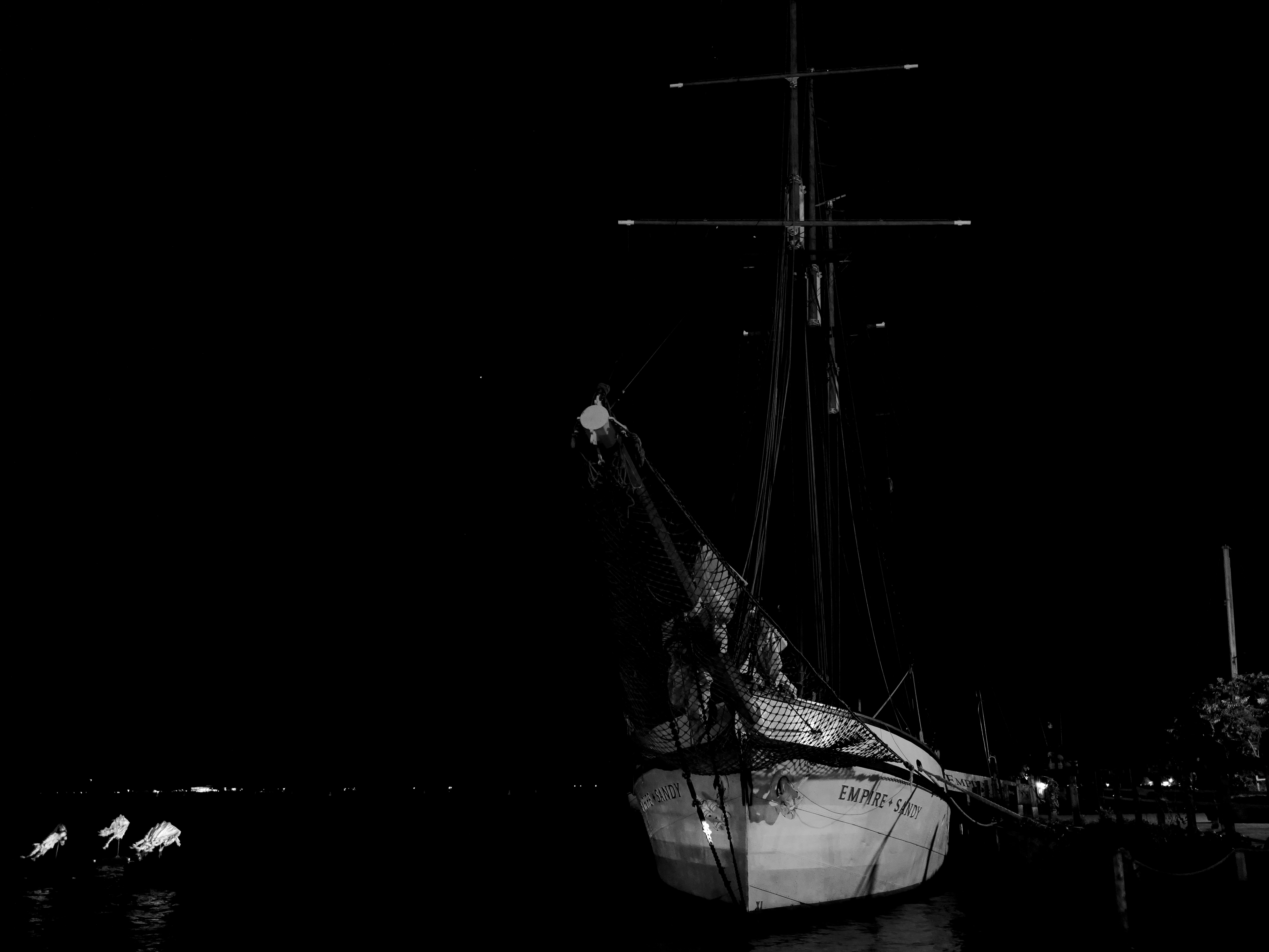
One of the marque exhibits of the year were glowing fish that were placed in the harbour. Here, I’ve captured their luminescent being alongside one of the tall ships that is always docked; the effect is spectral, to my eye, with the fish racing towards the ghost-boat.
Bathurst & Queens Quay, Toronto, 2024
Hosting a project that raised the issue of disability inside a basketball court forced audiences to confront the ableism that permeates our lives, and especially contemporary sport. The exhibit forced audiences to acknowledge that disabled athletes have led the way in more accessible design that is now the norm for all athletes, disabled or not. By this time it was about 5am and the crowds were dying down, though spectators and attendees to the festival were still around in smaller numbers.
Richmond & Spadina, Toronto, 2024
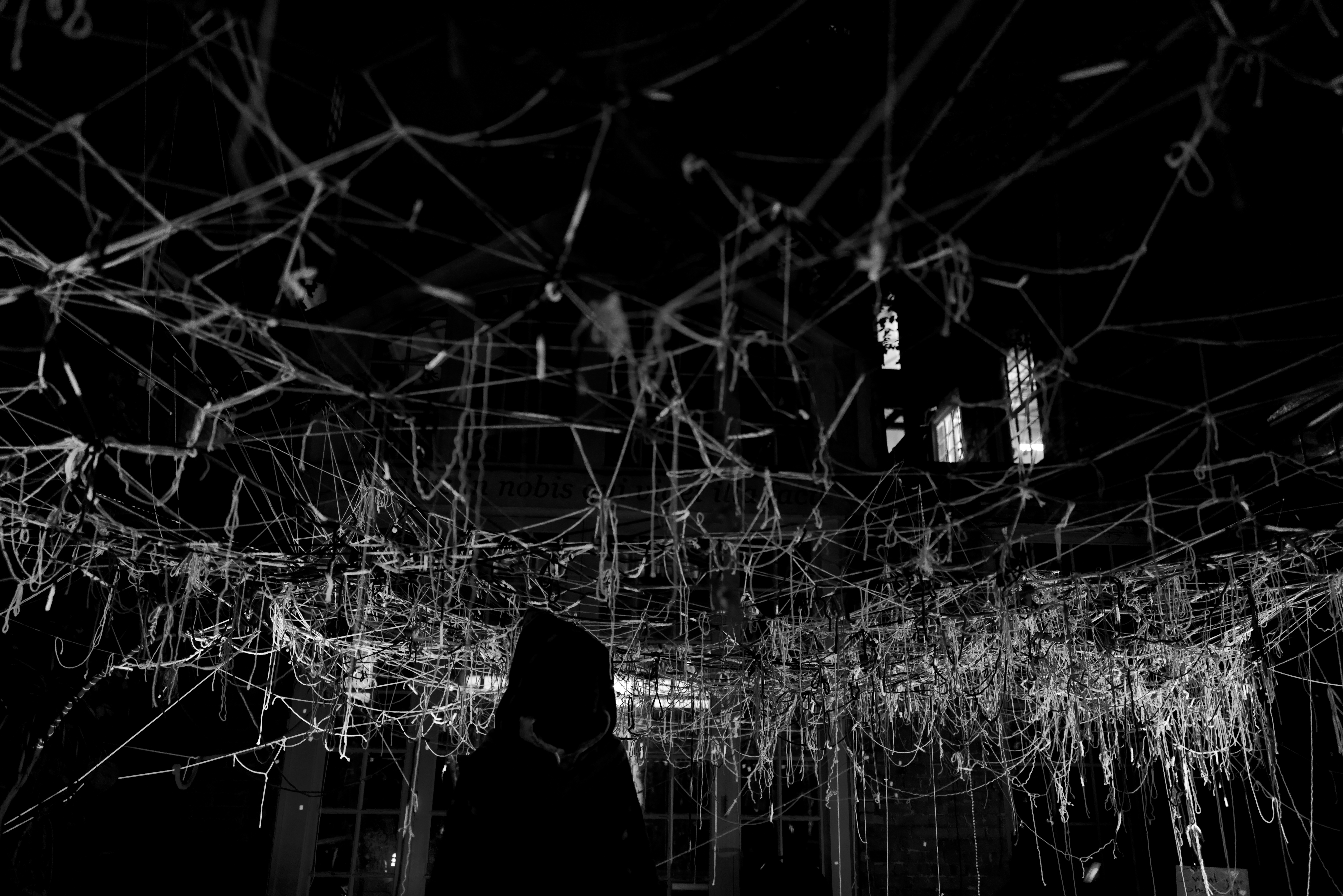
This was the last exhibit that I documented and left with an image I was satisfied with. The artists were lowering a multi-coloured spider web that had been elevated above the attendees, when a sole last participant walked through the exhibit despite the efforts to tear it down by sundown. The subject is reaper-like in their image and spoke to the end of the exhibit, and the end of Nuit Blanche for 2024.
Queen & Chestnut, Toronto, 2024
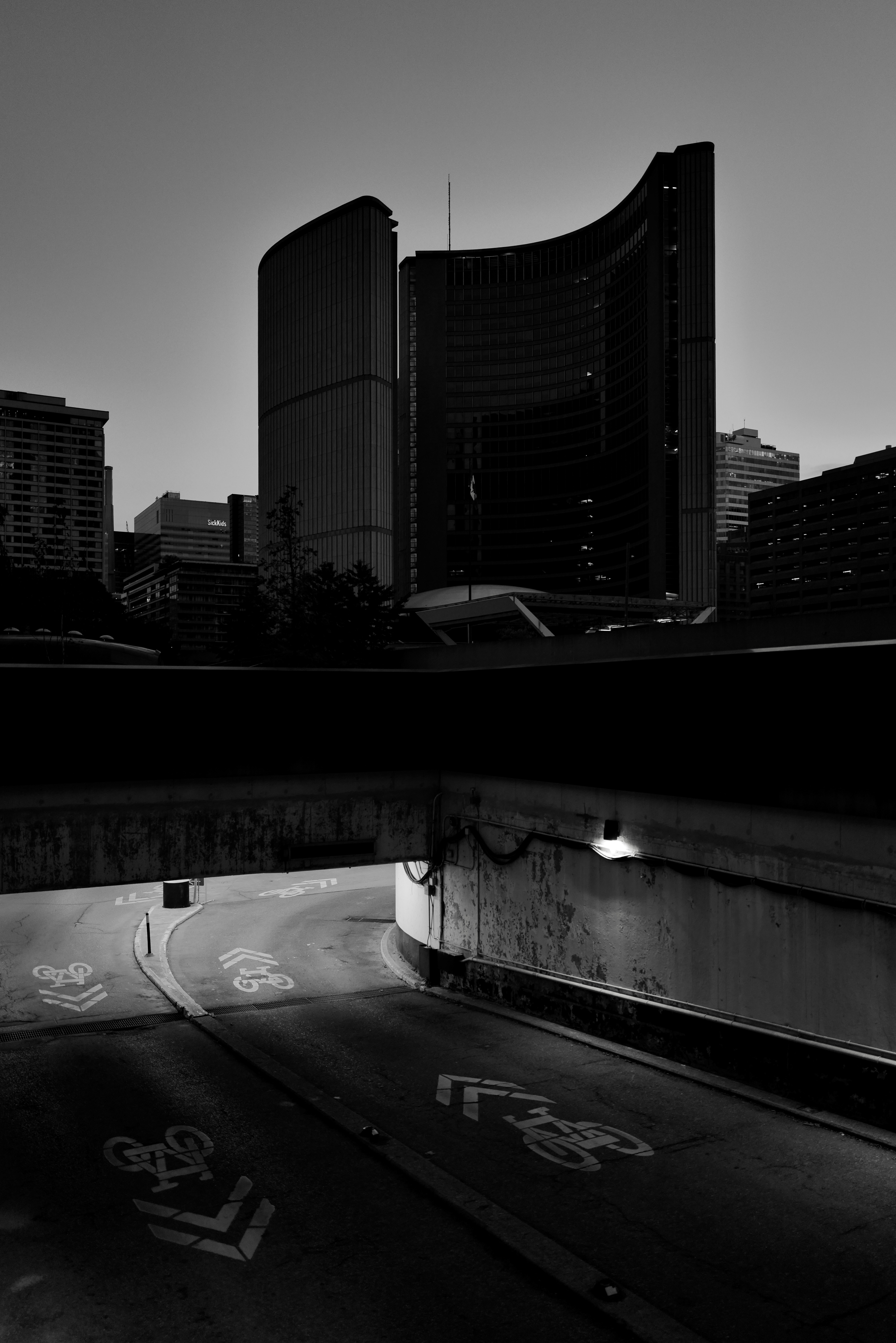
On my way to breakfast I captured this image of Toronto’s City Hall as the sun was just starting to rise. All was quiet, including the parking garages, though the city had begun coming back to life once I got home an hour or so later to crawl into bed before a short nap ahead of afternoon activities.
As part of my ongoing efforts to get more comfortable sharing my photographs with a wider audience I started to participate in photographic competitions last year. While I didn’t receive any awards the very act of submitting my work was the personal award that I took away.
This year, for the first time, I’m submitted to a contest with a small fee. I appreciate that many photographers take issue with the “pay to compete” models but this is normal, and I enjoy a level of disposable income that means I can afford to submit to a few contests a year. This post includes the images that I submitted to the Eyeshot 2024 competition, the descriptions I included with the images, and an artist’s statement.
Submitted Images
All of my images are part of a broader documentary project that traces how built environments that I inhabit develop and transform through the seasons, and across the years that I have been photographing my surroundings. As befits this objective, all of my images are titled by their rough location (based on major street intersections), geographic region or city, and the year made.
Great Lakes Waterfront Trail, Toronto, 2024
Toronto is home to a vast waterfront trail which was renovated in 2024 to include a large splash and mist park. On a swelteringly hot day I passed by after it had recently been re-opened and was delighted to see the silhouettes of people — mostly children — playing in the mist, while the looming under-construction condo towers of downtown Toronto provided a sense of youthfulness and activity to the cityscape itself. This photograph captures the youthful energy of Toronto as manifest in its residents and built infrastructures while simultaneously possessing a kind of timelessness as a result of capturing the moment in black and white.
Cumberland & Bellair, Toronto, 2024
One of Toronto’s most posh shopping areas is Yorkville, where the affluent come out to spend and be seen. I like how this monochromatic photograph results in the two women looking like they could have come from 40 or 60 years ago, while the reflection in the window reveals some of the built infrastructure surrounding them. It speaks to a timelessness that is specifically located to being within a large urban environment.
Yonge & Dundas, Toronto, 2024
The Saint Patrick’s Day parade is a major event in Toronto. I’ve been photographing it for years and always march in it to make images of the crowds. I like how the woman in this photograph is almost posing in her winter jacket — it gives her a sense of elegance and self-importance — while, above her, the sign suggests that she is happy we’ve ranked her #1. But in addition to her, the man who is looking on in the right-hand side of the frame adds a degree of electricity to the image with his dourness contrasting with the woman’s own more-positive energy.
Gerrard & Galt, Toronto, 2024
When was this photograph taken? 2024 or 1964? The use of black and white has the effect of confusing the viewer as to when the photograph was made. This is accentuated by the sign in the photograph being from another generation. Adding power to the image are the two figures who are wandering through the early January snow, with the young woman looking down and over to the city’s garbage, and the little boy looking up past the trash to the graffiti on the wall. This speaks to the hopes and ambitions of youth and the practicality of maturity, while they are both literally passing by the abandoned garbage of the day.
Queen & Peter, Toronto, 2023
This photograph is only made possible because of the advertising-heavy urban landscapes in which we live. Taken in downtown Toronto, this photograph juxtaposes a question about one’s life with an idealised (and unrealistic) advertised imagination of excitement, along with a man contemplating his possible future. Him exiting the frame leaves us to wonder whether he will do something to change his life or if, instead, he will continue to live the same life that he always has. We are already left with some sense of his trajectory, however: his walking out to the left of the frame imposes on us a question of whether his movements will take him back to something he once enjoyed in life, or if his retreat through that side of the frame instead symbolises a staidness. Regardless, he will not be moving forward into the future — into the right of the frame — to see some change to his life.
Nathan Phillips Square, Toronto, 2023
Yonge and Dundas Square is Toronto’s imagined equivalent to Times Square. In this photograph we see it at peak energy: the two women hiding under a transparent umbrella are huddling together with somewhat shocked looks on their faces, while behind them a woman is running from something out of scene and a giant in white strolls behind them. Photographs like this capture the dynamism of our urban landscapes while, simultaneously, not explaining what is specifically occurring. Instead the viewer is merely left with an ever-growing cascade of questions: Why are the women drinking out of a pineapple in the rain? Why are they shocked? Who is chasing the woman in the background? Why is there a tall white giant wandering around? What is going on with the squatting man in the advertisement? These questions draw the viewer in and invite them to create their own stories of what was before, and followed, the 1/320s that this frame holds together.
Artist’s Statement
I’m an amateur Toronto-based documentary and street photographer, and have been making images for over a decade. I make monochromatic photographs that focus on little moments that happen on the streets and which document the ebb and flow of the city over the course of years and decades. My work often deliberately plays with the temporality of photographs and calls into question when images were made, and invites the viewer to ask what specifically happened immediately prior to and following the pressing of the shutter button.
In 2023, Andrea Bianco wrote a lovely long-form meditation on the difference in practice between excellent smart phone cameras (i.e., iPhone 11 Pro) and excellent compact cameras (i.e., Ricoh GR 2). I appreciated that it wasn’t a “smartphones bad and dedicated cameras good” (or the vice versa) kind of assessment. He, instead, considered the utility and capabilities of both classes of cameras. He often noted how phone cameras were best consumed on smaller screens but that their limitations became more apparent when viewed on larger screens.
His post reminded me of some longer-term considerations I’ve had for the past year about the screens on which we assess the images that we make.
Cherry & Polson, Toronto, 2024
Our camera’s screen size, or viewfinder resolution, has an effect on how we compose images. We may try to squeeze in (or exclude) content based on what we can see. However, the screen on which we edit images also affects how we perceive and present the images we have captured.
Editing on smaller screens, such as those used with phones, can lead to presenting images differently than when editing on a larger tablet or computer monitor screen. A figure that is apparent on a 12” or 24” display and is poignant to the photo editing process may functionally be a near-invisible dot on a 6” phone screen.
Eireann Quay & Queens Quay, Toronto, 2024
How we see when editing images, then, will often affect the images which are produced using dedicated cameras by merit of photographers often editing them on larger tablet or laptop screens. By editing on these larger screens we will often make very different editorial or cropping decisions based (in part) on the sheer size of the screen we are reviewing and editing photographs on. The size of the screen (and its quality) affects how we read and interpret our own photographs.
Queen & Bay, Toronto, 2019
The effects of screen size then expand, further, when we consider what screens we use to view other photographers’ work, and correspondingly lead to very different perceptions of work that photographers are digitally displaying. If a photographer edits all their work on a display of 11” or greater, should we not view it with the same size screen to truly read what they are communicating? And, by way of contrast, if a photographer’s photos are all edited on a smartphone then should we view them primarily at the size of a phone? And either way, shouldn’t we view other photographers’ work at peak screen brightness?
Of course we will all use a variety of different screens, of different sizes and luminosity and quality, to look at one another’s work. But because we are both unaware of one another’s editing and viewing defaults it is imperative to think carefully when looking at photographers’ works and ask ourselves: “Do I have the same equipment as they do, to approximate an attempt to see the photograph and scene as they intended for it to be viewed?”
Note: Updated to correctly refer to Andrea’s gender. Apologies!