Categories
Quotations

2013.2.4

Privacy is not simply an individual right or civil liberty; it is a vital component of the social contract between Canadians and their government. Without privacy, without protective boundaries between government and citizens, trust begins to erode. Good governance requires mutual trust between state and citizen. Otherwise, alienation and a sense of inequality begin to spread, circumstances under which no program for public scrutiny can be tenable or effective in the long term. Where citizen trust hits a low point, in fact, such security measures may be undermined, ignored, circumvented – or in the most egregious cases – passively or actively resisted.

Office of the Privacy Commissioner of Canada, “A Matter of Trust: Integrating Privacy and Public Safety in the 21st Century
Categories
Links Writing

A Poignant Comment on Deleting Email

For the past two months I’ve been trying to figure out what to say about something Peter Fleischer, Google’s Global Privacy Counsel, wrote about his personal email retention and deletion policies. After talking about whether people should worry about “covering their tracks” from government snooping, he writes (emphasis added):

In the meantime, as users, we all have to decide if we want to keep thousands of old emails in our inboxes in the cloud.  It’s free and convenient to keep them.  Statistics published by some companies seem to confirm that the risks of governments seeking access to our data are extremely remote for “normal people”.  But the laws, like ECPA, that are meant to protect the privacy of our old emails are obsolete and full of holes.  The choice is yours:  keep or delete.  I’m a pragmatist, and I’m not paranoid, but personally, I’ve gotten in the habit of deleting almost all my daily emails, except for those that I’d want to keep for the future.  Like the rule at my tennis club:  sweep the clay after you play.

His comments struck me as being incredibly poignant when I first read them, and remain so today. I’ve stopped archiving email. I delete email (as best I can, given cloud data retention policies and all…) on a regular basis. Over the Christmas break I removed an aggregate of about 6 GB of mail that had just…accrued…in my various accounts over the past decade. In short, his post motivated me enough to spend the better part of 3 or 4 days sifting and sorting through my digital life. Ultimately I removed an awful lot of what was there.

At some point I hope to spend more time writing about, and thinking through, some of Peter’s points. At the moment, however, I’d just recommend you think about what it means when Google’s Global Privacy Counsel – the guy who is best able to go to the mat to protect the privacy of his own inbox – chooses to routinely delete his email from the cloud. If he takes that precaution, and he has the influence that he does, shouldn’t you at least consider following his lead?

Categories
Quotations

2013.1.24

Social utopians like Haque, Tapscott and Jarvis are, of course, wrong. The age of networked intelligence isn’t very intelligent. The tragic truth is that getting naked, being yourself in the full public gaze of today’s digital network, doesn’t always result in the breaking down of ancient taboos. There is little evidence that networks like Facebook, Skype and Twitter are making us any more forgiving or tolerant. Indeed, if anything, these viral tools of mass exposure seem to be making society not only more prurient and voyeuristic, but also fuelling a mob culture of intolerance, schadenfreude and revengefulness.

Andrew Keen, #digitalvertigo: how today’s online social revolution is dividing, diminishing, and disorienting us
Categories
Aside

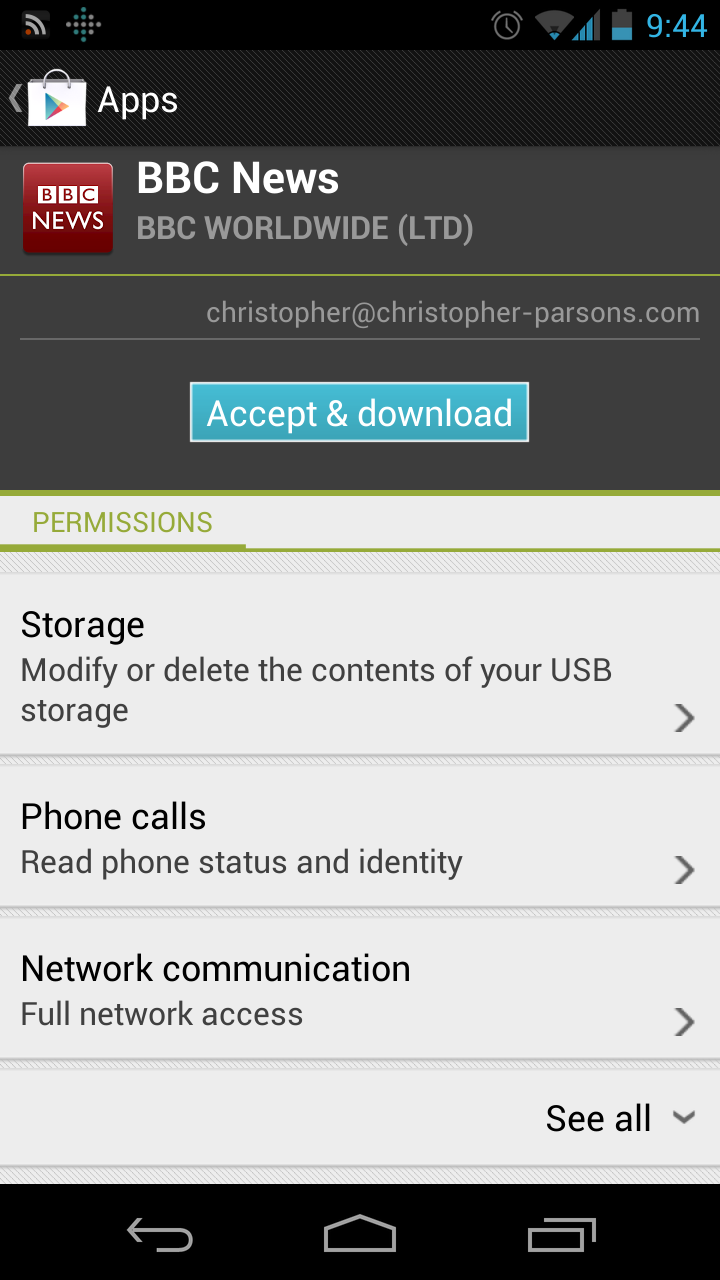
BBC News Permissions

You’d think that in the post UK phone scandals, newspapers wouldn’t want access to your phone calls with their apps

Categories
Quotations

2013.1.15

Placing sensitive data in insecure locations is never a good idea, and the loss of physical security has long been considered tantamount to a breach. Yet some early elements of the IoT incorporate this very flaw into their designs. It’s often an attempt to compensate for a lack of technological maturity where always-on network connectivity is unavailable or too expensive, or the central infrastructure does not scale to accommodate the vast number of input devices.

As the IoT crawls through its early stages, we can expect to see more such compromises; developers have to accommodate technical constraints — by either limiting functionality or compromising security. In a highly competitive tech marketplace, I think we all know which of these will be the first casualty.

And it’s not just security: it’s privacy, too. As the objects within the IoT collect seemingly inconsequential fragments of data to fulfill their service, think about what happens when that information is collated, correlated, and reviewed.

Andrew Rose, “The Internet of Things Has Arrived — And So Have Massive Security Issues
Categories
Quotations

2013.1.12

I don’t believe the public would intend for the government to be rummaging through your cupboards while your wife is lying in the next room being prepared to be taken to her final resting place. That’s an extraordinary violation of privacy.

Andrew Fackrell, in Dennis Romboy’s “Police drug search intrudes on husband’s final moments with deceased wife
Categories
Quotations

2013.1.11

But an attempt by Canadian ISPs to garner an all-access pass that would let them secretly install software to monitor potentially illicit user activity was thwarted, at least in part.

According to the note accompanying the draft regulations, industry representatives “had argued for exemptions from the requirement for consent to install software to prevent unauthorized or fraudulent use of a service or system, or to update or upgrade systems on their networks.”

Under the revised rules, service providers would only be permitted to install software “where illegal activities pose a threat to [their] networks.”

Kady O’Malley, “Ottawa’s anti-spam proposals prohibit secret monitoring software
Categories
Links

Advice on Browsing the Web Safely

Global Voices has a series of good suggestions on how to browse the web safely. Many users may not need to take the more extreme precautions – such as browsing from a USB-drive mounted operating system – but other pieces of information are helpful. Well worth the (quick) read.

Categories
Writing

Could Google+ Depend of Google Now’s Success?

MG Siegler recently argued that:

Google+ is a turd.

I’m not sure why everyone seems afraid to admit this. I think it’s similar to the reason why some seem reluctant to call Windows 8 a turd when it’s already abundantly clear: people are scared that such a bold statement could come back to bite them in the ass. But it won’t. Both are clearly turds.

Google continues to try to cram Google+ down people’s throats, but it just won’t stay down. People are gonna keep puking it right back up. The only compelling feature of Google+ is Hangouts; everything else is a carbon copy of some social activity that people can (and already do) do elsewhere. Google simply made a bad call and started chasing the wrong thing (social) far too late.

I wonder how long it will take Google to admit defeat here? I’m sure we’ll see a lot more of the shoving of Google+ in our faces first — Chrome, you’re next. But I really wish Google would take all the energy being put behind this dog and use it to blow out their truly interesting and innovative products, like Google Now.

I think that the of Google+ could depend on Google’s capability of linking signals from their social networking product with their Now product. Currently, Now can ascertain things like when you’re near certain locations or about to perform certain actions (e.g. near a bus stop/station or about to take a flight) and provide relevant and helpful data to the Android Phone user. This is really cool and, if you’re comfortable with this degree of personalized data mining, potentially convenient.

What Now presently lacks is the ability to tell me that when I’ve a break in my day (based on Google Calendar analysis) and a friend also has a break (based on an analysis of their calendar) that we could mutually meet for coffee or meal. It similarly lacks an awareness of my colleagues and friends to suggest that there are special non-birthday dates coming up. Same thing for mass-mining of check-ins (to figure out what my social community eats, and where they do it often) and preferred news and website content.

The thing is, all of these functionality elements could be implemented if there was widescale adoption and use of Google+. This means that updated version of Android need to get to millions of handsets or, alternately, Chrome need to deploy Now functionality (something that code analyses suggest is imminent). Either/or could encourage people to adopt Google+ to get heightened personalized data mining. Yes, you read that right: (perceived) helpful surveillance could get people to intentionally adopt products that facilitate useful personalized insights.

The key issue – beyond pure legal and regulatory concerns – will be whether this kind of mining is seen as ‘creepy’ or not. If the Now product is seen as cool, feature rich, opt-in, and not privacy infringing – and is adopted by a significant portion of the masses – then Google could offer personalized services in excess of those offered by Twitter and Facebook today. This might be the ‘nudge’ necessary to get a significant portion of the social graph onto Google and consequently elicit a network effect sufficient to turn Google+ into a viable and useful social networking community.

If Google+ is seen as a gateway to improved Now information, and if users see Now as a feature they want more of in their life, then Google+ could see a fresh (if somewhat forced) breath of life. A key question, however, is whether the advantages of a cool product offering are sufficient to get people to ‘jump ship’ onto a largely empty social networking platform. It’ll be curious to watch because if Google is successful they’ll have found a way to create a social graph in a novel manner, one that other companies may subsequently attempt to replicate.

Categories
Quotations

2012.12.31

I’m jealous of old people because they didn’t have the internet and Facebook when you were young — you could get away with just about anything.

Mathew Ingram, “Snapchat and our never-ending quest for impermanence