Categories
Photography Writing

Editing and Viewing Smartphone Images Versus Dedicated Camera Images

Manitoba & Nova Scotia, Toronto, 2023

In 2023, Andrea Bianco wrote a lovely long-form meditation on the difference in practice between excellent smart phone cameras (i.e., iPhone 11 Pro) and excellent compact cameras (i.e., Ricoh GR 2). I appreciated that it wasn’t a “smartphones bad and dedicated cameras good” (or the vice versa) kind of assessment. He, instead, considered the utility and capabilities of both classes of cameras. He often noted how phone cameras were best consumed on smaller screens but that their limitations became more apparent when viewed on larger screens.

His post reminded me of some longer-term considerations I’ve had for the past year about the screens on which we assess the images that we make.

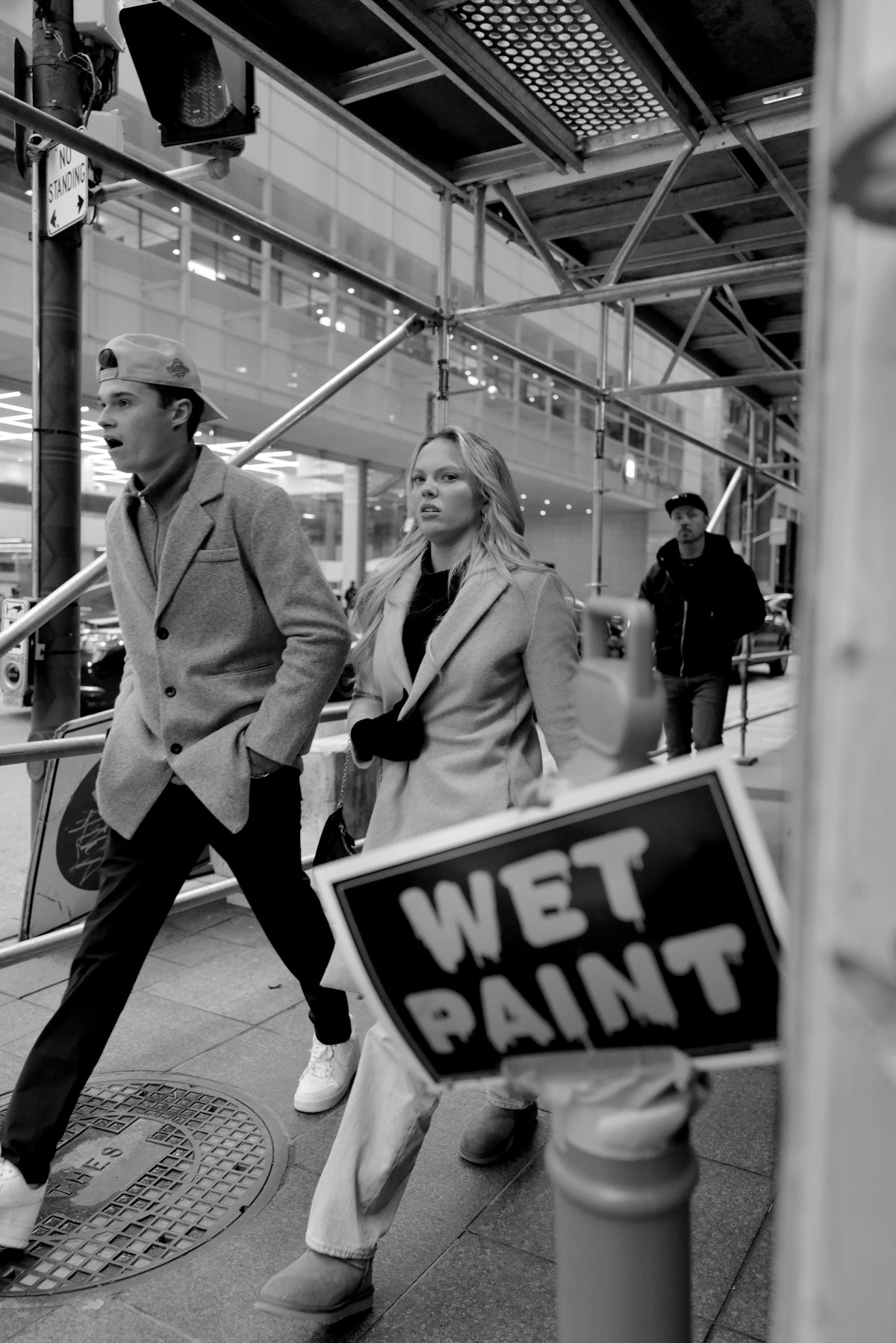
Cherry & Polson, Toronto, 2024

Our camera’s screen size, or viewfinder resolution, has an effect on how we compose images. We may try to squeeze in (or exclude) content based on what we can see. However, the screen on which we edit images also affects how we perceive and present the images we have captured.

Editing on smaller screens, such as those used with phones, can lead to presenting images differently than when editing on a larger tablet or computer monitor screen. A figure that is apparent on a 12” or 24” display and is poignant to the photo editing process may functionally be a near-invisible dot on a 6” phone screen.

Eireann Quay & Queens Quay, Toronto, 2024

How we see when editing images, then, will often affect the images which are produced using dedicated cameras by merit of photographers often editing them on larger tablet or laptop screens. By editing on these larger screens we will often make very different editorial or cropping decisions based (in part) on the sheer size of the screen we are reviewing and editing photographs on. The size of the screen (and its quality) affects how we read and interpret our own photographs.

Queen & Bay, Toronto, 2019

The effects of screen size then expand, further, when we consider what screens we use to view other photographers’ work, and correspondingly lead to very different perceptions of work that photographers are digitally displaying. If a photographer edits all their work on a display of 11” or greater, should we not view it with the same size screen to truly read what they are communicating? And, by way of contrast, if a photographer’s photos are all edited on a smartphone then should we view them primarily at the size of a phone? And either way, shouldn’t we view other photographers’ work at peak screen brightness?

Of course we will all use a variety of different screens, of different sizes and luminosity and quality, to look at one another’s work. But because we are both unaware of one another’s editing and viewing defaults it is imperative to think carefully when looking at photographers’ works and ask ourselves: “Do I have the same equipment as they do, to approximate an attempt to see the photograph and scene as they intended for it to be viewed?”


Note: Updated to correctly refer to Andrea’s gender. Apologies!

Categories
Photography Writing

Best Photography-Related Stuff of 2023

There are lots of ‘best of’ lists that are going around. Instead of outlining the best things that I’ve purchased or used over the year I wanted to add a thematic: what was the best ‘photography stuff’ that I used, read, watched, or subscribed to over the course of 2023?

Photography Stuff I Used

Best Technology of 2023

90-95% of the photographs that I made over the year were with the Fuji X100F. It’s a spectacular camera system; I really like how small, light, and versatile it is. I created a set of recipes early summer and really think that I dialled in how to use them and, also, how to apply my very minimal editing process to the images. I’m at the point with this camera that I can use it without looking at a single dial, and I know the location of every setting in the camera that I regularly use.

I do most of my writing on my well-used iPad Pro 11” (2018). It’s a great device that is enough for 99% of my needs.1 However, I have to admit that I’ve long missed owning an iPad Mini because they’re so small and light and portable. I do pretty well all of my reading on the iPad Mini these days. My partner purchased me one this year and I’ve fallen in love with it again. I’m using it everyday for an hour or more, and ultimately I now pull out the iPad Pro 11” just when I need to do longer-form writing.

Finally, though I haven’t had it all that long, I really do enjoy the Leica Q2. I’m still getting used to the 28mm focal length but deeply appreciate how I can now shoot in bad weather and low light.2 The in-camera stabilization is also letting me experiment with novel slow shutter speeds. I remain excited, however, for what it’ll be like to use the camera when I haven’t been in persistent cloud cover!

Best Services I Paid For

I have kept using Glass each and every day. Does it (still) have problems with its AI search? Yes. Does it have the best photographic community I’ve come across? Also yes. You should subscribe if you really love photography and want to contribute to a positive circle of practice. And if you’re watching a lot of photography-related materials on YouTube I cannot recommend a Premium subscription highly enough!

I also am deeply invested in Apple’s services and pay for Apple One. This gives me access to some things that I care about, including a large amount of cloud storage, News, customized email, Apple Music, and Apple TV. I find the current costs to be more than a little offensive–Apple’s decision to raise costs without increasing the benefits of the service was particularly shitty–but I’m deeply invested in Apple’s ecosystem–especially for storing my photographs!–and so will continue to pay Apple’s service tax.

Best Apps

I use lots of apps but the best ones I rely on for photography include:

  • Podcasts App to listen to the different podcasts to which I’ve subscribed.
  • Reeder for staying on top of the different blogs/websites I’m interested in reading.
  • Glass to look at, comment on, and reflect on photographers’ images.
  • Geotags Photos Pro and Geotags Photo Tagger. I’ve set the former app to record my geolocation every 5 minutes when I’m out making images and the latter to then apply geotags to the photographs I keep from an outing.3

Stuff I Read

Best Photography Books

Most of the non-fiction books that I read throughout the year were focused around photography. The two best books which continue to stand out are:

  • Bystander: A History of Street Photography. This book does an amazing job explaining how (and why) street photography has developed over the past 150 years. I cannot express what a terrific resource this is for someone who wants to understand what street photography can be and has been.
  • Daido Moriyama: A Retrospective. This book is important for all photographers who are interested in monochromatic images because it really explains why, and how, Moriyama made his classic images. It reveals why he made his gritty black and white images and, also, why some of the equivalent ‘recipes’ the mimic this kind of image-making may run counter to his whole philosophy of image making.

Stuff I Watched

Best Movies

The best photography-related movies that I watched were all classics. They included Bill Cunningham: New York; Gary Winogrand: All Things Are Photographable; The Jazz Loft According to W. Eugene Smith; and Ordinary Miracles: The Photo League’s New York. Combined with written history and photo books they helped to (further) reinforce my understanding of how and why street photographers have made images.

Best YouTube Channels

I watch a lot of photography YouTube. The channels I learn the most from include those run by James Popsys, Tatiana Hopper, EYExplore, Alan Schaller, Pauline B, aows, Aperture, and Framelines. My preference is for channels that either provide POV or discuss the rationales for why and how different images are being (or have been) made.4

Stuff I Subscribed To

Best Podcasts

I tend to listen to photography podcasts on the weekend when I go out for my weekly photowalks. The two that I listen to each and every week are The Photowalk and The Extra Mile. It’s gotten to the point that it almost feels like Neale James (the host of the podcasts) is walking along with me while I’m rambling around taking photos.

Aside from those, I’ll often listen to A Small Voice or The Candid Frame. These are interviews with photographers and I regularly learn something new or novel from each of the interviews.

Best Blogs/RSS Feeds

For the past year I’ve trimmed and managed the number of my RSS feeds. I keep loving the work by Craig Mod, Little Big Traveling Camera,5 and Adrianna Tan’. They all do just amazing photoessays and I learn a tremendous amount from each of them in their posts.

Biggest Disappointments

I somehow managed to break the hood that I’d had attached to my Fuji X100F in the fall and decided to get what seemed like a cool square hood to replace it. It was a really, really bad idea: the hood was a pain to screw on so that it wasn’t misaligned and, once it was aligned, was on so tight that it was very hard to remove. I would avoid this particular hood like the plague.

I also bought a Ricoh GR IIIx and while it’s a fantastic camera I just haven’t used it that much. I didn’t take as many images with it as I’d hoped when I was walking to or from work, and really ended up just using it when I needed to go out and take photos in the rain (I kept it safely hidden under my umbrella). Also, the camera periodically just fails to start up and requires me to pull the battery to reset it. Is it a bad camera? Nope, not at all, and I did manage to capture some images I was happy with enough to submit to Ricoh’s photography contest. But it’s not a camera that I’ve really fallen in love with.

Finally, while I use my AirPods Pro all the time I really don’t like them because I cannot get them to stay in my ears unless I purchase third-party foam tips. And I need to keep purchasing new sets of tips because they wear out after a couple of months. Are they good headphones once they stay in my ears? Yes. But the only way to accomplish that is becoming increasingly costly and that’s frustrating.

Conclusion

Anyhow, that’s my list of the ‘best photography-related stuff’ I’ve used in the course of 2023. What was your top stuff of the year?


  1. I really do want to get a new iPad 11” and will do so once they update the screen. I edit pretty well all of my photos on the iPad Pro and an updated screen (and battery…) would be lovely. ↩︎
  2. There is a caveat that I’ve found: the electronic shutter is absolute garbage for shooting at dusk/in the dark with LED lights. And I think the single-use exposure dial on the Fuji X100F is preferable to the configurable dial on the Q2. ↩︎
  3. You can set the app to record your location more regularly but I’ve found this to be a good balance between getting geolocation information and preserving my phone’s battery life. ↩︎
  4. If you watch a lot of YouTube then I recommend that you pay for a YouTube Premium subscription. You’ll cut out the frustrating advertising that otherwise intrudes into the videos. ↩︎
  5. I think that this is perhaps the single best photography blog that I’ve found. I aspire to this level of excellence and regularity of updates! ↩︎
Categories
Aside Photography

2023.12.29

I’ve owned a Leica Q2 for a little over a month so far. I haven’t really used it enough to say what I truly like (or dislike) about it, aside from moving from an APC-C sensor to a full frame sensor has been a fantastic upgrade in the lighting conditions in which I’ve been shooting.

The last day I had actual, honest to god, direct sunlight was on November 19, 2023. Every other day I’ve been out has been cloudy, rainy, or just grey. The larger sensor has meant that I’m reliably able to shoot at 1/500 and at an ISO under 3200. That would have been entirely impossible where I shoot with either my Fuji X100F or the Ricoh GR IIIx.

You can see what I’ve been shooting over at my Glass profile.

Categories
Photo Essay Photography Writing

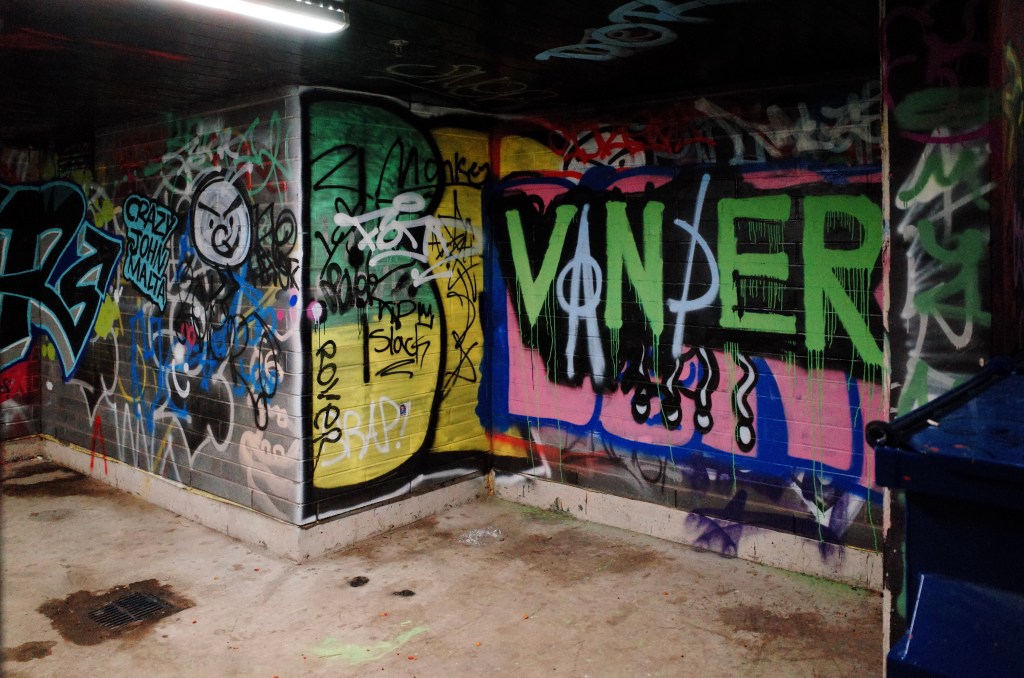
January 1st Graffiti Photowalk

I routinely try and take a bit of a longer photowalk at the start of each year. It’s an opportunity to stretch my legs some and a great way to start of the year while, also, getting a chance to document the city while it’s still recovering from New Years celebrations.

This year was no different, save that I ended up leaving for my walk later than intended and was drawn to a number of Toronto’s alleys throughout the evening.

While I did the majority of my shooting through the late afternoon and evening in monochrome, I couldn’t help by see how the positive film simulation in my Ricoh GRs would showcase the vibrant colours of graffiti under artificial lighting situations.

It was only once I’d brought the images home and looked at them that it became apparent that the majority of the photos were made from the same angle. I had no idea I was doing this at the time but, in hindsight, I definitely wish that I’d made images from wider variety of angles.

When I was wandering through some of the alleys I wished that there had been more people about to include in some of the images. Even a wisp of a figure would, I think, have added a bit of a haunting character to many of the photographs.

In their absence, however, I largely (though not completely) tried to channel Tatianna Hopper. She sometimes engages in a kind of street photography that simultaneously showcases the existence and absence of humans. Graffiti and human trash, or waste, expresses this concept to my mind.

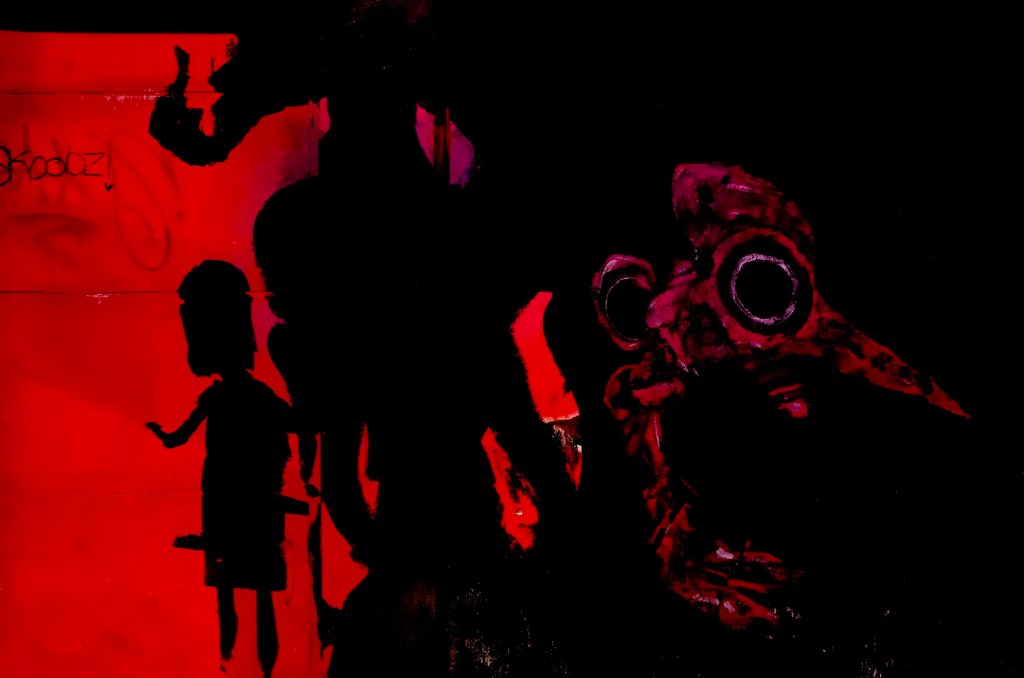
In a number of alleys there were quasi-monstrous or demonic imagery. I see more and more of it around the city and have met the artists of some of it. The effort they’re putting in is amazing with really interesting effects; when shooting with humans in the frame and in monochrome, I find the graffiti adds an interesting graphic element and juxtaposition. Even on its own, however, the juxtaposition between colour and monochrome graffiti causes its own novel contrast.

Almost the entirety of 2022, and the tail end of 2021, saw me shoot 99% of my images in monochrome. I’m happy with the progress I’ve made on the street and can see the very real improvements in composition and ability to ‘see’ in monochrome. However I’m inspired by Alex Webb and Gustavo Minas’ ‘Maximum Shadow Minimal Light’. Both use shadow in colour photography and I’d like to develop similar skills . Maybe that means I’ll experiment some through the year in trying to translate what I’ve learned about light and shadows in monochrome images into colour photos!

Categories
Solved

Solved: Ricoh GR Not Using Auto-Hi ISO

I spent a few frustrating evenings shooting on aperture priority with the original Ricoh GR. It held my shutter speed at 1/40s and varied the ISO so that it was always at 1/40s.

I’ve finally sat down to figure out what the heck was going on as I’d never previously experienced this issue. For some reason each time I tried to set the ISO to Auto-High (with a 5000 ISO maximum and shutter minimum at 1/160s) it kept defaulting to Auto, instead.

The Problem

My Ricoh GR was stuck at 1/40s when shooting aperture priority (i.e., ‘Av’) with the ISO varying to ensure it could hit that shutter speed. My work-around solution was to take manual control of the ISO. When I manually raised the ISO I could get a much faster shutter speed.

The Solution

I had previously disabled ‘Continuous Mode’ when I had been experimenting with an external flash. In doing so I had, unknowingly, simultaneously disabled the camera’s ability to use ‘Auto-High.’1 Auto-High is used to set a maximum ISO and minimum shutter speed.2

To enable Auto-High on the Ricoh GR:

  1. Open the menu
  2. Enter the Shooting Menu (Camera symbol)
  3. Scroll down to ‘Continuous Mode’
  4. Press the right button on the control dial
  5. Scroll to ‘Continuous Mode’
  6. Press ‘OK’

You may, also, need to set the maximum ISO and minimum shutter speed for Auto-High. To set these values:

  1. Open the menu
  2. Enter the Setup Menu (Screwdriver and Wrench symbol)
  3. Scroll down to ‘ISO Auto-High Settings’
  4. Press the right button on the control dial
  5. Set the Maximum ISO and Change Shutter Speed to preferred values
  6. Press ‘OK’

At the conclusion of this you should hopefully have (re)enabled Auto-High ISO.

Note: My solution to this problem differs from some on the Internet. A post in the DP Review forums, as an example, suggests that you must disable ‘dynamic range compensation’ to solve the problem. This is not the case in my experience as I have dynamic range compensation set to ‘Medium’ on my Ricoh GR.


  1. This is not clearly explained in the Ricoh GR manual when when doing a search for ‘Auto-Hi’. ↩︎
  2. If shooting conditions are such that the camera cannot expose properly at a given aperture and maximum ISO setting, it may reduce the shutter speed below the minimum shutter speed set under Auto-High to get a correct exposure. ↩︎
Categories
Photography Writing

Improving My Photography In 2021

CB1A5DDF-8273-47CD-81CF-42C2FC0BA6F5
(Climbing Gear by Christopher Parsons)

I’ve spent a lot of personal time behind my cameras throughout 2021 and have taken a bunch of shots that I really like. At the same time, I’ve invested a lot of personal time learning more about the history of photography and how to accomplish things with my cameras. Below, in no particular order, is a list of the ways I worked to improve my photography in 2021.

Fuji Recipes

I started looking at different ‘recipes’ that I could use for my Fuji x100f, starting with those at Fuji X Weekly and some YouTube channels. I’ve since started playing around with my own black and white recipes to get a better sense of what works for making my own images. The goal in all of this is to create jpgs that are ‘done’ in body and require an absolute minimum amount of adjustment. It’s very much a work in progress, but I’ve gotten to the point that most of my photos only receive minor crops, as opposed to extensive edits in Darkroom.

Comfort in Street Photography

The first real memory I have of ‘doing’ street photography was being confronted by a bus driver after I took his photo. I was scared off of taking pictures of other people for years as a result.

Over the past year, however, I’ve gotten more comfortable by watching a lot of POV-style YouTube videos of how other street photographers go about making their images. I don’t have anyone else to go an shoot with, and learn from, so these videos have been essential to my learning process. In particular, I’ve learned a lot from watching and listening to Faizal Westcott, the folks over at Framelines, Joe Allan, Mattias Burling, and Samuel Lintaro Hopf.

Moreover, just seeing the photos that other photographers are making and how they move in the street has helped to validate that what I’m doing, when I go out, definitely fits within the broader genre of street photography.

Histories of Photography

In the latter three months of 2021 I spent an enormous amount of time watching videos from the Art of Photography, Tatiana Hopper, and a bit from Sean Tucker. The result is that I’m developing a better sense of what you can do with a camera as well as why certain images are iconic or meaningful.

Pocket Camera Investment

I really love my Fuji X100F and always have my iPhone 12 Pro in my pocket. Both are terrific cameras. However, I wanted something that was smaller than the Fuji and more tactile than the iPhone, and which I could always have in a jacket pocket.

To that end, in late 2021 I purchase a very lightly used Ricoh GR. While I haven’t used it enough to offer a full review of it I have taken a lot of photos with it that I really, really like. More than anything else I’m taking more photos since buying it because I always have a good, very tactile, camera with me wherever I go.

Getting Off Instagram

I’m not a particularly big fan of Instagram these days given Facebook’s unwillingness or inability to moderate its platform, as well as Instagram’s constant addition of advertisements and short video clips. So since October 2021 I’ve been posting my photos almost exclusively to Glass and (admittedly to a lesser extent) to this website.

Not only is the interface for posting to Glass a lot better than the one for Instagram (and Flickr, as well), the comments I get on my photos on Glass are better than anywhere else I’ve ever posted my images. Admittedly Glass still has some growing pains but I’m excited to see how it develops in the coming year.