Toronto is a city of destruction and construction: destruction of the previous era’s architecture (and often industrial buildings) and the construction of housing or glass office towers in their stead. This image by Tecumseth & Niagara shows the destruction of an abattoir that was removed to make room for condos, and the buildings in the background are new rentals in Toronto’s Liberty Village. When I landed in Toronto, in Liberty Village over a decade ago, the land those rentals are on were home to a few artist spaces where the big Toronto samba schools practiced and massive parade puppets were made. Nothing has replaced those artist spaces, to the detriment of artists across the city.
Weirdly I have very intimate memories of the abattoir. Toronto hosts an annual sunset-to-sunrise art festival, Nuit Blanche, and a couple interesting art exhibits were hosted at the abattoir over the years, and I have photos of them that I regularly return to re-experience. After the buildings were designated for destruction a number of community vegetable gardens were maintained on the outside lots. It was always a striking place to come and make images, and was a reminder of the Toronto-that-once-was and was yet-to-become.
For many street photographers, we take images and it is decades later that ‘difference’ is registered because many cities take a long time for major changes to become visible. It’s part of why the habits of the population —what people are wearing, holding, or driving — resonate so strongly with viewers; people and culture change while the built environment persists.
Toronto, by way of contrast, is in a moment of hyper-growth and so an attentive and active street photographer can document things today that may literally be different tomorrow. It turns the street photographer, almost by default, into an urban documentarian. And, also, is one of the many reasons why I think that Toronto offers a subset of street photographers a real opportunity to do novel and rapidly impactful work, as compared to those working in cities that aren’t undergoing the same tempo of destruction and re-construction.
A friend identified a series of photos I’ve made over the past year that they wanted to have as prints. The matte prints all came in yesterday, and I was really pleased at how well Annex Photo made them.
Bathurst Station, Toronto, 2023
I hade three prints made, one from my Ricoh GRiiix (uncropped, 10×15), one from my Fuji X100F (cropped to 17MP, 10×15), and one from the telephoto on my iPhone 14Pro (9MP, 8.5×11). When I’ve shown the prints to others they can’t tell which camera made which image, nor do they see any notable quality difference between the prints.
Spadina & Grange, Toronto, 2023
Now all that’s left is to package and mail the prints to their owner!
In the late fall of 2022 I decided that I’d turn one of my street photographs into a postcard for each month of 2023. I just received my proofs for 2023 this week and I’m happy with them; the full order will be made in the next week or two.
I also, however, will be posting the preceding year’s images to Excited Pixels. So, this January I’m posting the January 2023 photograph, in February I’ll post the February photograph from February 2023, and so on.
In addition to the street photograph that was made into a postcard I’ll also be publishing my favourite landscape/streetscape from that month. Despite making a reasonable number of landscapes/streetscapes, this will be the first time that I regularly publish some of them.
January 2023: Streetscape
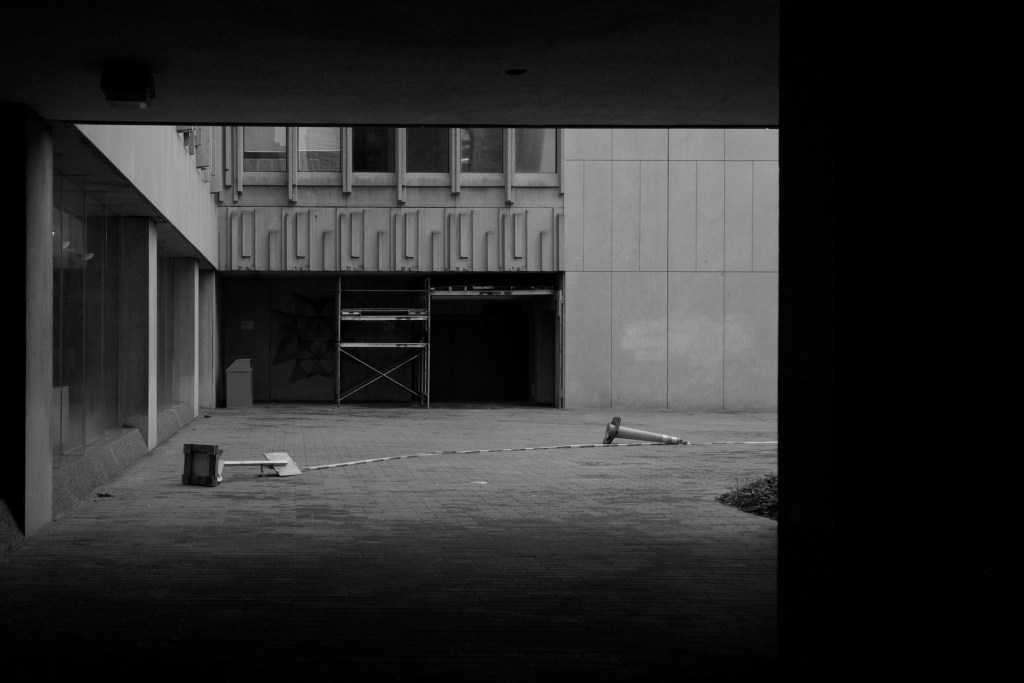
University of Toronto , Toronto, 2023
I made this image of an under-construction part of the University of Toronto in my last few weeks employed with the institution. It is, in many ways, a deeply personal photo that reflected my passage to a new space. The tape and barriers being knocked over was figurative, in the sense that what once was a warning to keep me away was now a path to follow out of frame, and into new experiences and adventures after working with the same employer for almost a decade.
January 2023: Street Photograph
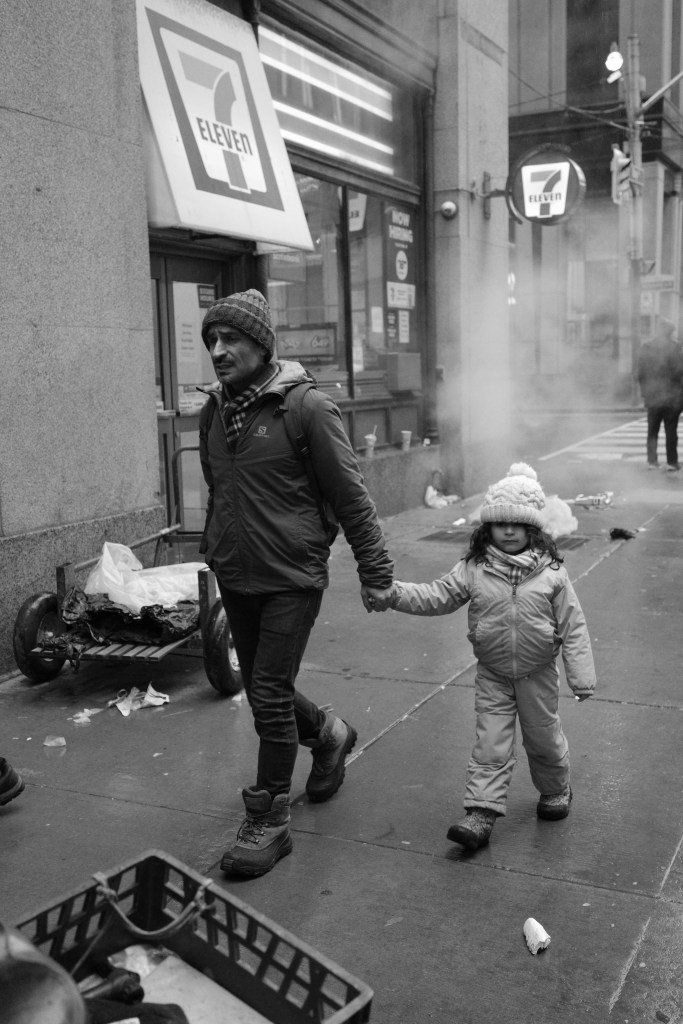
Richmond & Bay, Toronto, 2023
This photo was made January 1, 2023 and it remains one of my favourites. The emotion in the subjects’ face draws me in and the steam and garbage lends this part of the city (home to the country’s largest banks, stock exchange, and other financial and legal institutions) a kind of grittiness that belies its proximity to wealth and power. The photograph, also, speaks of how you can build a story in a frame that might look one way, but which doubles in meaning and context once grounded in the space and time wherein it was made.
I kept coming back to Bay and Richmond throughout the year and was regularly rewarded with rich images. The fluidity of the location, with updates to the built infrastructure in the form of temporary construction scaffolding, and the steam emerging from vents in this party of the city, just made it fun to keep coming back to.
Throughout 2023 I sorted the photographs I made with the intention of choosing one, from each month, to use in a limited run of postcards. All are street photos from around Toronto. I just ordered some proofs and I can’t wait to see them in the next few weeks ahead of doing a full print run!
There are lots of ‘best of’ lists that are going around. Instead of outlining the best things that I’ve purchased or used over the year I wanted to add a thematic: what was the best ‘photography stuff’ that I used, read, watched, or subscribed to over the course of 2023?
Photography Stuff I Used
Best Technology of 2023
90-95% of the photographs that I made over the year were with the Fuji X100F. It’s a spectacular camera system; I really like how small, light, and versatile it is. I created a set of recipes early summer and really think that I dialled in how to use them and, also, how to apply my very minimal editing process to the images. I’m at the point with this camera that I can use it without looking at a single dial, and I know the location of every setting in the camera that I regularly use.
I do most of my writing on my well-used iPad Pro 11” (2018). It’s a great device that is enough for 99% of my needs.1However, I have to admit that I’ve long missed owning an iPad Mini because they’re so small and light and portable. I do pretty well all of my reading on the iPad Mini these days. My partner purchased me one this year and I’ve fallen in love with it again. I’m using it everyday for an hour or more, and ultimately I now pull out the iPad Pro 11” just when I need to do longer-form writing.
Finally, though I haven’t had it all that long, I really do enjoy the Leica Q2. I’m still getting used to the 28mm focal length but deeply appreciate how I can now shoot in bad weather and low light.2 The in-camera stabilization is also letting me experiment with novel slow shutter speeds. I remain excited, however, for what it’ll be like to use the camera when I haven’t been in persistent cloud cover!
Best Services I Paid For
I have kept using Glass each and every day. Does it (still) have problems with its AI search? Yes. Does it have the best photographic community I’ve come across? Also yes. You should subscribe if you really love photography and want to contribute to a positive circle of practice. And if you’re watching a lot of photography-related materials on YouTube I cannot recommend a Premium subscription highly enough!
I also am deeply invested in Apple’s services and pay for Apple One. This gives me access to some things that I care about, including a large amount of cloud storage, News, customized email, Apple Music, and Apple TV. I find the current costs to be more than a little offensive–Apple’s decision to raise costs without increasing the benefits of the service was particularly shitty–but I’m deeply invested in Apple’s ecosystem–especially for storing my photographs!–and so will continue to pay Apple’s service tax.
Best Apps
I use lots of apps but the best ones I rely on for photography include:
Podcasts App to listen to the different podcasts to which I’ve subscribed.
Reeder for staying on top of the different blogs/websites I’m interested in reading.
Glass to look at, comment on, and reflect on photographers’ images.
Geotags Photos Pro and Geotags Photo Tagger. I’ve set the former app to record my geolocation every 5 minutes when I’m out making images and the latter to then apply geotags to the photographs I keep from an outing.3
Stuff I Read
Best Photography Books
Most of the non-fiction books that I read throughout the year were focused around photography. The two best books which continue to stand out are:
Bystander: A History of Street Photography. This book does an amazing job explaining how (and why) street photography has developed over the past 150 years. I cannot express what a terrific resource this is for someone who wants to understand what street photography can be and has been.
Daido Moriyama: A Retrospective. This book is important for all photographers who are interested in monochromatic images because it really explains why, and how, Moriyama made his classic images. It reveals why he made his gritty black and white images and, also, why some of the equivalent ‘recipes’ the mimic this kind of image-making may run counter to his whole philosophy of image making.
I watch a lot of photography YouTube. The channels I learn the most from include those run by James Popsys, Tatiana Hopper, EYExplore, Alan Schaller, Pauline B, aows, Aperture, and Framelines. My preference is for channels that either provide POV or discuss the rationales for why and how different images are being (or have been) made.4
Stuff I Subscribed To
Best Podcasts
I tend to listen to photography podcasts on the weekend when I go out for my weekly photowalks. The two that I listen to each and every week are The Photowalk and The Extra Mile. It’s gotten to the point that it almost feels like Neale James (the host of the podcasts) is walking along with me while I’m rambling around taking photos.
Aside from those, I’ll often listen to A Small Voice or The Candid Frame. These are interviews with photographers and I regularly learn something new or novel from each of the interviews.
Best Blogs/RSS Feeds
For the past year I’ve trimmed and managed the number of my RSS feeds. I keep loving the work by Craig Mod, Little Big Traveling Camera,5 and Adrianna Tan’. They all do just amazing photoessays and I learn a tremendous amount from each of them in their posts.
Biggest Disappointments
I somehow managed to break the hood that I’d had attached to my Fuji X100F in the fall and decided to get what seemed like a cool square hood to replace it. It was a really, really bad idea: the hood was a pain to screw on so that it wasn’t misaligned and, once it was aligned, was on so tight that it was very hard to remove. I would avoid this particular hood like the plague.
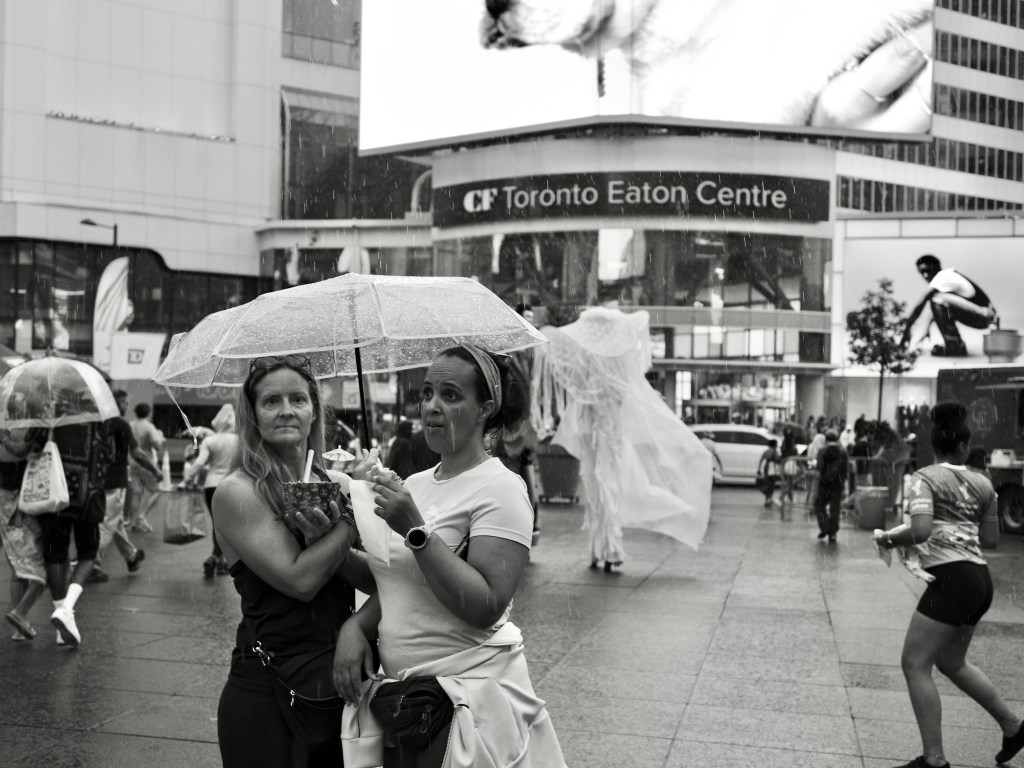
I also bought a Ricoh GR IIIx and while it’s a fantastic camera I just haven’t used it that much. I didn’t take as many images with it as I’d hoped when I was walking to or from work, and really ended up just using it when I needed to go out and take photos in the rain (I kept it safely hidden under my umbrella). Also, the camera periodically just fails to start up and requires me to pull the battery to reset it. Is it a bad camera? Nope, not at all, and I did manage to capture some images I was happy with enough to submit to Ricoh’s photography contest. But it’s not a camera that I’ve really fallen in love with.
Finally, while I use my AirPods Pro all the time I really don’t like them because I cannot get them to stay in my ears unless I purchase third-party foam tips. And I need to keep purchasing new sets of tips because they wear out after a couple of months. Are they good headphones once they stay in my ears? Yes. But the only way to accomplish that is becoming increasingly costly and that’s frustrating.
Conclusion
Anyhow, that’s my list of the ‘best photography-related stuff’ I’ve used in the course of 2023. What was your top stuff of the year?
I really do want to get a new iPad 11” and will do so once they update the screen. I edit pretty well all of my photos on the iPad Pro and an updated screen (and battery…) would be lovely. ↩︎
There is a caveat that I’ve found: the electronic shutter is absolute garbage for shooting at dusk/in the dark with LED lights. And I think the single-use exposure dial on the Fuji X100F is preferable to the configurable dial on the Q2. ↩︎
You can set the app to record your location more regularly but I’ve found this to be a good balance between getting geolocation information and preserving my phone’s battery life. ↩︎
If you watch a lot of YouTube then I recommend that you pay for a YouTube Premium subscription. You’ll cut out the frustrating advertising that otherwise intrudes into the videos. ↩︎
I think that this is perhaps the single best photography blog that I’ve found. I aspire to this level of excellence and regularity of updates! ↩︎
I’ve had the good fortune to get out and take photos pretty well every week of the summer. On the whole I’ve enjoyed decent light, good and interesting weather, and lots of events that opened up opportunities to capture the city in interesting ways.
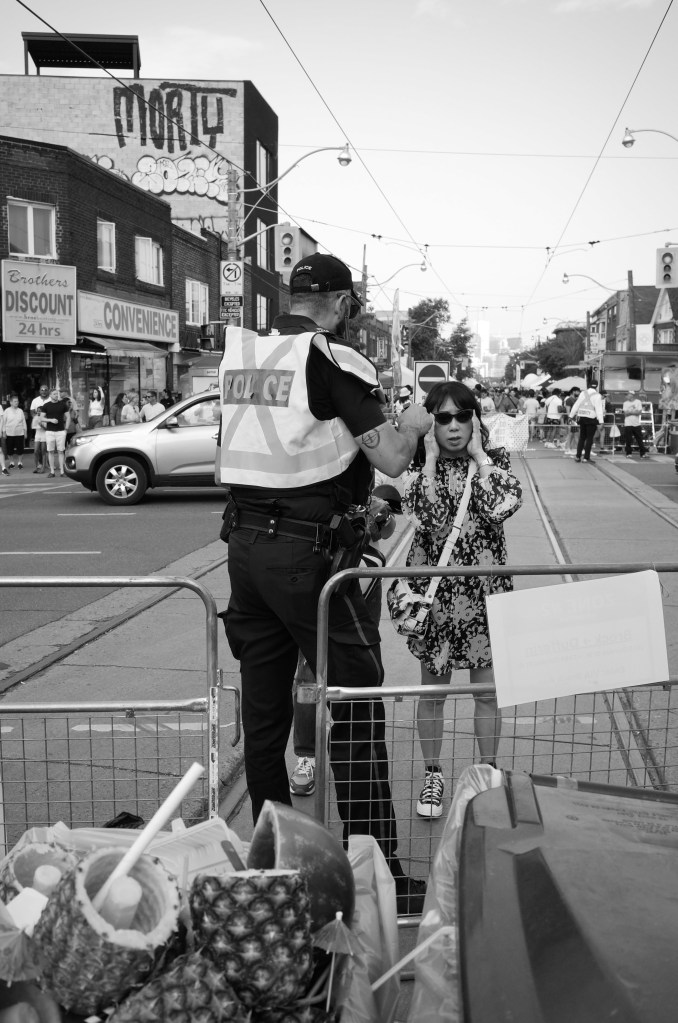
This was taken at one of the first festivals of the summer. I just walked back and forth through it over a couple of days and left with a number of images I liked, with this probably my favourite. Why?
First, I love the woman’s expression in her relationship to the officer, as well as with the pineapples: what exactly is the problem? Why is she so shocked? What has the officer said, if anything?
Second, I liked the background — it showcases this part of Toronto. It’s not filled with the new shiny glass buildings and condos, and still has some of the older shops and signs. This location gives a sense of ‘where’ this image was taken.
Third, I just like having images with pineapples in them. I don’t know why but I can tell it’s a motif in studying the images that I’ve taken over the years.
Queens Quay & Spadina, Toronto, 2023
This image was taken on Toronto’s waterfront. It just captures all the things that summer can be in Toronto: ferries coming from the Toronto islands, some people relaxing along the water, seagulls (which are everywhere along the waterfront in the summer), travellers landing at the island airport, and just a sense of activity and calm.
York & Wellington, Toronto, 2023
Taken from the financial district of downtown Toronto, I really liked how the light was falling on the scene and the way that the male subject is relaxing against the bulls. It almost feels pastoral to me, which isn’t the typical experience I get when walking around (or living in) the downtown core.
Queen & Bay, Toronto, 2023
I’m a sucker for taking photos of ice cream trucks and I really liked how this guy was looking out of the truck while a pigeon was just wandering by in the lower left of the frame. Is this the most complex image I took in the summer? Nope. But I still liked the environmental portrait that was captured.
Spadina & St Andrew, Toronto, 2023
Taken along one of my regular patrol routes, there’s a lot that I like throughout this frame.
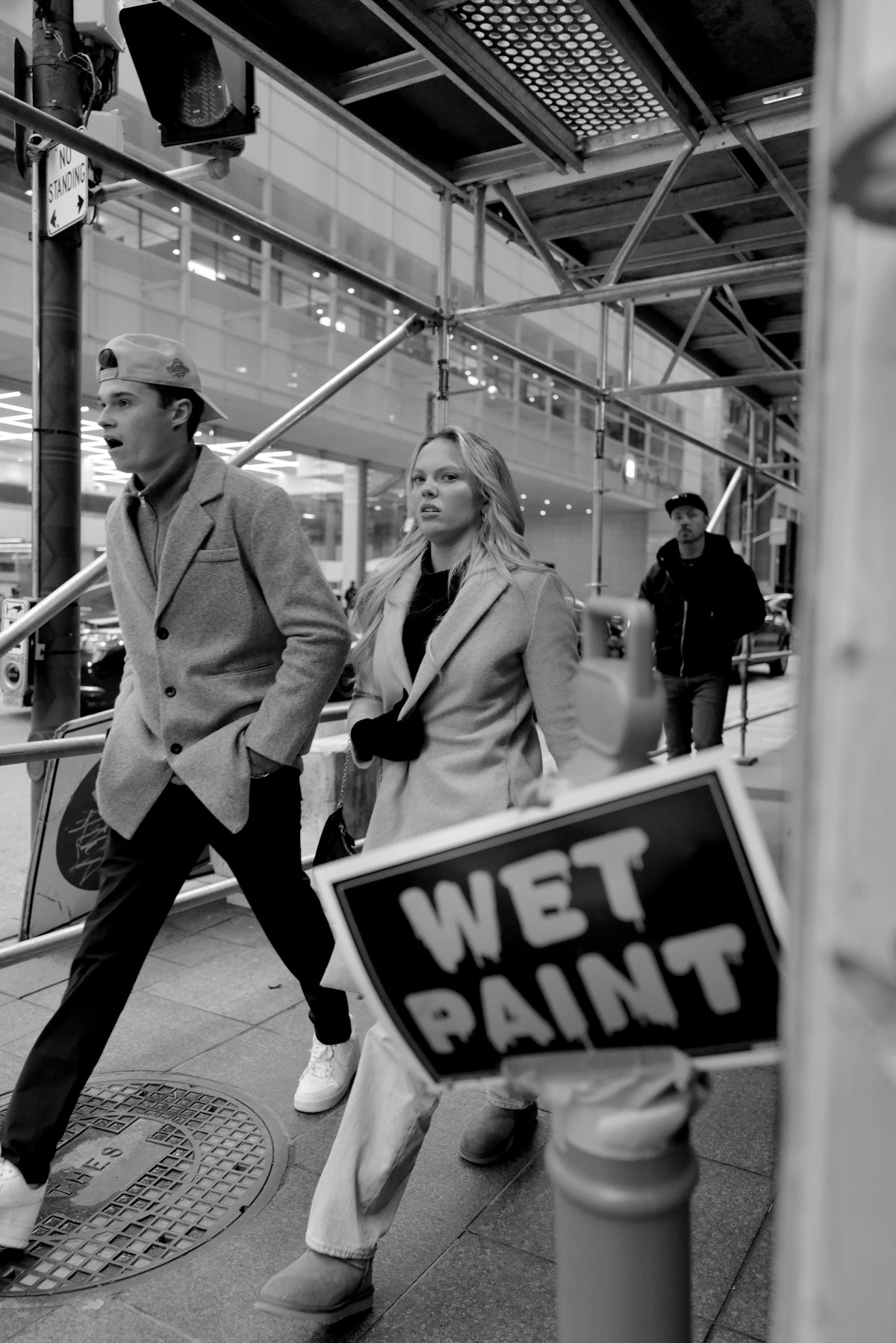
It has a lot of construction elements — something I’ve been deliberately including in my street photos as part of a long-term project — and there’s some sub-framing that comes out because of how the shadows lay against the wall. The subjects to the far right of the frame are somewhat interesting — what are they pointing at? And does it intersect with the ‘caution’ warning? — but their shadows are where they shine. The shadows seem like they’re up to…something…while at the same time there is a subject that is reminiscent of the Invisible Man wandering along the left side of the frame. In aggregate, this scene has a degree of dimensionality that I really liked, some subjects of interest, and fit within an ongoing project.
Queens Quay & Bay, Toronto, 2023
I’m always a sucker for isolated subjects in the city who are in interesting situations, or have interesting expressions or body language. This photograph captures this for me.
I like that the main subject seems somewhat desolate, and yet is sitting alongside a series of summer treats and toys. And the fact that this is a vendor who only takes cash? I wonder when such signs are going to be real indicators of a distant past. The other piece that I like is how the top, right, and left of the frame are all food-related: the subject is selling popcorn and candies, hotdogs are being sold along the left of the frame, and the top of the frame can refer to top-end gourmet restaurants. So there’s multiples ‘frames’ to the subject which, again, adds a degree of structure or complexity into the composition.
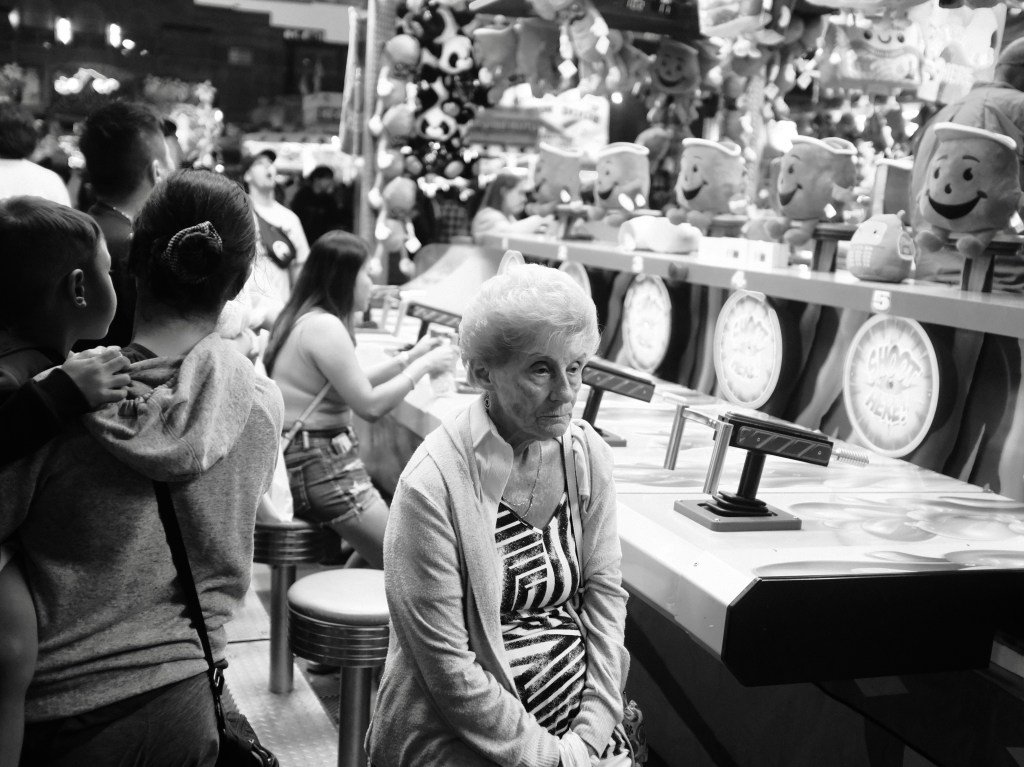
Canadian National Exhibition, Toronto, 2023
This was taken during the waning days of the CNE, which is a massive festival that takes place annually in Toronto. People are typically excited and happy, but our older subject, here, seems sad, quiet, or in deep contemplation.
Having her placed against games and the Kool-Aid Man on one side, and the child and mother on the other, really underscores her emotional state in what is typically a festive situation. I also like the depth of the photo that indicates where the women is in Toronto. This leaves the viewer with a deeper sense of context, which helps to amplify the woman’s facial expression and body language.
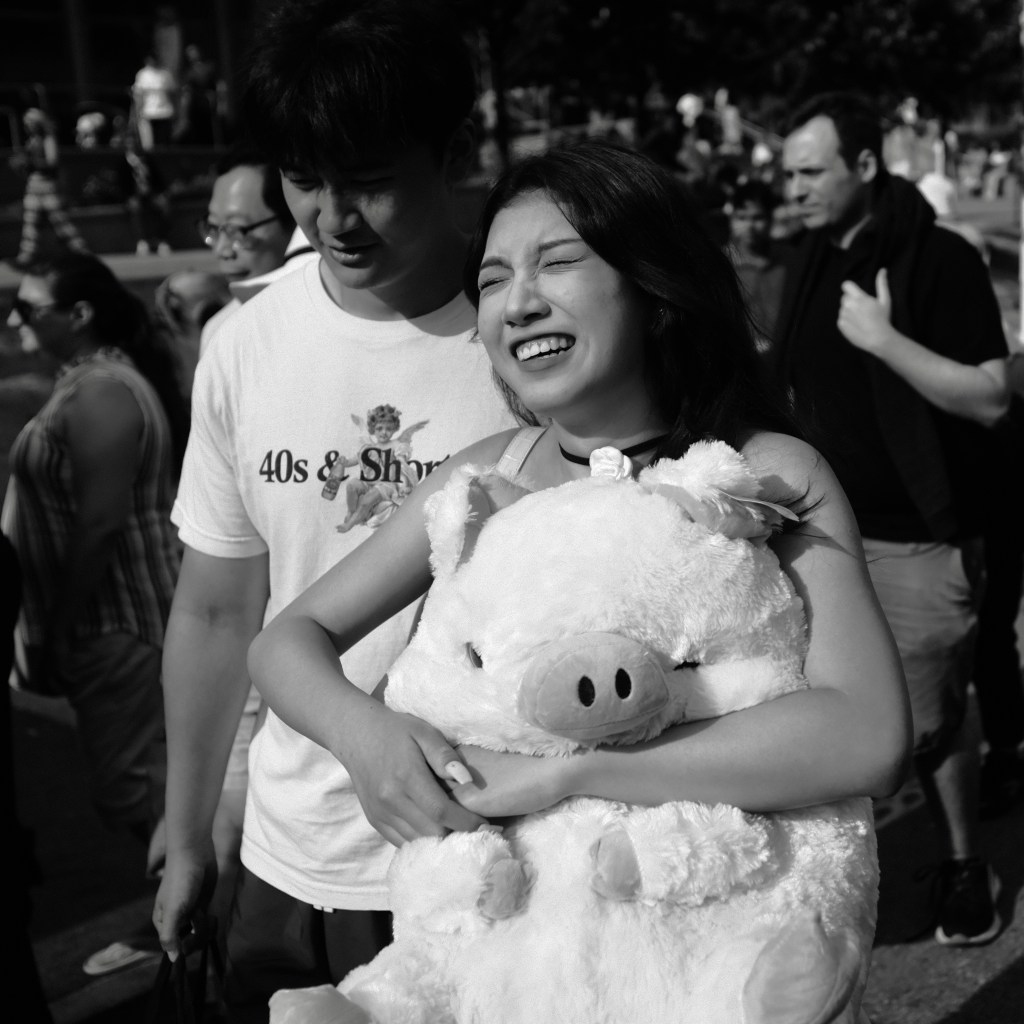
Canadian National Exhibition, Toronto, 2023
The final photo of the summer is another from the CNE. The subjects in this one exemplify what is ‘normal’ in the summer — happiness, togetherness, and fun. The subjects’ expressions and open and apparent and I love how large the stuffed pig is in context to the woman — what will she do with it once she gets it home?
While it’s not the most complicated of photos I took over the summer it expresses a sense of unadulterated happiness or joy that regularly brings a smile to my face.
For the past several months Neale James has talked about how new laws which prevent taking pictures of people on the street will inhibit the documenting of history in certain jurisdictions. I’ve been mulling this over while trying to determine what I really think about this line of assessment and photographic concern. As a street photographer it seems like an issue where I’ve got some skin in the game!
In short, while I’m sympathetic with this line of argumentation I’m not certain that I agree. So I wrote a longish email to Neale—which was included in this week’s Photowalk podcast—and I’ve largely reproduced the email below as a blog post.
I should probably start by stating my priors:
As a street photographer I pretty well always try to include people in my images, and typically aim to get at least some nose and chin. No shade to people who take images of peoples’ backs (and I selectively do this too) but I think that capturing some of the face’s profile can really bring many street photos to life.1
I, also, am usually pretty obvious when I’m taking photos. I find a scene and often will ‘set up’ and wait for folks to move through it. And when people tell me they aren’t pleased or want a photo deleted (not common but it happens sometimes) I’m usually happy to do so. I shoot between 28-50mm (equiv.) focal lengths and so it’s always pretty obvious when I’m taking photos, which isn’t the case with some street photographers who are shooting at 100mm . To each their own but I think if I’m taking a photo the subjects should be able to identify that’s happening and take issue with it, directly, if they so choose to.
Anyhow, with that out of the way:
If you think of street photography in the broader history of photography, it started with a lot of images with hazy or ghostly individuals (e.g. ‘Panorama of Saint Lucia, Naples’ by Jones or ’Physic Street, Canton’ by Thomson or ‘Rue de Hautefeuille’ by Marville). Even some of the great work—such as by Cartier-Bresson, Levitt, Bucquet, van Schaick, Atget, Friedlander, Robert French, etc—include photographs where the subjects are not clearly identified. Now, of course, some of their photographs include obvious subjects, but I think that it’s worth recognizing that many of the historical ‘greats’ include images where you can’t really identify the subject. And… that was just fine. Then, it was mostly a limitation of the kit whereas now, in some places, we’re dealing with the limitations of the law.
Indeed, I wonder if we can’t consider the legal requirement that individuals’ identifiable images not be captured as potentially a real forcing point for creativity that might inspire additional geographically distinctive street photography traditions: think about whether, in some jurisdictions, instead of aperture priority being a preferred setting, that shutter priority is a default, with speeds of 5-15 second shutters to get ghostly images.2
Now, if such a geographical tradition arises, will that mean we get all the details of the clothing and such that people are wearing, today? Well…no. Unless, of course, street photographers embrace creativity and develop photo essays that incorporate this in interesting or novel ways. But street photography can include a lot more than just the people, and the history of street photography and the photos we often praise as masterpieces showcase that blurred subjects can generate interesting and exciting and historically-significant images.
One thing that might be worth thinking about is what this will mean for how geographical spaces are created by generative AI in the future. Specifically:
These AI systems will often default to norms based on the weighting of what has been collected in training data. Will they ‘learn’ that some parts of the world are more or less devoid of people based on street photos and so, when generating images of certain jurisdictions, create imagery that is similarly devoid of people? Or, instead, will we see generative imagery that includes people whereas real photos will have to blur or obfuscate them?
Will we see some photographers, at least, take up a blending of the real and the generative, where they capture streets but then use programs to add people into those streetscapes based on other information they collect (e.g., local fashions etc)? Basically, will we see some street photographers adopt a hybrid real/generative image-making process in an effort to comply with law while still adhering to some of the Western norms around street photography?
As a final point, while I identify as a street photographer and avoid taking images of people in distress, the nature of AI regulation and law means that there are indeed some good reasons for people to be concerned about the taking of street photos. The laws frustrating some street photographers are born from arguably real concerns or issues.
For example, companies such as Cleaview AI (in Canada) engaged in the collection of images and, subsequently, generated biometric profiles of people based on scraping publicly available images.
Most people don’t really know how to prevent such companies from being developed or selling their products but do know that if they stop the creation of training data—photographs—then they’re at least less likely to be captured in a compromising or unfortunate situation.
It’s not the photographers, then, that are necessarily ‘bad’ but the companies who illegally exploit our work to our detriment, as well as to the detriment of the public writ large.
All to say: as street photographers, and photographers more generally, we should think broader than our own interests to appreciate why individuals may not want their images taken in light of technical developments that are all around us. And importantly, the difference is that as photographers we do often share our work whereas CCTV cameras and such do not, with the effect that the images we take can end up in generative AI, and non-generative AI training data systems, whereas the cameras that are monitoring all of us always are (currently…) less likely to be feeding the biometric surveillance training data beast.
While, at the same time, recognizing that sometimes a photo is preferred because people are walking away from the camera/towards something else in the scene. ↩︎
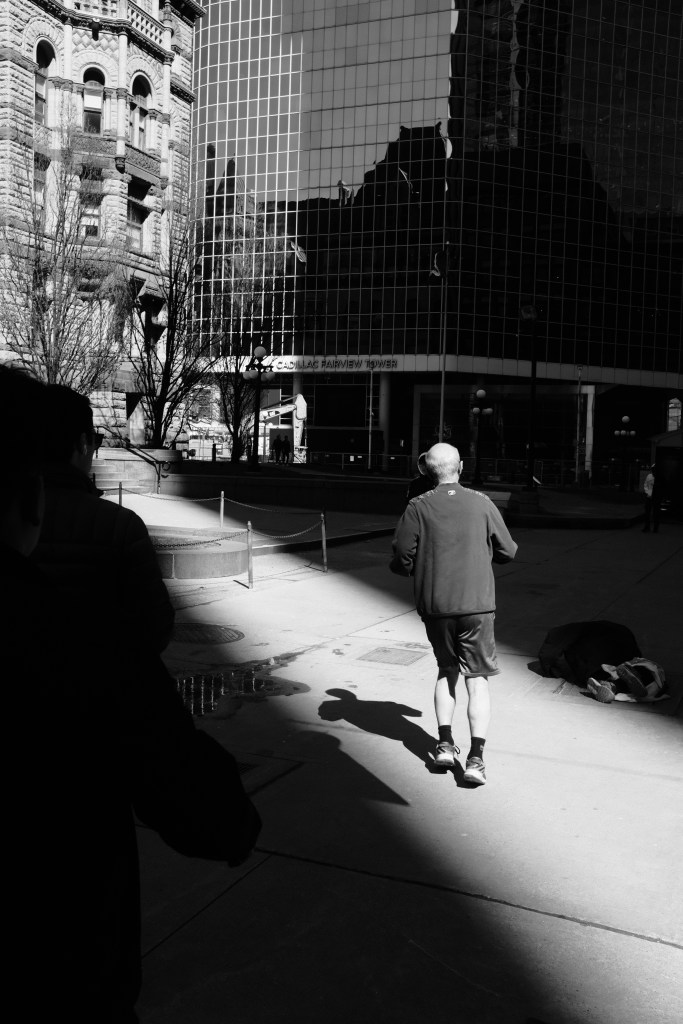
I made this image while out on my weekend photowalk. I’ve passed this same location hundreds of time since I’ve lived in Toronto. In what might become a semi-regular type of post, I wanted to write a bit about the backstory of the image. It was originally posted to Glass.
I was drawn to this scene, first, just because of how the light managed to slice through the shadows which were cast by the surrounding skyscrapers. After dialling the exposure to -1.3 I waited for some interesting characters to pass through the light.
It was only after taking a couple images that I really noticed how the unhoused person’s feet and legs were apparent. They were on grates that pass steam in the colder times of the year. Some of the unhoused use these grates to stay warm during the winter.
Still, the city—and especially the city core—does have a serious and growing housing issue. And so I ultimately decided to compose the scene with the hopes that it would show people noticing, but passing by, the individual on the street, as a kind of broader commentary of the social housing issues that exist in Toronto.
Compositionally the image is simple: a pair of men looking in the direction of the source of the light, and not towards the half shrouded person on the sidewalk, and moving towards the light. Behind them the aperture of the light beam starts to close, but the reader of the photograph can see the sparkle of youth (the new, glass, building) as juxtaposed agains the old (Toronto’s historical city hall). The young reflects the old, reminding us that youth is impermanent. As I said: it’s not a deep photograph nor are any particularly special tricks used to make it.
I often linger when I find light that I like for at least a couple minutes, to see if more interesting (or any interesting!) subjects come to fill the scene. Other times I’ll recompose and work the scene a little bit. But I have to admit that staying put is something that I need to get better with: it’s not enough to just linger for 5-10 minutes!
The above set of images aren’t touched up and are a few of the ‘raw’ versions of images I took and normally wouldn’t post (I took a total of about 20 frames before I settled on the one at the top of the post). I, personally, learn a lot from the older Magnum photos that include contact sheets.
While my rougher images aren’t the same, nor as descriptive, as contact sheets maybe they’ll be helpful to someone else when they are thinking of weighing a scene. Or maybe just to make clear that the admittedly very amateur images I make involve a lot more than just one lucky capture (with a handful of exceptions of course).
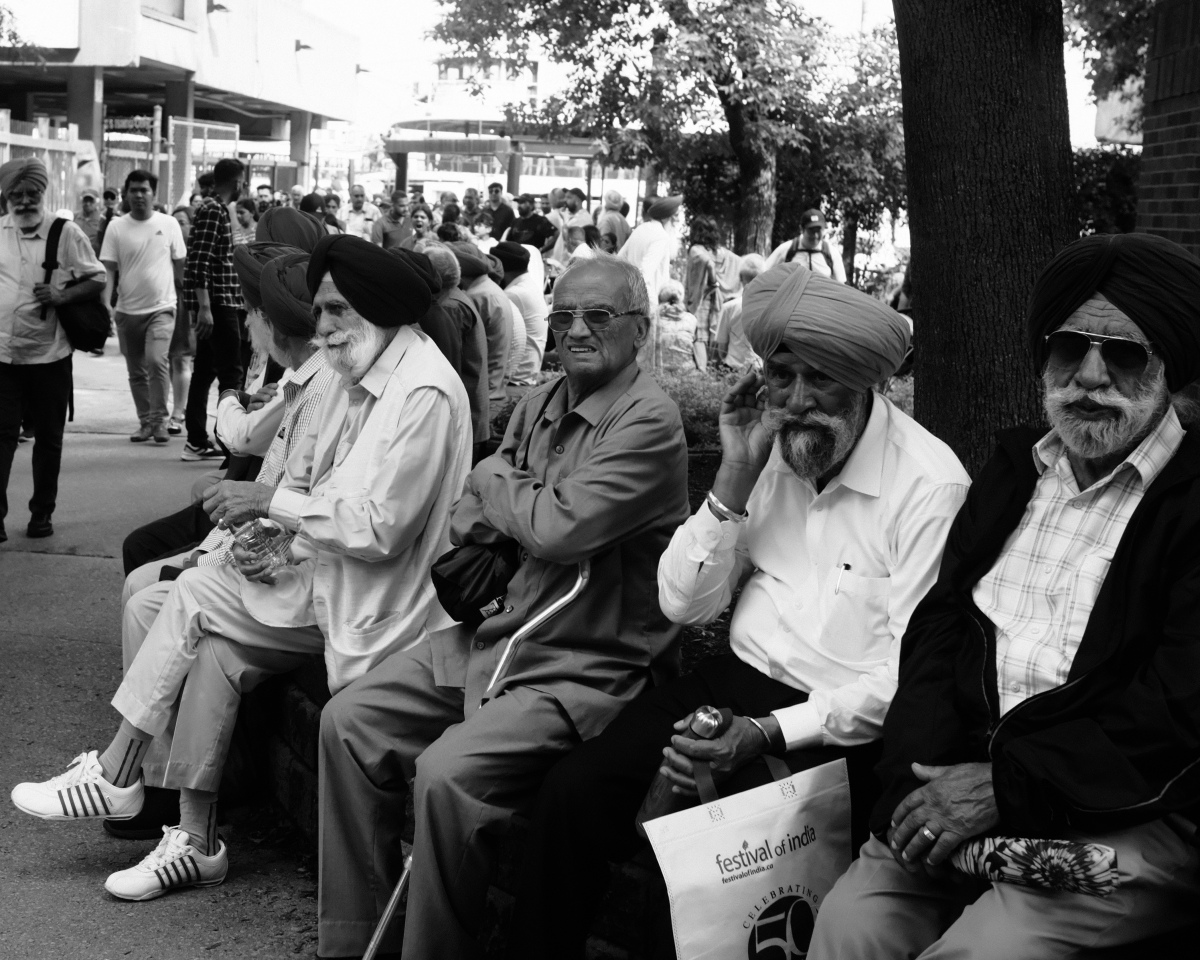
Black Tap Magazine has a helpful article that distinguishes between photojournalism, documentary photography, and street photography. I found it particularly helpful to see the author grapple with the differences (and commonalities) between documentary and street photography, with the former focusing more on projects and potentially posed/non-urban photography, and the latter being cast as more spontaneous and less project-driven. While I think good street photography should be emotive and tell a story over time, I appreciate that the core assertion is that documentary photography must tell (or try to tell) some story, often as a photo set, whereas street photography is not similarly bound by these conditions.










 Excited Pixels