Categories
Links

US Government’s Harassment Made Visible

When your government behaves in such a way that innocent citizens are forced to act as a spies to keep safe, then it’s evident that something has gone terribly awry. Laura Poitras, an American citizen and journalist, now lives like a spy: under the constant pressure of potential government harassment and surveillance of herself, her sources, and anyone that is particularly close to her.

Her crime? Being an award winning filmmaker who has produced films addressing the negative impacts of American imperialism abroad.

Glenn Greenwald has a terrific piece that unpacks what it means to be a prominent journalist, activist, or simple government contrarian who is willing to take entirely legal actions against the American state. Actions like speaking up or otherwise exercising basic civil rights. I won’t lie: it’s a long piece, probably not something you can skim in 2-3 minutes. But if you only read one thing that holds your attention for 10-15 minutes today, go read Glenn’s piece. It’s eye opening.

As a teaser:

In many instances, DHS agents also detain and interrogate her in the foreign airport before her return, on one trip telling her that she would be barred from boarding her flight back home, only to let her board at the last minute. When she arrived at JFK Airport on Thanksgiving weekend of 2010, she was told by one DHS agent — after she asserted her privileges as a journalist to refuse to answer questions about the individuals with whom she met on her trip — that he “finds it very suspicious that you’re not willing to help your country by answering our questions.” They sometimes keep her detained for three to four hours (all while telling her that she will be released more quickly if she answers all their questions and consents to full searches).

Poitras is now forced to take extreme steps — ones that hamper her ability to do her work — to ensure that she can engage in her journalism and produce her films without the U.S. Government intruding into everything she is doing. She now avoids traveling with any electronic devices. She uses alternative methods to deliver the most sensitive parts of her work — raw film and interview notes — to secure locations. She spends substantial time and resources protecting her computers with encryption and password defenses. Especially when she is in the U.S., she avoids talking on the phone about her work, particularly to sources. And she simply will not edit her films at her home out of fear — obviously well-grounded — that government agents will attempt to search and seize the raw footage.


(Read More)


Categories
Links

US Looking to Expand CALEA?

From the New York Time we find that American officials are campaigning for updates to CALEA, a surveillance bill that was passed in 1994. The officials claim updates are needed because

some telecommunications companies in recent years have begun new services and made system upgrades that caused technical problems for surveillance.

Albert Gidari Jr., a lawyer who represents telecommunications firms, said corporations were likely to object to increased government intervention in the design or launch of services. Such a change, he said, could have major repercussions for industry innovation, costs and competitiveness.

“The government’s answer is ‘don’t deploy the new services — wait until the government catches up,’ ” Mr. Gidari said. “But that’s not how it works. Too many services develop too quickly, and there are just too many players in this now.”

In essence, it appears that the US government is advocating for updates to their laws that are similar to provisions in Canada’s lawful access legislation. The tabled Canadian legislation includes provisions that preclude interception capabilities from degrading over time (Section 8), mandate that interception capabilities continue to meet government requirements as telecommunications services providers upgrade their services (Section 9), and require new software and product offerings to be compliant with interception demands (Section 11). It would seem that, without these provisos, CALEA is showing its age: ISPs are deploying services that ‘break’ existing wiretap capabilities and that it takes some time to restore those capabilities. ISPs innovate, and then surveillance catches up.

Of course, it’s useful to remember that none of the details surrounding the FBI’s problems in maintaining wiretaps is really made clear in the article. The sources that the reporter draws upon are primarily from law enforcement agencies and, as we have seen in Canada and in prior US legislative gambits, such agencies are prone to overstating problems and understating their complicity in generating/maintaining them. It’s also unclear just how ‘impaired’ investigations actually were. In essence, a full accounting of the alleged problems is needed, and the accounting ought to be public. If the American public is going to shell out more money for surveillance, and potentially endanger next-generation telecommunications services’ innovative potentials, then the government has to come totally clean about their allegations so that a rational and empirically-grounded debate can occur.

Categories
Links Writing

Surprise: American Equipment Spies on Iranians

Steve Stecklow, for Reuters, has an special report discussing how Chinese vendor ZTE was able to resell American network infrastructure and surveillance products to the Iranian government. The equipment sold is significant;

Mahmoud Tadjallimehr, a former telecommunications project manager in Iran who has worked for major European and Chinese equipment makers, said the ZTE system supplied to TCI was “country-wide” and was “far more capable of monitoring citizens than I have ever seen in other equipment” sold by other companies to Iran. He said its capabilities included being able “to locate users, intercept their voice, text messaging … emails, chat conversations or web access.”

The ZTE-TCI documents also disclose a backdoor way Iran apparently obtains U.S. technology despite a longtime American ban on non-humanitarian sales to Iran – by purchasing them through a Chinese company.

ZTE’s 907-page “Packing List,” dated July 24, 2011, includes hardware and software products from some of America’s best-known tech companies, including Microsoft Corp, Hewlett-Packard Co, Oracle Corp, Cisco Systems Inc, Dell Inc, Juniper Networks Inc and Symantec Corp.

ZTE has partnerships with some of the U.S. firms. In interviews, all of the companies said they had no knowledge of the TCI deal. Several – including HP, Dell, Cisco and Juniper – said in statements they were launching internal investigations after learning about the contract from Reuters.

The sale of Western networking and surveillance equipment/software to the Iranian government isn’t new. In the past, corporate agents for major networking firms explained to me the means by which Iran is successfully importing the equipment; while firms cannot positively know that this is going on, it’s typically because of an intentional willingness to ignore what they strongly suspect is happening. Regardless, the actual sale of this specific equipment – while significant – isn’t the story that Western citizens can do a lot to change at this point.

Really, we should be asking: do we, as citizens of Western nations, believe that manufacturing of these kinds of equipment is permissible? While some degree of surveillance capacity is arguably needed for lawful purposes within a democracy it is theoretically possible to design devices such that they have limited intercept and analysis capability out of the box. In essence, we could demand that certain degrees of friction are baked into the surveillance equipment that is developed, and actively work to prevent companies from producing highly scaleable and multifunctional surveillance equipment and software. Going forward, this could prevent the next sale of significant surveillance equipment to Iran on grounds that the West simply doesn’t have any for (legal) sale.

In the case of government surveillance inefficiency and lack of scaleability are advantageous insofar as they hinder governmental surveillance capabilities. Limited equipment would add time and resources to surveillance-driven operations, and thus demand a greater general intent to conduct surveillance than when authorities have access to easy-to-use, advanced and scalable, surveillance systems.

Legal frameworks are insufficient to protect citizens’ rights and privacy, as has been demonstrated time and time again by governmental extensions or exploitations of legal frameworks. We need a normatively informed limitation of surveillance equipment that is included in the equipment at the vendor-level. Anything less will only legitimize, rather than truly work towards stopping, the spread of surveillance equipment that is used to monitor citizens across the globe.

Categories
Quotations

The great evil that we as Americans face is the banal evil of second-rate minds who can’t make it in the private sector and who therefore turn to the massive wealth directed by our government as the means to securing wealth for themselves. The enemy is not evil. The enemy is well dressed.

Lawrence Lessig from Republic, Lost: How Money Corrupts Congress – and a Plan to Stop It
Categories
Quotations

… an institution can be corrupted in the same way Yeltsin was when individuals within that institution become dependent upon an influence that distracts them from the intended purpose of the institution. The distracting dependency corrupts the institution.

Larry Lessig from Republic, Lost: How Money Corrupts Congress – and a Plan to Stop It
Categories
Aside Humour

Your Friendly Neighbourhood Wiretap Man

If C-30 passes, Canadians too will get to enjoy their own free lifetime supply of surveillance.

Categories
Aside Humour

My First Cavity Search

Categories
Aside

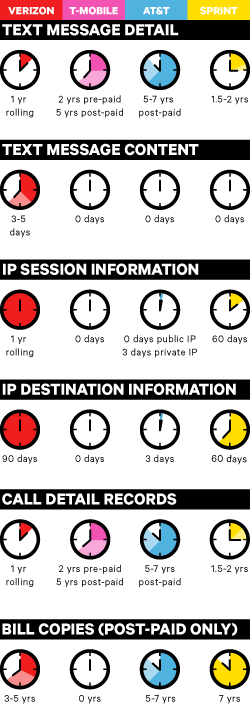
How long American telcos hold onto customer data

Categories
Links

American Link To Greek Surveillance Debacle?

In 2004 it was discovered that parties unknown had been secretly monitoring a hundred of Greece’s top politicians and bureaucrats. An article from 2011 reveals that,

According to what sources told Kathimerini, the experts found that a mobile phone connection that had been purchased in the name of the US Embassy in Athens was used on one of these phones. Sources said that Dasoulas is now investigating whether any suspects who are not protected by diplomatic immunity could face charges.

Ericsson, which supplied the telephone exchange that was hacked into, and Vodafone, which was the service provider, were both fined by ADAE in 2007 for failing to protect the privacy of those who had their phones hacked, which included the head of the National Intelligence Service (EYP), several ministers and members of the armed forces, but the Council of State later cancelled these penalties.

The followup, of whether the Americans were actually involved, is ongoing as far as I can tell. Regardless of the culprits it’s instructive that even the head of the intelligence service was successfully targeted. We need to be mindful of how surveillance technologies are deployed in our communications networks, not just because we worry about how our own government might use the technologies, but also because of how other third-parties might use the technologies against the citizenry.

Categories
Links Writing

FYI: Governments Spy On Citizens. A Lot.

You often hear that if you’ve nothing to hide then government surveillance isn’t really something you should fear. It’s only the bad people that are targeted! Well….sorta. It is the case that (sometimes) ‘bad people’ are targeted. It’s also (often) the case that the definition of ‘bad people’ extends to ‘individuals exercising basic rights and freedoms.’ This is the lesson that a woman in the US learned: the FBI had secretly generated a 436 page report about her on the grounds that she and friends were organizing a local protest.

What’s more significant is the rampant inaccuracies in the report. The woman herself notes that,

I am repeatedly identified as a member of a different, more mainstream liberal activist group which I was not only not a part of, but actually fought with on countless occasions. To somehow not know that I detested this group of people was a colossal failure of intelligence-gathering. Hopefully the FBI has not gotten any better at figuring out who is a part of what, and that this has worked to the detriment of their surveillance of other activists. I am also repeatedly identified as being a part of campaigns that I was never involved with, or didn’t even know about, including protests in other cities. Maybe the FBI assumes every protester-type attends all other activist meetings and protests, like we’re just one big faceless monolith. “Oh, hey, you’re into this topic? Well, then, you’re probably into this topic, right? You’re all pinkos to us.”

In taking a general survey of all area activists, the files keep trying to draw non-existant connections between the most mainstream groups/people and the most radical, as though one was a front for the other. There are a few flyers from local events that have nothing to do with our campaign, including one posted to advertise a lefty discussion group at the university library. The FBI mentions that activists may be planning “direct action” at their meetings, which the document’s author clarifies means “illegal acts.” “Direct action” was then, and I’d say now, a term used to talk about civil disobedience and intentional arrests. While such things are illegal actions, the tone and context in these FBI files makes it sound like protesters got together and planned how to fly airplanes into buildings or something.

You see, it isn’t just the government surveillance that is itself pernicious. It’s the inaccuracies, mistaken profilings, and generalized suspicion cast upon citizens that can cause significant harms. It is the potential for these profiles to be developed and then sit indefinitely in government databases, just waiting to be used against law abiding ‘good’ citizens, that should give all citizens pause before they grant authorities more expansive surveillance powers.