Categories
Links Writing

DHS, Drones, and Domestic Surveillance

In the name of efficiency and good long-term planning, DHS is ensuring that its Predator Drones over the USA are able to distinguish persons from animals, evaluate whether such persons are armed, and are also integrating signals intelligence systems into the vehicles. From the article:

Homeland Security’s specifications for its drones, built by San Diego-based General Atomics Aeronautical Systems, say they “shall be capable of identifying a standing human being at night as likely armed or not,” meaning carrying a shotgun or rifle. They also specify “signals interception” technology that can capture communications in the frequency ranges used by mobile phones, and “direction finding” technology that can identify the locations of mobile devices or two-way radios.

The analysis and interdiction capabilities being integrated into drones may – prospectively – be considered legal. If they are legal then it should be clear that ethical and normative (to say nothing of constitutional) claims should be brought to bear on the basis that such expansions of government surveillance are almost certain to be used inappropriately and to the disadvantage of American citizens and residents alike.

Categories
Links Quotations

When the Whole World Has Drones

The proliferation of drone technology has moved well beyond the control of the United States government and its closest allies. The aircraft are too easy to obtain, with barriers to entry on the production side crumbling too quickly to place limits on the spread of a technology that promises to transform warfare on a global scale. Already, more than 75 countries have remote piloted aircraft. More than 50 nations are building a total of nearly a thousand types. At its last display at a trade show in Beijing, China showed off 25 different unmanned aerial vehicles. Not toys or models, but real flying machines.

When the Whole World Has Drones
Categories
Aside Quotations

Government photograph databases form the basis of any police facial recognition system. They’re not very good today, but they’ll only get better. But the government no longer needs to collect photographs. Experiments demonstrate that the Facebook database of tagged photographs is surprisingly effective at identifying people. As more places follow Disney’s lead in fingerprinting people at its theme parks, the government will be able to use that to identify people as well.

In a few years, the whole notion of a government-issued ID will seem quaint. Among facial recognition, the unique signature from your smart phone, the RFID chips in your clothing and other items you own, and whatever new technologies that will broadcast your identity, no one will have to ask to see ID. When you walk into a store, they’ll already know who you are. When you interact with a policeman, she’ll already have your personal information displayed on her Internet-enabled glasses.

Soon, governments won’t have to bother collecting personal data. We’re willingly giving it to a vast network of for-profit data collectors, and they’re more than happy to pass it on to the government without our knowledge or consent.

Bruce Schneider, “The Public/Private Surveillance Partnership

It’s the ability for government to prospectively combine public and private data that makes American laws such as CISPA, which would permit the disclosure of private information to public bodies without absent warrant requirements, so significant. Privacy legislation serves as a necessary friction to delay, limit, and prevent governments from accessing citizens’ and resident aliens’ personal information unless such access is absolutely necessary: we need to strengthen such laws to preserve basic democratic freedoms, not weaken or erode them.

Categories
Quotations

2013.5.21

In 2010 and 2011, many discounted and differentiated Julian Assange from mainstream journalists by comparing him to a spy or foreign agent, despite the fact that he was just doing what every major US journalism organization does: publishing leaked classified information in the public interest.

Well, the government alleges in Rosen’s case that he acted “much like an intelligence officer would run a clandestine intelligence source” and communicated his “clandestine communications plan.” This is reminiscent of a disturbing House Judiciary hearing last year where the committee’s lead witness compared the New York Times’ David Sanger to a spy, saying he “systematically penetrating the Obama White House as effectively as any foreign agent.”

By that language, the government is arguing journalism is now akin to spying, no matter if its WikiLeaks or the mainstream press.

Trevor Timm, “Virtually Everything the Government Did to WikiLeaks is Now Being Done to Mainstream US Reporters
Categories
Links

Arizona Man Winds Up Jailed, Unemployed and Homeless After Photographing Courthouse

nyxxisnite:

Raymond Michael Rodden was bored this week, so he drove to downtown Phoenix and began walking around, snapping photos of the federal courthouse and the state capitol with his iPhone.

The 33-year-old man ended up jailed, unemployed and homeless; his iPhone, iPad and Macintosh laptop confiscated as “evidence.”

All because they found it odd he was taking photos at 3 a.m.

“They told me they’re going to keep my computer because they want to see my search history,” he said Saturday evening in a telephone interview with Photography is Not a Crime.

“They wanted to know if I belonged to any extremist groups like the national socialist movement or sovereign citizens. They wanted to know what kind of books I checked out of the library.”

However, the only charges pending against him, if you even want to call them charges, are citations that he walked into an alley – a bogus charge that applies only to motorized vehicles –  and that he neglected to change the address on his driver license after moving to Phoenix from Tucson last August.

They couldn’t even keep him jailed on the initial charge of an outdated warrant out of California because the San Obispo County Sheriff’s Office did not want to bother extraditing him from Phoenix.

“The warrant was not even valid in Arizona,” adding that it was over a probation violation for unlawful use of a vehicle, stemming from a 2001 incident in which he took his roommate’s car without permission after a heated argument.

That old roommate is still one of his best friends, allowing him to stay in his Tucson home after he was kicked out of the Phoenix home that was part of his employment.

“I was living in my boss’s house taking care of his son,” he said. “Now he thinks I’m some crazy person.”

The fact that the Phoenix police bomb squad tore his boss’s car apart searching for explosives before impounding it most likely convinced him that Rodden was not the most suitable person to care for his six-year-old son as he worked as a long-distance truck driver.

“The most radical thing I do is read Photography is Not a Crime and Cop Block,” he said.

So like most people who read those sites, he knows his rights when it comes to dealing with police.

And that is exactly why he is going through this ordeal.

It started Thursday at 3 a.m. when he was sitting at home, unable to sleep. He decided to drive to downtown in his boss’s car, which he had permission to do.

He parked the car in front of the Phoenix Police Department and began walking around downtown, which is a ghost town at that time.
This is particularly insane.

Categories
Aside Humour

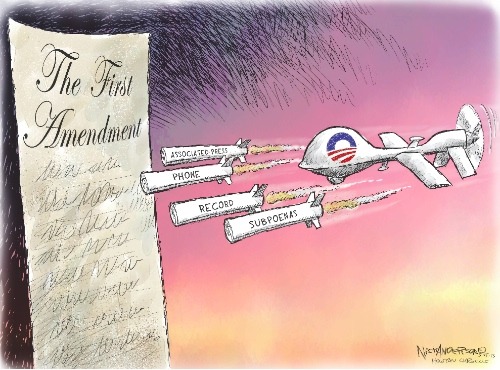
Droney and the Constitution

azspot:

Nick Anderson: Missile Launches

Droney’s coming to help Americans understand their rights. Aggressively.

Categories
Links

The secret laser-toting Soviet satellite that almost was

Via Ars Technica:

A super interesting story about the politics and the (minor, but very significant) technical failure that doomed the Soviet Union’s attempt to put anti-Satellite lasers in space.

Categories
Aside Humour

Why Do You Hate US?

randomactsofchaos:

Clay Bennett/Chattanooga Times Free Press (04/25/2013)

A particularly good – if depressing – political cartoon.

Categories
Quotations

2013.4.5

Much of the information collected by CIFA [Counterintelligence Field Activity] was amassed in a database called Talon, which stands for Threat and Local Observation Notice. Under a classified order data July 20, 2005, and reported in the Washington Post by military affairs blogger William Arkin, CIFA was allowed to collect information about U.S. citizens in Talon if there was reason to believe those citizens were connected to international terrorist activities, narcotics traffic, and foreign intelligence organizations and were a “threat” to DoD installations and personnel (“In other words,” Arkin commented, “some military gumshoe or over-zealous commander just has to decide [that] someone is a ‘threat to’ the military”). CIFA also obtained information about U.S. persons from the NSA and the DIA. As it turned out, however, many of these threatening people were antiwar activists, and the information about them came from monitoring meetings held in churches, libraries, college campuses, and other locations.

Tim Shorrock, Spies for Hire: The Secret World of Intelligence Outsourcing. Pp. 178.
Categories
Aside Quotations

2013.3.30

The determination by Congress and President Barack Obama’s administration to protect networks of critical U.S. industries from hackers and cyberspies is creating an explosive growth opportunity – for lobbyists.

There were 513 filings by consultants and companies to press Congress on cybersecurity by the end of 2012, up 85 percent from 2011 and almost three times as many as in 2010, according to U.S. Senate filings. Twelve firms have submitted new registrations this year on behalf of companies including Google Inc. (GOOG)’s Motorola Mobility unit, Symantec Corp. (SYMC), United Parcel Service Inc. (UPS) and Ericsson Inc., the U.S. subsidiary of Stockholm-based Telefonaktiebolaget LM Ericsson.

Eric Engleman & Jonathan D. Salant, “Cybersecurity Lobby Surges as Congress Considers New Laws

I’m sure the lobbyists are only there as good patriotic Americans, aiming to best ensure that Americans are kept safe and Congresspeople and Senators (and their associated staff) just get the best information possible. No way that, in the wake of US scaremongering, lobbyists are looking to massively expand ‘security’ projects to the detriment of Americans’ privacy and (almost comically) security interest. Right?