In the wake of the Cambridge Analytica scandal, there are calls for people to delete their Facebook accounts. Similar calls have gone out in the past following Facebook-related scandals. As the years have unfolded following each scandal, Facebook has become more and more integrated into people’s lives while, at the same time, more and more people claim to dislike the service. I’m confident that some thousands of people will delete (or at least deactivate) their accounts. But I don’t think that the Cambridge Analytica scandal is going to be what causes people to flee Facebook en mass for the following reasons:
Few people vote. And so they aren’t going to care that some shady company was trying to affect voting patterns.
Lots of people rely on Facebook to keep passive track of the people in their lives. Unless communities, not individuals, quit there will be immense pressure to remain part of the network.
Facebook is required to log into a lot of third party services. I’m thinking of services from my barber to Tinder. Deleting Facebook means it’s a lot harder to get a haircut and impossible to use something like Tinder.
Now, does this mean Cambridge Analytica will have no effect? No. In fact, Facebook’s second-worst nightmare is probably an acceleration of decreased use of the social network. So if people use Facebook hesitantly and significantly decrease how often they’re on the service this could open the potential for other networks to capitalize on the new minutes or hours of attention which are available. But regardless, Facebook isn’t going anywhere barring far more serious political difficulties.
For many years I’ve kept paper records of the things I’ve done in a given week. The rationale for keeping track is that I can be very busy, get a lot of real work done, but quickly forget about it because I routinely task shift between major projects. The result of this shifting is that I often produce thousands of words a week and forget about them once published. Keeping records has helped to ameliorate this forgetfulness problem.
In more recent years, rather than letting my week get filled up with ‘what I’ve done’ I’ve developed lists to try and keep me focused on the most important things. That has worked reasonably well, save that a lot of ‘extras’ get added to my week and then I’d typically just list them down with all of the planned tasks. So it looked like I was getting a lot done but, when I reviewed those lists a few weeks or months later, I couldn’t determine which were intentional versus unintentional tasks. During this period I also started to have a master list of my professional and personal objectives for a given week, and crossed them off as I finished them up. Tasks that didn’t get done tended to be moved to the subsequent week and, at the end of a work week, I’d have a short narrative explanation for what I did, why I did it, and how I felt about my professional and personal life during that period of time. That narrative component was important because it forced me to reflect at the end of the week on how the week had gone: pure lists didn’t compel that kind of introspection and, as such, weren’t as helpful for facilitating my personal development.
This year, things are (again) slightly different. I’ve separated out personal and professional tasks, for one: I continue to maintain a professional notebook but instead of also including a long list of my personal goals for the week, only highlight the top two or three personal items. I also have a section in my professional notebook for ‘extras’, or things which other people place on my schedule and which I accomplish in a given week. This helps me to segregate out how much of my work — and work accomplishments — are ‘mine’ versus belonging to others.
I also now have a pair of ‘personal’ notebooks; one is very tiny and travels everywhere with me. In addition to goal tracking I use it to record highlights from some books I’m reading, record useful quotations, or otherwise collect mental items that I want to retain longer-term. At the end of each week I move the items on the task list into my long-term personal notebook; other items (e.g. quotations, book notes, etc) are moved over when appropriate, such as when I’m done with reading a book for personal development and have concluded taking notes from it. On the Sunday or Monday of each week (i.e. very end of one week or very beginning of the next) I undertake a narrative reflection on how my personal life unfolded.
I’ve found that this system has been helpful for advancing my projects. It means that my work projects are always moving ahead a little each week, or that a single project enjoys a significant advancement if I almost entirely concentrate on it. Because I have a deliberate system planned out I can always find something else ‘productive’ to do if I’m stuck on a task or complete the element of a project I’d assigned myself in a given week. Having a deliberate series of tasks to complete also helps me to say ‘no’ to requests: if it’s important, and will take some time, then it gets moved to next week’s ‘todo’ instead of being taken up right away.1 In tandem with maintaining a deliberate task list I’ve taken to recording monthly highlights: I go through and identify the major victories over a given month (e.g. writing, speaking, planning, etc); this is useful to capture what I’ve been up to in a given month as well as to potentially advocate for pay cheque increases when my contract is renewed.
On the personal side, the system I’ve adopted of establishing weekly goals means I’m genuinely working on my more measurable yearly goals. It also means that I can always identify something ‘productive’ that I can spend time on, rather than just burning away a lot of time playing video games or watching Netflix. That’s not to say that all of my personal time is spent working! Projects I assign myself can range from reading fiction a few times in a given week, working through a backlog of high-quality magazine articles, exercising, or just organizing/cleaning my home. The point is to spend my personal time more deliberately, not to cut myself off from things that bring me joy and pleasure.
So far this system has served me well and keeps me relatively well grounded in my personal and professional life. It’s not as complicated or ornate as some of the task management systems that other people use. It doesn’t entail scheduling each and every second of my day, because I know that such organization systems just won’t work for me. It also means that there remains a lot of ‘gap’ time that’s filled with miscellaneous activities and opportunities, meaning that my life is relatively self-scheduled without being over-scheduled.
What system have you found works best, for you, to advance your professional and personal goals, projects, and objectives?
Quotation of the Week
“I strongly believe that the amount of love and care you put into a project is always apparent. Even if people are not conscious of it, they can sense when you have paid attention to every little detail.”
– Jocelyn K. Glei
Great Photography Shots
I really love these shots that Yuichi Yokota took of Tokyo during snowfalls.
I’ve been finding that if you promise you can do something, but only one week later, a lot of the miscellaneous tasks that are really about people just wanting fast work done go away, thus freeing up my schedule. Your mileage may vary. ↩
I’ve had a pair of surprisingly great customer service experiences this week. The first was with Structube, who are sending me a small Allen key to tighten some screws (I lost the one that accompanied the product I bought from them), at no charge. The second was with the support team at TunnelBear who were both humorous and helpful in directing me to a buried purchase option on their website. It seems rare that I experience really good service, and so just wanted to highlight the great work of a pair of companies!
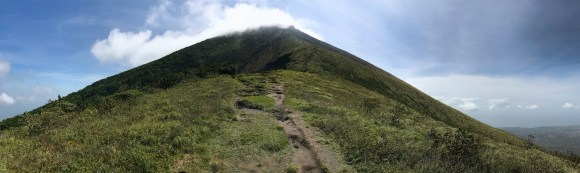
We went on the sole most challenging hike of our lives yesterday, summitting Volcán Concepción and coming down again safely. It wasn’t the longest hike we’ve gone on but it was terrifying; at one point I was sure I was about to fall a kilometre to my death, and at another point truly had my nerves act up to the point of near paralysis (not a great thing when 1550 meters up and off-path on a rock face!). I really don’t think I’d do it again, knowing how hard it is, but I’m immensely delighted to have gone up and down without serious incident, entirely because of the epically amazing guide we had to show us the way, provide assistance, and keep us safe.
I’ve been on a speaking circuit this week, and so living a quasi-nomadic life. It’s a very strange experience to be shuttled between locations and across vast distances, all with only a modicum of awareness of all the places I’m scheduled to attend, persons I’ll be meeting, and expectations I will have to meet. I don’t mean to say that I don’t know why I’m travelling, or what I’ll be speaking about, but that the aspects of travel itself are often almost entire dealt with by other parties. There is no effort to determine where I need to go: someone will take me to the designated address. I don’t need to find a place to eat: I’ll be taken to where I need to eat. I don’t need to figure out where to sleep: someone else will determine that.
I contrast it with trips I take for personal relaxation and it’s a totally different experience. Tomorrow, as an example, I’ll be landing in a new place where I don’t speak the language and have no read guidance once I’m there. There are a few tent pole events — nature hikes! — but otherwise time will be entirely unoccupied with designated tasks or todos other than exploring. I actually find this kind of travel deeply uncomfortable because it feels so uncontrolled, but every time I learn a great deal more about the world, and how I should readjust my perceptions of that world.
While shuttling between places for conferences and events is intellectually stimulating it doesn’t tend to push me into uncomfortable spaces that facilitate growth. The exact opposite is true of personal travel. I half wonder, though: if I didn’t travel so often for work where things are scheduled and I’m attended to, would I prefer personal travel that had those characteristics? Would visiting resorts have some resonance if I wasn’t functionally visiting them for work on a semi-regular basis?
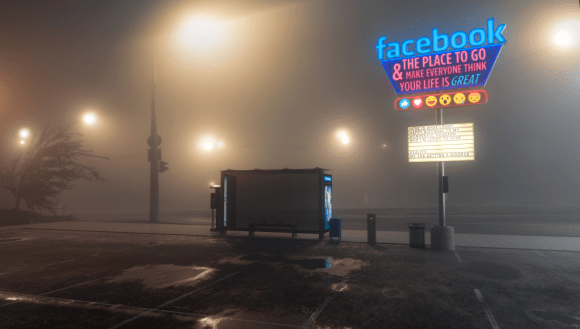
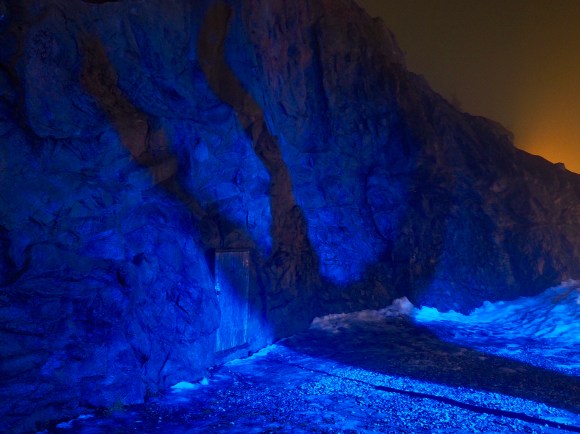
I really love the social media billboards that Mike Campau has created. Just stunning pieces to look at while providing always-needed critical introspection of social media services themselves.
For the past few weeks I’ve been deliberately constraining my photography by shooting exclusively by a 35mm equivalent lens. This was the focal length that really convinced me that I enjoyed photography as a way of seeing and experiencing the world. I’m a big fan of zoom lenses, and keep eyeing the Olympus 12-40mm 2.8 Pro lens, but I find that I learn the most about a scene by having to walk around it with a bright prime lens.
Alien Reach by Christopher Parsons
When I travelled to Cuba, having to march around with a 50mm equivalent lens meant I went into entirely new places and angles that I wouldn’t have if I’d had a zoom lens to otherwise get a shot. And while I’ve previously used my 35mm equivalent, I have to admit that I’ve been far more reliant on some of my zooms and the 50mm; I just haven’t focused on learning to use the 35mm lens because there is so much more walking-by-zooming that I have to do with it compared to even my other prime lenses.
Sound Off! by Christopher Parsons
But that’s silly: I enjoy the focal length, I just have to work a lot more to get things out of the camera. So I’ve been using it at night, during the day, and exclusively attached it to my camera body for the past month and intend to bring it (along with an 80-300mm equivalent lens) when I travel to South America in a week and change. I like the idea of an unobtrusive lens as my walkabout, and then the zoom for when I’ve trekking through nature. And, perhaps most importantly, I really like the idea of forcing myself to get a lot more comfortable with my current gear as a way to inhibit my desire to buy more gear: I have functionally underused equipment, and I should be playing with it, first and foremost, before even considering the purchase of new kit.
Inspiring Quotation
“We start on the path to genuine adulthood when we stop insisting on our emotional competence and acknowledge the extent to which we are – in many areas of our psyche – likely to be sharply trailing our biological age. Realising we aren’t – as yet, in subtle ways – quite adults may be the start of true maturity.”
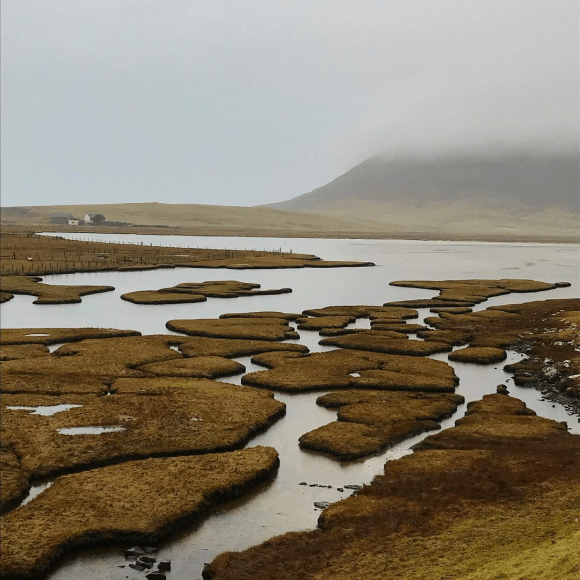
Mobiography’s landscape photography shots are really, really amazing and showcase just how much you can do with a contemporary smartphone and good lighting conditions.
Jagged horizon, Monument Valley… by Joseph CyrIt’s been a good day… full of weather again.. by Fi AustinSnow & Fishing Cottages by Jen Pollack BiancoWindswept by lkbside
An update by Ars Technica on Cellebrite’s ability to access the content on otherwise secured iOS devices:
Cellebrite is not revealing the nature of the Advanced Unlocking Services’ approach. However, it is likely software based, according to Dan Guido, CEO of the security firm Trail of Bits. Guido told Ars that he had heard Cellebrite’s attack method may be blocked by an upcoming iOS update, 11.3.
“That leads me to believe [Cellebrite] have a power/timing attack that lets them bypass arbitrary delays and avoid device lockouts,” Guido wrote in a message to Ars. “That method would rely on specific characteristics of the software, which explains how Apple could patch what appears to be a hardware issue.”
Regardless of the approach, Cellebrite’s method almost certainly is dependent on a brute-force attack to discover the PIN. And the easiest way to protect against that is to use a longer, alphanumeric password—something Apple has been attempting to encourage with TouchID and FaceID, since the biometric security methods reduce the number of times an iPhone owner has to enter a password.
This once again confirms the importance of establishing strong, long, passwords for iOS devices. Sure they’re less convenient but they provide measurably better security.
The Israeli firm, a subsidiary of Japan’s Sun Corporation, hasn’t made any major public announcement about its new iOS capabilities. But Forbes was told by sources (who asked to remain anonymous as they weren’t authorized to talk on the matter) that in the last few months the company has developed undisclosed techniques to get into iOS 11 and is advertising them to law enforcement and private forensics folk across the globe. Indeed, the company’s literature for its Advanced Unlocking and Extraction Services offering now notes the company can break the security of “Apple iOS devices and operating systems, including iPhone, iPad, iPad mini, iPad Pro and iPod touch, running iOS 5 to iOS 11.” Separately, a source in the police forensics community told Forbes he’d been told by Cellebrite it could unlock the iPhone 8. He believed the same was most probably true for the iPhone X, as security across both of Apple’s newest devices worked in much the same way.
If Cellebrite has, indeed, found a way of compromising all iOS devices then they’ve accomplished a pretty impressive task. I have to wonder whether the vulnerabilities emerged from studying the iBoot leak or their own software or hardware research. Assuming Cellebrite’s claims are legitimate they serve to underscore the position that government’s shouldn’t introduce backdoors or vulnerabilities into devices given that doing so will only exacerbate the existing problems associated with securing devices. Security is designed to add friction, not totally prevent an unauthorized party’s actions, and deliberately reducing such friction will put all users at greater jeopardy.














 Excited Pixels