Categories
Links RPG

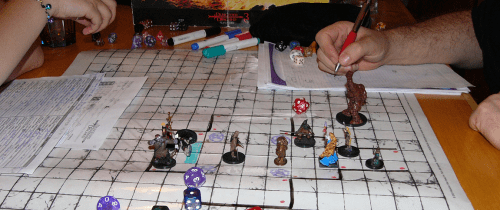
Do you: pre-made adventures?

epicroll:

I love reading through pre-made adventures for a hook or two for my main game. The only time I’ve ever run a pre-made was on Free RPG day at my local game shop – but even then I changed things up (one guy said he’d played the adventure elsewhere that day already…).

Do you use pre-made adventures or do you prefer to make your own?

I use a combination of pre-made and my own; for overall structure I tend to use the published work but then I add in ‘micro’ adventures that work out to about 30% of a campaign that are my own creations. My additions tend to focus on improving narrative arcs in the published campaign itself, to build the story arcs of individual PCs, and to develop multi-campaign themes and stories.

I used to mostly do just self-written work when I ran 2nd edition but, sadly, just don’t have that kind of time anymore if I’m going to produce adventures that I’m personally proud of and am happy with. But maybe that’ll change if I run into a published adventure/campaign in D&D(5e) that I’m unhappy with…

Categories
Quotations RPG

2015.10.16

Once, Belkram had taken a dagger through the palm of his hand. The attacking bolts felt like seven such daggers in swift succession. The pain smashed the breath out of him as the force of the striking magic missiles drove him back into an untidy heap on the ground. It was like being struck in the short ribs over and over again, Belkram thought, struggling to get his breath.

Ed Greenwood. “Cloak of Shadows.”

A great description of what being hit with magic missiles feels like!

Categories
RPG Writing

On Balancing Encounters

Over the past few days I’ve done some listening on balancing encounters in 5e D&D. In a pair of successive episodes on The Tome Show earlier in 2015, Andy, Sam, and Mike have repeatedly noted that it is far more challenging to balance encounters in a post-4e world and that, moreover, the “math is broken” in 5e D&D.

I’m sympathetic to these concerns. But as someone who admittedly always preferred the pre-CR days (i.e. 2nd Edition AD&D and earlier) I think that this is a good problem to have. I’ve always just sort of guesstimated the kind of encounter that I wanted to generate in order to advance a story and went from there; that often means that a 1st level party of 5 adventurers might be up against dozens or hundreds of opponents and that, if they don’t play very, very smart, they will all either have to flee (and hopefully not get hunted down afterwards) or perish.

I don’t tend to run what I’d consider lethal games, though it’s pretty normal for the PCs to have to retreat if they’ve adopted a bad tactical or strategic approach to engaging with an encounter. I’ve also always seen adventurers as borderline insane, insofar as they tend to run towards dangers that no normal person would ever consider to be reasonable or appropriate. Good adventurers are those that learn to think through an encounter prior to taking it on and, in some cases, recognizing when they’ve gotten themselves in too deep and the ‘adventure’ is figuring out how to extricate themselves with minimal loss of life and limb.

This isn’t to say that I, or any other DM, should or want to just hurl the world at PCs to watch them perish. Instead, it’s to say that unbalanced encounters — where the PCs cannot necessarily win, and have to simply exit the field of battle — are not inherently bad. Of course the PCs still have to succeed routinely enough that they are ‘heroes’ in their own eyes and the eyes of the peasantry/nobles/etc. But always knowing that an encounter is structured so that you can mathematically succeed just isn’t how the world tends to work and, so, I think it’s perfectly OK to develop adventures that are intentionally very dangerous. It’s been my experience that players will usually rise to the challenge and succeed in ways that I’d never considered, and part of the stories they take away from my games is the bizarre and awesome ways that they figured out how to overcome what was mathematically an ‘unbalanced’ encounter.

Categories
RPG

Stone of Silencing

Wonderous, rare

Description

Stones of Silencing appear as dull silver balls with small grooves on one hemisphere of the sphere. They radiate a grey light for the duration of their activation

History

The Shadow Thieves are best known for developing and using these items to carry out assassinations in centuries gone past. There were originally only a few dozen created — merely for the assassins within the guild — but since then copycat wizards and spell hurlers have created (and sold) them to adventurers, nobles, and even more dangerous folk.

These items are prized by thieves and assassins and are generally feared most by spell casters. To prevent their own creations from being used against themselves, many wizards have included ways of de-activating one of their Stones of Silencing using somatic gestures. Those gestures are often closely guarded secrets and left unknown to whomever purchases one of these items from the creator.

Powers

1/day the owner can cast a Silence spell in a 10 ft. radius from the stone as an action. It lasts for 10 minutes. There is no concentration requirement and the power can be dismissed by the owner as a bonus action.

Categories
RPG Writing

Markdown Template for 5e Monsters

I use Ulysses to organize most of my D&D stuff; here’s the basic Markdown template I use for monsters (some additional items can be added for more advanced monsters, such as those with special abilities and spells).

# NAME

*SIZE type, alignment*

—-

**Armour Class**

**Hit Points**

**Speed**

—-

**Str** | **Dex** | **Con** | **Int** | **Wis** | **Cha**

—-

**Damage immunities**

**Condition Immunities**

**Senses** passive Perception X

**Languages**

**Challenge** X (XX XP)

—-

**Actions**

***Melee*** *Melee Weapon Attack*: +X to hit, reach X ft., X creature. *Hit*: X (XdX+X), X-type damage. (Effects)

***Range***: *Ranged Weapon Attack*: +X to hit, reach X ft., X creature. *Hit*: X (XdX+X), X-type damage.

—-

**Equipment**

Categories
Links RPG

See the Sketches J.R.R. Tolkien Used to Build Middle-Earth

Many of these are amazing, in that they show how one of the most adored fantasy world’s maps began just as those used in most homebrew D&D games.

Categories
Links

How ‘white hat’ hackers could help in the Ashley Madison investigation

How ‘white hat’ hackers could help in the Ashley Madison investigation:

TORONTO – It’s not every day that the police appeal to the hacking community to help investigate a wide-scale hacking incident.

Because much of the Ashley Madison data leak unfolded on the dark web, it makes sense that authorities are appealing to “good” hackers who may have engaged with those behind the leak to come forward. However, according to cyber security expert Chris Parsons, it could have major implications.

“Such hackers possess a technical skill set and may use it to analyze leaked data or to try and track down or identify those suspected for leaking the Ashley Madison data,” said Parsons.

“The danger…is that in hunting for suspected leakers some parties may act beyond, or outside, the law in an attempt to help authorities. In the course of behaving this way they might actually endanger the investigation’s legitimacy or even compromise legitimate evidence.”

Parsons added that without a clearer set of ‘terms of engagement,’ police could bring on further investigations into those “recruited” to help them – putting a strain on resources and risking the integrity into the investigation into the Ashley Madison data breach.

Categories
Links

Feds considering warrantless access to internet subscriber info: police chiefs

Feds considering warrantless access to internet subscriber info: police chiefs:

OTTAWA – A new administrative scheme that would allow police to obtain basic information about Internet subscribers without a warrant is one option being considered by federal officials following a landmark Supreme Court ruling that curbed access to such data, Canadian police chiefs say.

A researcher who has long pressed for more transparency around police access to subscriber data said Monday that law-enforcement agencies have yet to make the case for warrantless access – especially since companies can make information available quickly in a genuine emergency.

“We’re not at a point where it’s clear the police have a legitimate concern,” said Christopher Parsons, a postdoctoral fellow with the Citizen Lab at Toronto’s Munk School of Global Affairs.

In June last year, the Supreme Court ruled police need judicial authorization to obtain subscriber data linked to online activities. The high court rejected the notion the federal privacy law governing companies allowed them to hand over subscriber identities voluntarily.

The court judgment came amid swelling public concern about authorities quietly gaining access to customer information with little evident scrutiny or oversight.

Parsons wants police to release more statistical information about their requests. “They actually have to make the argument with data, so we can have an evidence-based policy discussion.”

He would also like to see civil society groups and others included in the discussions about possible legislative change.


Categories
Links

Twitter closes off ability to track and repost politicians’ deleted tweets | Toronto Star

Twitter closes off ability to track and repost politicians’ deleted tweets:

Twitter has shut off the ability of more than two dozen accounts to track and repost tweets deleted by politicians and other officials in 30 countries around the world, including Canada.

Christopher Parsons, a fellow at the Citizen Lab at the University of Toronto’s Munk School of Global Affairs, said Twitter’s decision shows that the company “is unwilling to have its API routinely used to monitor what people have tried to delete.

“It appears as though Twitter is saying, ‘Look we know it’s possible, but we don’t want it being done.’ ”

According to Parsons, the weekend Twitter closures may force groups to analyze the different reasons tweets are deleted, rather than posting all deletions automatically, which could change the data’s impact.

“The way in which (the information is) published can be very different, the context can be much broader, and depending on the intent of the group in question, it could be more damning,” he said.

The debate, he added, shows the impact corporations such as Twitter can have on how public figures communicate with people.

“With the American election right now and the Canadian election going on, that’s where these sorts of deletions are often most interesting to the general public,” he said.


Categories
Links

Canadian companies have no incentive to report cyber attacks, like that on Ashley Madison | Toronto Star

Canadian companies have no incentive to report cyber attacks, like that on Ashley Madison:

Canada’s Digital Privacy Act, passed by Parliament in June, will require companies to report breaches once regulations are prepared. But experts say it is essentially toothless because it contains few financial penalties.

The Act will introduce fines up to $100,000 for deliberately not reporting a breach.

“There’s the obligation to report, which is, of course, positive,” said Christopher Parsons, managing director of the telecom transparency project at the Munk School of Global Affairs’ Citizen Lab.

“But without any sort of punitive consequences you run into the question of how useful is the notification itself.”

There is little data on how secure corporate Canada truly is partly because of a lack of breach notification laws, Parsons said.

Without a financial imperative to beef up security, companies are unlikely to shell out the millions of dollars required to identify and prevent them, Parsons said.

“For most companies, security is a drag,” Parsons said, adding that executives tend to reject investment in cybersecurity, where concerns tend to lead to IT professionals saying “no” to a lot of ideas, while also eating up company time, money and resources.

“All those no’s either inhibit fast fluid business, or they increase the cost and the friction of anything a company wants to do.”
Meanwhile, hackers are getting more sophisticated, but they don’t even need to because the defence systems are so weak, Parsons said.

“If you’re a hacker, you have to succeed once; if you’re a defender, you have to succeed every single time.”