
If he’s smiling, it must be OK. Right? Right?
Privacy advocates have long warned that allowing the government to collect and store unlimited “metadata” is a highly invasive form of surveillance of citizens’ communications activities. Those records enable the government to know the identity of every person with whom an individual communicates electronically, how long they spoke, and their location at the time of the communication. Such metadata is what the US government has long attempted to obtain in order to discover an individual’s network of associations and communication patterns. The request for the bulk collection of all Verizon domestic telephone records indicates that the agency is continuing some version of the data-mining program begun by the Bush administration in the immediate aftermath of the 9/11 attack.
Glenn Greenwald (via azspot)
Anyone trying to convince people “it’s only metadata” should be discounted as a fool or a government shill. Or perhaps as being both.
Your Klout score is gaining in importance: A high one might bring perks, but a low one could dash your career dreams.
Something that hit me while I was reading this (other than how much I dislike Klout) is that companies are increasingly using the ‘service’ to discriminate between preferred and non-preferred customers. I can see a service like Klout developing in the future that is widely used by marketers, insurance agencies, and other groups interested in actuarial sales/risk analysis to mine social media information in order to assign scores that invisibly affect individuals’ daily behaviours and routines.
Hopefully things won’t be so invisible that consumer protection laws can’t be activated to dilute such behaviours. Even more hopefully, let’s pray that those laws still have the dulled teeth they have today when Klout on steroids is truly birthed.
In an economy of scarcity, a rare commodity like office space will be fought over tenaciously.
I have to admit that I’ve never had an issue finding office spaces on campus; at a previous university I had three separate offices, and presently enjoy two separate (and well furnished!) offices. I tend to work out of those spaces 6-7 days a week, 6-12 hours a day. In other words: I use the spaces that are provided to me.
That said, I’ve watched just how nasty office-space wars can become. Such conflicts aren’t something that I’d wish on my worst enemy, and the most aggravating aspect of most space conflicts is the sheer amount of unused office space. There’s nothing like seeing a war occur between a small group of people in a department for a coveted office space while 95% of the offices are unoccupied because graduate students and faculty alike refuse to come and work on campus.
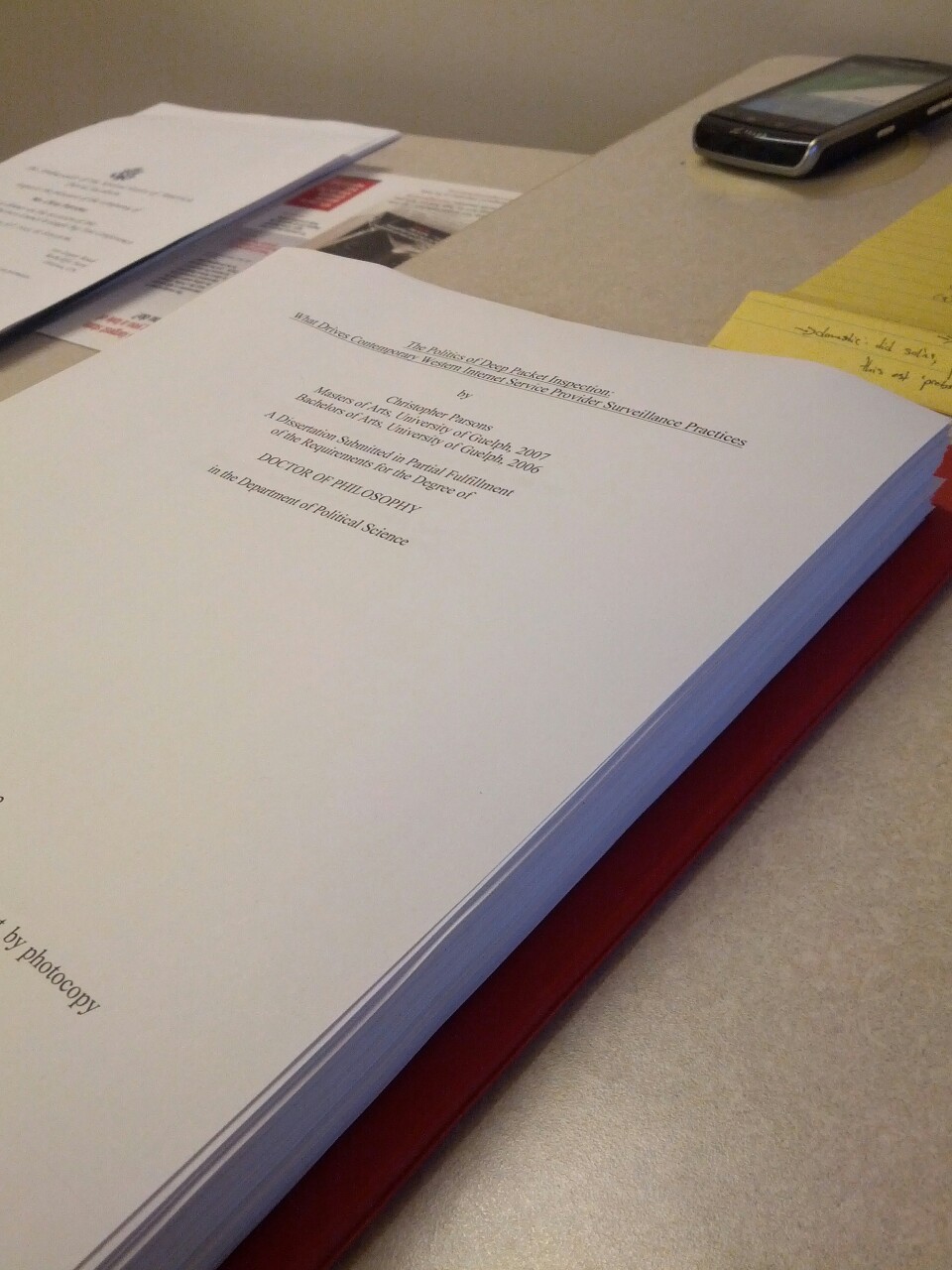
Our symposium was also interested in the differences between writing a journal article and writing an extended monograph of up to 100,000 words. The sheer challenge of constructing a sustained argument over this many words clearly prepared the PhD for the book in ways that writing journal articles might not. So was there also something here, we wondered, about the PhD by journal publication being a way of preparing the audit ready scholar, already primed to turn out articles for high status journals, as opposed to what might appear as the increasingly less audit valued process of producing a monograph?
It is important to put on record that our symposium wasn’t suggesting that the solution to this increasing diversity should be some kind of monolithic pan-European doctorate, an extension of the Bologna process that would involve massive amounts of moderation, record keeping and audit. This would be the simple knee jerk bureaucratic response to emergent diversity. We did think that there might be a set of questions to discuss about the criteria used to evaluate/examine doctorates, and some work at the edges of what were reasonable expectations and what were not. We were very clear that there ought to be a conversation among the scholarly community at large about diversity and equity – it wasn’t something just for national policy-makers to think about.
The changes we were addressing are of course not the only changes in the doctorate. There are also increasing pressures on narrow nineteenth century definitions of the thesis by monograph brought about via digital and arts informed scholarship, and these too need to be taken into account in any discussions.
Pat Thomson, “the PhD and publication/by publication – a very peculiar practice? part one”
Anecdotally, I can personally say that each type of writing a scholar engages in will be different. A manuscript is different from an article, which are both different from a report, review, book chapter, or submission to government. And each is independently valuable insofar as each teaches discrete writing skills.
I know that there is a shift away from manuscripts, and towards PhD by publishing in the social sciences. I can certainly appreciate how this publication approach enhances CVs for postdoctoral fellowships (e.g. demonstrates a track record of publishing) but it also seems to take away from learning a key skill: book writing. While many people who receive a PhD won’t continue on into the academy there is a certain discipline associated with building, and sustaining, and argument over 80-100 thousand words.
And…another publication (as second author) in a law journal for our work on social media companies and their privacy practices, as related to compliance with Canadian law.
I think this puts me on track for 5-6 publications this year alone…
Government photograph databases form the basis of any police facial recognition system. They’re not very good today, but they’ll only get better. But the government no longer needs to collect photographs. Experiments demonstrate that the Facebook database of tagged photographs is surprisingly effective at identifying people. As more places follow Disney’s lead in fingerprinting people at its theme parks, the government will be able to use that to identify people as well.
In a few years, the whole notion of a government-issued ID will seem quaint. Among facial recognition, the unique signature from your smart phone, the RFID chips in your clothing and other items you own, and whatever new technologies that will broadcast your identity, no one will have to ask to see ID. When you walk into a store, they’ll already know who you are. When you interact with a policeman, she’ll already have your personal information displayed on her Internet-enabled glasses.
Soon, governments won’t have to bother collecting personal data. We’re willingly giving it to a vast network of for-profit data collectors, and they’re more than happy to pass it on to the government without our knowledge or consent.
Bruce Schneider, “The Public/Private Surveillance Partnership”
It’s the ability for government to prospectively combine public and private data that makes American laws such as CISPA, which would permit the disclosure of private information to public bodies without absent warrant requirements, so significant. Privacy legislation serves as a necessary friction to delay, limit, and prevent governments from accessing citizens’ and resident aliens’ personal information unless such access is absolutely necessary: we need to strengthen such laws to preserve basic democratic freedoms, not weaken or erode them.
There is a technical term economists like to use for behavior like this. Unbelievable chutzpah.
- Edward Kleinbard, a law professor at USC speaking to NYT about Apple’s overseas tax situation — or lack thereof.
One potentially good thing out of all this, Tim Cook will address it directly tomorrow in front of the Senate:
Mr. Cook is expected to emphasize that Apple is most likely “the largest corporate income tax payer in the U.S., having paid nearly $6 billion in taxes to the U.S. Treasury” in the last fiscal year. “Apple does not use tax gimmicks,” Mr. Cook is expected to testify.
He is expected to seek to rebut the Congressional findings by arguing that some of Apple’s largest subsidiaries do not reduce Apple’s tax liability, and to argue in support of a sweeping overhaul of the United States corporate tax code – in particular, lowering rates on companies moving foreign overseas earnings back to the United States. Apple currently assigns more than $100 billion to offshore subsidiaries.
I figured this would lead to a change in tax policy. Now I’m sure of it.
(via parislemon)
This story, the day before Cook testifies to the Senate, is probably the worst thing Apple PR could have dreamed of. I wouldn’t want to be in Cook’s shoes tomorrow though, by the same token, if I were an American taxpayer I’d be pissed as all hell about Apple’s actions regardless of the legality of those actions.

Yahoo unveils the new Flickr with one terabyte of free space
Looks wild.
As a pretty heavy Google user, I look forward to seeing if Google ups their own storage offerings to ‘compete’ with Yahoo!

 Excited Pixels