I regularly speak with scholars who complain policy makers don’t read their work. 95% of the time that work is either published in books costing hundreds of dollars (in excess of department budgets) or behind a journal paywall that departments lack access to.1
Bluntly, it’s hard to have impact if your work is behind paywalls.
Moreover, in an era of ‘evidence-based policymaking’ dedicated public servants will regularly want to assess some of the references or underlying data in the work in question. They perform due diligence when they read facts, arguments, or policy recommendations.
However, the very work that a scholar is using to develop their arguments or recommendations may, also, lay behind paywalls. Purchasing access to the underlying books and papers that go into writing a paper could run a public servant, or their department, even more hundreds or thousands of dollars. Frankly they’re not likely to spend that amount of money and it’d often be irresponsible for them to do so.
So what are the effect of all these paywalls? Even if the government policymaker can get access to the scholar’s paper they cannot fact-check or assess how it was built. It is thus hard for them to validate conclusions and policy recommendations. This, in turn, means that committed public servants may put important scholarly research into an ‘interesting but not sufficiently evidence-based’ bucket.
Does this mean that academics shouldn’t publish in paywalled journals or books? No, because they have lots of audiences, and publications are the coin of the academic realm. But it does mean that academics who want to have near- or middle-term impacts need to do the work and make their findings, conclusions, and recommendations publicly available.
What to do, then?
Broadly, it is helpful to prepare and publish summaries of research to open-source and public-available outlets. The targets for this are, often, think tanks or venues that let academics write long-form pieces (think maximum of 1,200-1,500 words). Alternately, scholars can just start and maintain a blog and host summaries of their ideas, there, along with an offer to share papers that folks in government might be interested in but to which they lack access.
I can say with some degree of authority from my time in academia that publishing publicly-available reports, or summarising paywalled work, can do a great deal to move the needle in how government policies are developed. But, at the same time, moving that needle requires spending the time and effort. You should not just expect busy government employees to randomly come across your paywalled article, buy it, read it, and take your policy recommendations seriously.
Few government departments have extensive access to academic journals. Indeed, even working at one of the top universities at the world and having access to a wealth of journals, I regularly came across articles that I couldn’t access! ↩︎
Several years ago I was speaking with a special advisor to President Bush Jr. He was, also, an academic and in the summer he had returned to his university to teach some of international relations courses. This was during the time when the US had a force stationed in Iraq, and his students regularly had more up to date information on what was happening on the ground than he did, notwithstanding having a broad security clearance and access to top US intelligence. How was this possible?
His students were on Twitter.
Another story: when I was doing my PhD there was an instance where it was clear that the Iranian government had managed to access information that should have been encrypted while in transit between using Google products from Iran. After figuring this out I shared information on Twitter and the infosec community subsequently went to work to rectify the situation.
There are lots of similar stories of how social media has been good for individuals in their personal and professional lives. But, equally (or more so ), there are stories where social media services have fed serious and life threatening problems. The Myanmar genocide. Undermining young women’s sense of self-confidence and leading to thoughts of self-harm. Enabling a former President to accelerate an irregular political and policy environment, often with harmful effects to members of government, residents of the United States, and the world more broadly.
The Future of Social Media
But the social media services that enable the positive and negative network effects of the past are significantly different, today, than just 5 years ago. What does this mean for the future of social media services?
First, we need to assess the extents to which the services remain well situated for their purposes. For the sharing of popular news, as an example, some companies to moving away from doing so partially or entirely in response to economics or emerging law or regulations. What does it mean when a core driver of some hardcore users — journalists, academics, some in government — no longer see the same utility in engaging online? What does this mean for the affordances of new services?
Second, to what extent are the emerging services really able to address the harms and problems of the old services? How can these services be made ‘safe to use’ and promote equity and avoid generating harms to some individuals and communities? I think there is a valid open question around whether you can ever create a real-time communications platform that enables mass broadcast, and which does not amplify historical harms and dangerous social effects.
Third, to what extent have these services outlived some of their utility? While individuals used to share information broadly on social media networks they can now retreat to large chat groups or online chat services (i.e., the next generation of AOL chat is here!). These more private experience still enable the formation of community without the exposure to some of the harmful or disquieting content or messages that existed on the more public social media sites.1
There has, also, been an explosion of new-Twitter competitors (along with those competing with other networks, including Instagram and popular/corporate chat services). While this has the benefit of reducing some of the aggregated harms that can arise, just in the sense that individuals are spread out between services and cannot mass against one another as they could previously, it also means that content which is published may lack the same kind of reach as in the past. Whereas once you may have had thousands of Twitter or Instagram or Facebook followers who you could alert to pressing issues of social injustice, now this same population is scattered across a bevy of different services and platforms. The dispersion effect makes it hard to have the same kind of thought leader status as may have been possible, even in the relatively recent past.
One of the solutions to these problems, writ large, is to facilitate a ‘Post Once (on your own) Site, Syndicate Everywhere’ (POSSE) situation, where you can post on one service and then syndicate it to all the other services. Promoters of this maintain that you can then have a single ‘identity’ or location, put all your content there, and then share it around the world.
Obviously this approach has some initial appeal. And for many individuals or groups they may prefer this approach. But a POSSE ‘solution’ to the disintermediation of social media fails to take into account the value of having discrete online identities.
As I contemplate the state of social media and identity, today, I guess I’m left with the ongoing recognition that classic media organizations played a key role in identifying what was more or less important to pay attention to, especially when the information sources I cultivated over the past decade have quickly and suddenly changed. The social media that was so useful in aggregating information even intelligence services lacked, as well as that was used to respond to information security issues, is now long past.
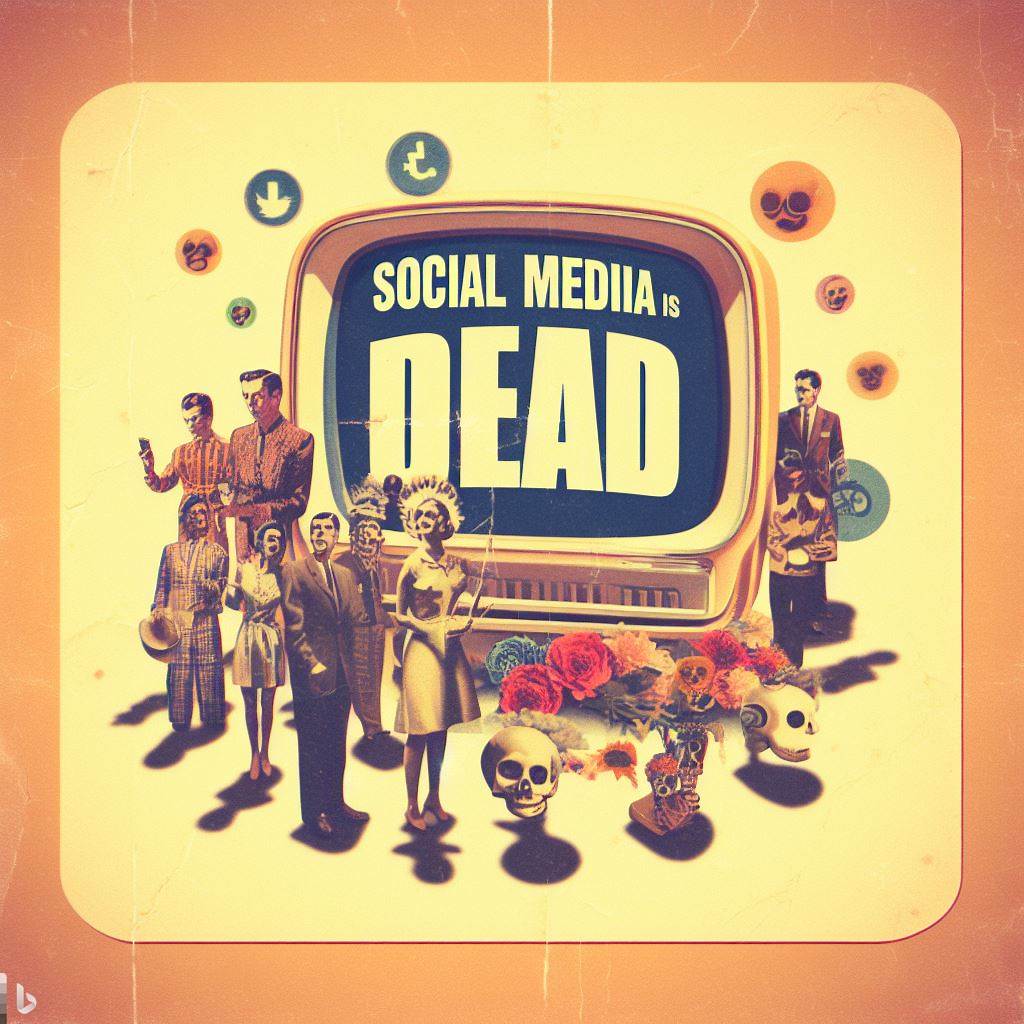
Social media as it was is dead. Long live socialized media.
With the caveat that some groups retreat to these more private spaces to share harmful or disturbing content without worry their actions are likely to be detected and stopped. ↩︎
While some emerging generative technologies may positively affect various domains (e.g., certain aspects of drug discovery and biological research, efficient translation between certain languages, speeding up certain administrative tasks, etc) they are, also, enabling new forms of harmful activities. Case in point, some individuals and groups are using generative technologies to generate child sexual abuse or exploitation materials:
Sexton says criminals are using older versions of AI models and fine-tuning them to create illegal material of children. This involves feeding a model existing abuse images or photos of people’s faces, allowing the AI to create images of specific individuals. “We’re seeing fine-tuned models which create new imagery of existing victims,” Sexton says. Perpetrators are “exchanging hundreds of new images of existing victims” and making requests about individuals, he says. Some threads on dark web forums share sets of faces of victims, the research says, and one thread was called: “Photo Resources for AI and Deepfaking Specific Girls.”
…
… realism also presents potential problems for investigators who spend hours trawling through abuse images to classify them and help identify victims. Analysts at the IWF, according to the organization’s new report, say the quality has improved quickly—although there are still some simple signs that images may not be real, such as extra fingers or incorrect lighting. “I am also concerned that future images may be of such good quality that we won’t even notice,” says one unnamed analyst quoted in the report.
The ability to produce generative child abuse content is becoming a wicked problem with few (if any) “good” solutions. It will be imperative for policy professionals to learn from past situations where technologies were found to sometimes facilitate child abuse related harms. In doing so, these professionals will need to draw lessons concerning what kinds of responses demonstrate necessity and proportionality with respect to the emergent harms of the day.
As just one example, we will have to carefully consider how generative AI-created child sexual abuse content is similar to, and distinctive from, past policy debates on the policing of online child sexual abuse content. Such care in developing policy responses will be needed to address these harms and to avoid undertaking performative actions that do little to address the underlying issues that drive this kind of behaviour.
Relatedly, we must also beware the promise that past (ineffective) solutions will somehow address the newest wicked problem. Novel solutions that are custom built to generative systems may be needed, and these solutions must simultaneously protect our privacy, Charter, and human rights while mitigating harms. Doing anything less will, at best, “merely” exchange one class of emergent harms for others.
The USA government recently took a bad beat when it came to light that alleged Chinese threat actors undertook a pretty sophisticated espionage operation that got them access to sensitive email communications of members of the US government. As the details come out it seems as though the Secretary of State and his inner circle weren’t breached but that other senior officials managing the USA-China relationship were.
Still, the actual language the US government is using to describe the espionage operation is really good to read. As an example, the cybersecurity director of the NSA, Rob Joyce, has stated that:
“It is China doing espionage […] That is what nation-states do. We need to defend against it, we need to push back on it, but that is something that happens.”
Why is this good? Because the USA was successfully targeted by an advanced espionage operation that has likely serious effects but this is normal, and Joyce is saying so publicly. Adopting the right language in this space is all too rare when espionage or other activities are often cast as serious ‘attacks’ or described using other inappropriate or bombastic language.
The US government’s language helps to clarify what are, and are not, norms-violating actions. Major and successful espionage operations don’t violate acceptable international norms. Moreover, not only does this make clear what is a fair operation to take against the USA; it, also, makes clear what the USA/FVEY think are appropriate actions to take towards other international actors. The language must be read as also justifying the allies’ own actions and effectively preempts any arguments from China or other nations that successful USA or FVEY espionage operations are anything other than another day on the international stage.
You have to kind of salute the Chinese for what they did. If we had the opportunity to do that, I don’t think we’d hesitate for a minute.
But it bears regularly repeating to establish what remain ‘appropriate’ in terms of signalling ongoing international norms. This signalling is not just to adversary nations or friendly allies however, but also to more regular laypersons, national security practitioners, or other operators who might someday work on the national or international stage. Signalling has a broader educational value for them (and for new reporters who end up picking up the national security beat someday in the future).
At an operational level, it’s also worth noting that this is intelligence gathering that can potentially lower temperatures. Knowing what the other side is thinking or how they’re interpreting things is super handy if you want to defrost some of your diplomatic relations. Though it can obviously hurt by losing advantages in your diplomatic positions, too, of course! And especially if it lets the other side outflank you.
Still, I have faith in the EquationGroup’s ongoing collection against even hard targets in China and elsewhere to help balance the information asymmetry equation. While the US suffered a now-publicly reported loss of information security, the NSA is actively working to achieve similar (if less public) successes of its own on a daily basis. And I’m sure they’re racking up wins of their own!
For the past several months Neale James has talked about how new laws which prevent taking pictures of people on the street will inhibit the documenting of history in certain jurisdictions. I’ve been mulling this over while trying to determine what I really think about this line of assessment and photographic concern. As a street photographer it seems like an issue where I’ve got some skin in the game!
In short, while I’m sympathetic with this line of argumentation I’m not certain that I agree. So I wrote a longish email to Neale—which was included in this week’s Photowalk podcast—and I’ve largely reproduced the email below as a blog post.
I should probably start by stating my priors:
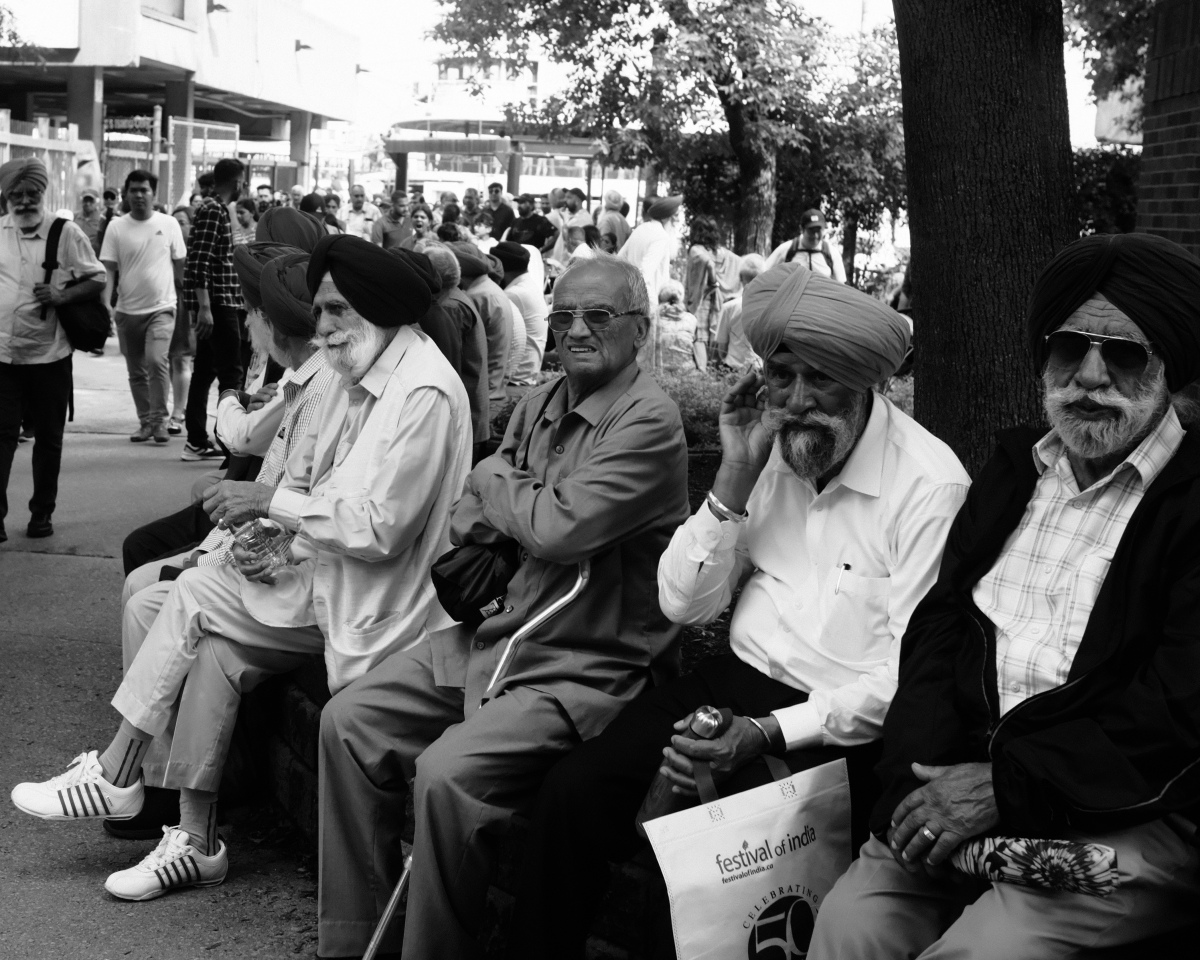
As a street photographer I pretty well always try to include people in my images, and typically aim to get at least some nose and chin. No shade to people who take images of peoples’ backs (and I selectively do this too) but I think that capturing some of the face’s profile can really bring many street photos to life.1
I, also, am usually pretty obvious when I’m taking photos. I find a scene and often will ‘set up’ and wait for folks to move through it. And when people tell me they aren’t pleased or want a photo deleted (not common but it happens sometimes) I’m usually happy to do so. I shoot between 28-50mm (equiv.) focal lengths and so it’s always pretty obvious when I’m taking photos, which isn’t the case with some street photographers who are shooting at 100mm . To each their own but I think if I’m taking a photo the subjects should be able to identify that’s happening and take issue with it, directly, if they so choose to.
Anyhow, with that out of the way:
If you think of street photography in the broader history of photography, it started with a lot of images with hazy or ghostly individuals (e.g. ‘Panorama of Saint Lucia, Naples’ by Jones or ’Physic Street, Canton’ by Thomson or ‘Rue de Hautefeuille’ by Marville). Even some of the great work—such as by Cartier-Bresson, Levitt, Bucquet, van Schaick, Atget, Friedlander, Robert French, etc—include photographs where the subjects are not clearly identified. Now, of course, some of their photographs include obvious subjects, but I think that it’s worth recognizing that many of the historical ‘greats’ include images where you can’t really identify the subject. And… that was just fine. Then, it was mostly a limitation of the kit whereas now, in some places, we’re dealing with the limitations of the law.
Indeed, I wonder if we can’t consider the legal requirement that individuals’ identifiable images not be captured as potentially a real forcing point for creativity that might inspire additional geographically distinctive street photography traditions: think about whether, in some jurisdictions, instead of aperture priority being a preferred setting, that shutter priority is a default, with speeds of 5-15 second shutters to get ghostly images.2
Now, if such a geographical tradition arises, will that mean we get all the details of the clothing and such that people are wearing, today? Well…no. Unless, of course, street photographers embrace creativity and develop photo essays that incorporate this in interesting or novel ways. But street photography can include a lot more than just the people, and the history of street photography and the photos we often praise as masterpieces showcase that blurred subjects can generate interesting and exciting and historically-significant images.
One thing that might be worth thinking about is what this will mean for how geographical spaces are created by generative AI in the future. Specifically:
These AI systems will often default to norms based on the weighting of what has been collected in training data. Will they ‘learn’ that some parts of the world are more or less devoid of people based on street photos and so, when generating images of certain jurisdictions, create imagery that is similarly devoid of people? Or, instead, will we see generative imagery that includes people whereas real photos will have to blur or obfuscate them?
Will we see some photographers, at least, take up a blending of the real and the generative, where they capture streets but then use programs to add people into those streetscapes based on other information they collect (e.g., local fashions etc)? Basically, will we see some street photographers adopt a hybrid real/generative image-making process in an effort to comply with law while still adhering to some of the Western norms around street photography?
As a final point, while I identify as a street photographer and avoid taking images of people in distress, the nature of AI regulation and law means that there are indeed some good reasons for people to be concerned about the taking of street photos. The laws frustrating some street photographers are born from arguably real concerns or issues.
For example, companies such as Cleaview AI (in Canada) engaged in the collection of images and, subsequently, generated biometric profiles of people based on scraping publicly available images.
Most people don’t really know how to prevent such companies from being developed or selling their products but do know that if they stop the creation of training data—photographs—then they’re at least less likely to be captured in a compromising or unfortunate situation.
It’s not the photographers, then, that are necessarily ‘bad’ but the companies who illegally exploit our work to our detriment, as well as to the detriment of the public writ large.
All to say: as street photographers, and photographers more generally, we should think broader than our own interests to appreciate why individuals may not want their images taken in light of technical developments that are all around us. And importantly, the difference is that as photographers we do often share our work whereas CCTV cameras and such do not, with the effect that the images we take can end up in generative AI, and non-generative AI training data systems, whereas the cameras that are monitoring all of us always are (currently…) less likely to be feeding the biometric surveillance training data beast.
While, at the same time, recognizing that sometimes a photo is preferred because people are walking away from the camera/towards something else in the scene. ↩︎
Toronto ended up getting a proper snowstorm late January. While it wasn’t the first snow of the year it was the first proper storm that saw 15cm of snow (or more) coming down over the course of many hours. In fact, the snow was coming down heavily enough that I didn’t want to risk my non-weather sealed cameras: I’m happy to get them damp by snow but in this weather they were certain to get soaked.
So what was I to do? Despite not being in love with the iPhone 14 Pro it’s a weather sealed camera and capable of making some decent images. So I grabbed it, donned my winter weather gear and some smartphone-compatible gloves, and headed out for a few hours of capturing the city.
When I went out I decided to increase the exposure a bit–set to 0.7–to keep the snow from coming out grey, but I found that exposure kept resetting. I half suspect that this was due to a combination of the somewhat bulky gloves I was using and the water on the screen resetting or modifying the exposure slider. Still, given that I was shooting in ProRAW I could generally modify exposures to my taste when I got home and did some light post-processing.
Speaking of the ProRAWs…I accidentally left the 24mm (equiv.) sensor set to 48MP images from the last time I was shooting with it! Which in hindsight explains why it often took so long to go from pressing the shutter button to capturing an image; I’d thought the delay was because of an issue with the conductive gloves or the cold or the water on the screen but, in fact, was was due to the file size. As always, I should have fully checked my equipment (and its software) before heading out. I’m just glad that I have a 512GB iPhone so at least I didn’t need to worry about running out of space on the device!
I did end up coming home with some smaller files using the main sensor from when I was shooting in burst mode. In burst you will default down to taking 12MP images on the 24mm (equivalent) lens and I used it when shooting faster-action scenes earlier in my walk.
In some notes to myself about the iPhone 14 Pro, I previously wrote:
The 48 megapixel main camera (24mm equivalent) when shot at its full resolution, in ProRAW, doesn’t work well for street photography. I tend to shoot bursts to get people stepping just so in a shot, but there’s an approximately 1 second or so delay in capturing one image and being able to capture another. That’s a shame as this is supposed to be a highlight feature and the A16 processor and specialized ISP just cannot process things fast enough for how I shoot street.
At the time, I didn’t realise the camera app would shift from taking 48MP to 12MP images under burst mode. It’s, also, not something that is apparent in the user interface. Just like, when in the camera app, there’s no indication or warning that you’re shooting at 48MP! All of which is to say that the stock Camera app on iPhone is getting very long in the tooth and is in desperate need of an overhaul.
Lest it sound that I only have negative things to say I should be very clear: I managed to go out and make images for several hours and came back with some that I liked. I couldn’t have gone out with my other camera gear. Since I thought I was shooting with the 12MP 24mm (equiv.) main lens quite often I tried to be fastidious in how I framed shots because I wasn’t going to be able to crop much. By happy accident, this ultimately meant that the images shot on that lens ended up being much higher quality than anticipated due to capturing 48MP images in all of their glory.
I also took the time to use the ultra-wide as well as telephoto lenses. I admit that I just don’t have a huge amount of experience shooting ultra-wide and so this was a fun experience in seeing what I could capture in the scene. Other images that didn’t quite make the cut saw me experiment with cutting the frame in two, with a divider in the centre of the frame and building scenes to the left and right of it. While I didn’t get any publishable-quality photos it was a good experiment and reminded me of just how challenging it is to replicate photographic masters who use this technique, like Sean Penn. The images I made with the 78mm lens, however, often ended up being too soft and ultimately I’ve opted to publish only one of them (above, woman walking away from sign with an arrow on it while looking at her phone).
When I went out I had hoped that I’d be able to capture the sense of how much the snow was beating down on everyone in the city. I think this came true as the iPhone didn’t shoot above 1/120 of a second the whole day, and at times was as low as 1/23. The result is that the snow is apparent and the subjects–unless they were relatively unmoving–have a bit of blur to them as they raced from place to place.
At the same time, because of the snow most people couldn’t move as quickly as they would on clear sidewalks and roads. It was an interesting personal lesson, insofar as I realised that in this weather I can probably easily get away with 1/80 to 1/200 and get sufficiently sharp images that still communicate the fury of the weather.
As I kept walking, however, a number of annoyances returned. I absolutely hate how holding your finger on the shutter button in the stock iPhone Camera app records a video instead of firing of a burst shot. This was a problem because when I was trying to take a single image sometimes I’d get a very short video, instead, meaning that I was without a photograph! I get that this is how most people probably want to use the app but it’d be nice to be able to customise the app’s functionality some. Especially if these are supposed to be ‘professional’ devices. Also, for reasons I couldn’t figure out, the Podcasts app also sometimes sped up the episodes I was listening to, or even skipped to the next podcast. Frustrating!
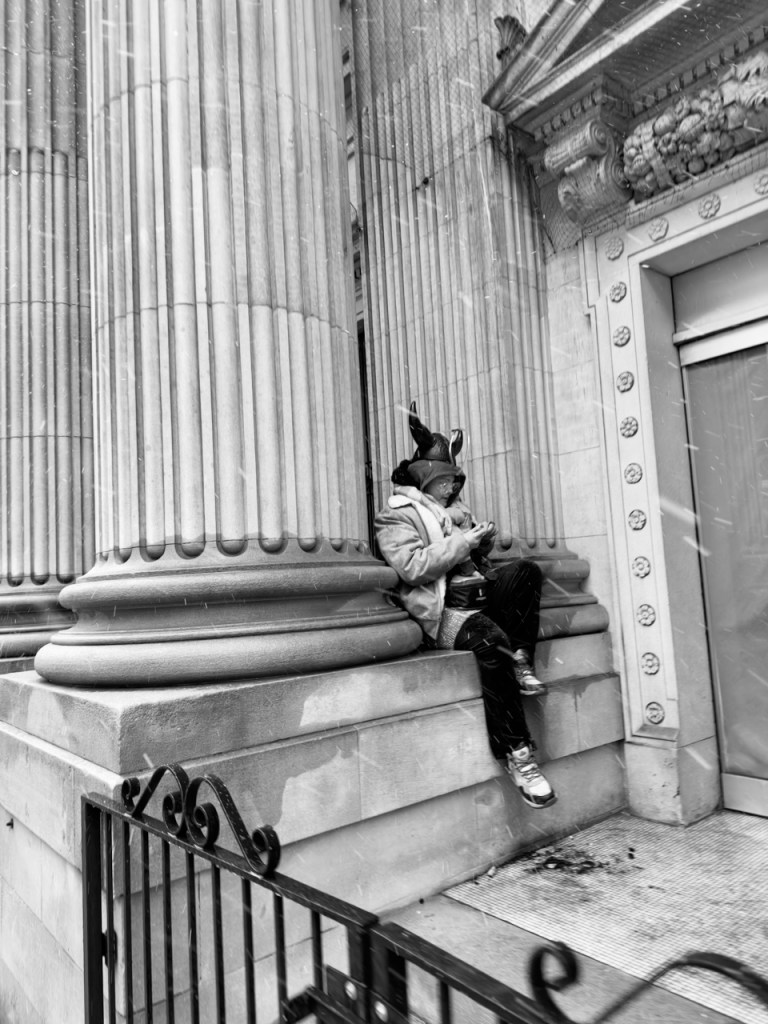
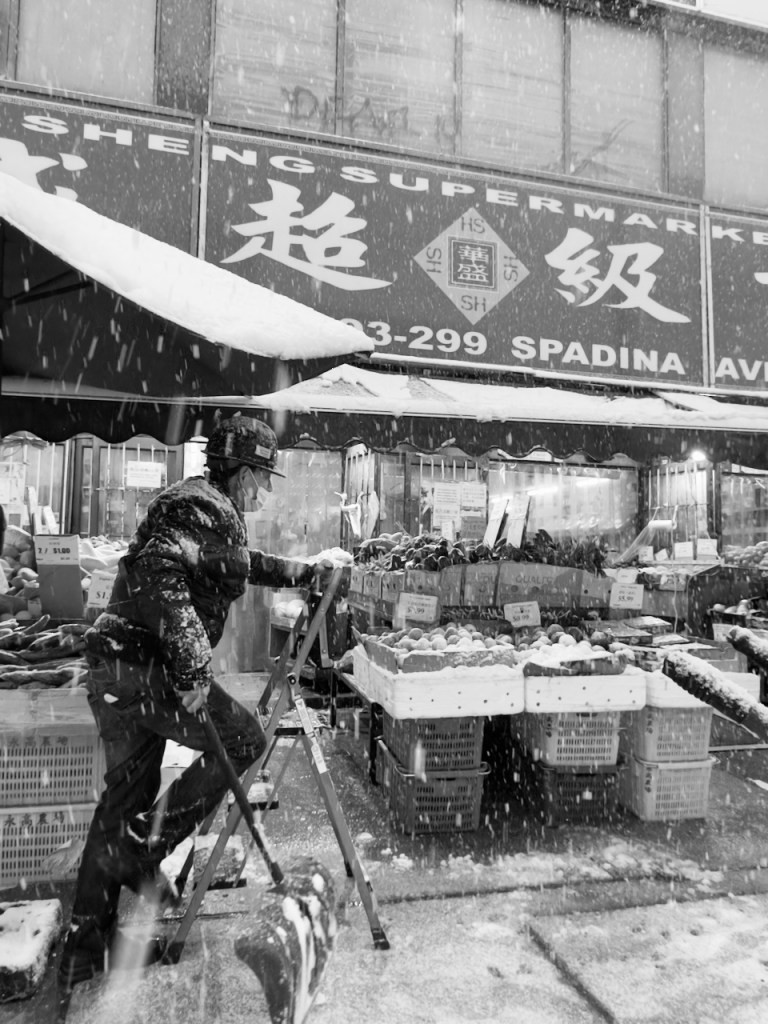
It had been quite some time since I’d walked through Chinatown during a real dropping of snow and it was great to see very familiar scenes in slightly different situations. Catching someone shovelling while, at the same time, a customer was taking refuge in a doorway was a real catch for me. I’m sure I’ve captured images from this location (as in the very spot I was standing in to make the image) dozens of times; this is a very different feel and texture than those I tend to make at this location. Win!
I ended up walking through Kensington Market last year during a slightly-less intense snowstorm and was rewarded with an image that was amongst my favourites of the year. I don’t think that I caught images that will necessarily fall into the same bucket this year, in part because several times I wasn’t able to activate the iPhone camera quickly enough. Still, I liked capturing how desolate the Market was, which was largely reflective of how quiet it was.
I did like how, towards the end of the shoot and into the evening, the snow started to come down even heavier which had the effect of leaving little droplets of water on the lens. While these blotches do upset the ‘perfection’ of the image I think they, also, have the effect of making it that much clearer what the weather was like and ideally put the viewer more firmly into the cold and wet scene.
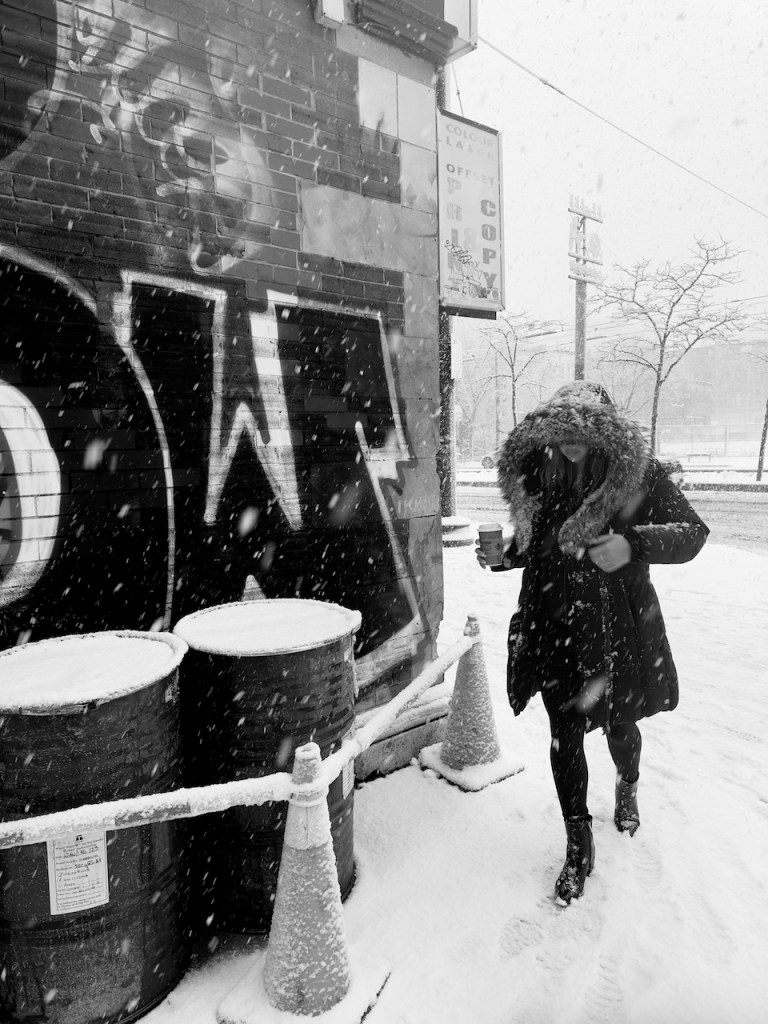
It was on my return trip home that the worst of the weather was apparent for those who had to brave the wet snow that had piled up over the past many hours. There were relatively few pedestrians out, even at the major intersections, as compared to better-weather times. Hoods were up and high, foot slips were common, and cars were throwing up huge volumes of grey and brown slush onto anyone who happened to get too close to the curb.
Amongst the bravest of the brave were the few cyclists who continued to try and share the road with Toronto drivers. Between the streets that hadn’t been cleared and the erratic behaviour of vehicles whose owners hadn’t driven in the snow in over a year, it seemed risky and not that much faster than just walking. Still, they made for interesting subjects when they were waiting for a chance to get onto the road and make their way to their destination, and especially with the streetcar lines overhead layered with snow.
While cyclists arguably had a hard time of things, even harder times were surely experienced by the parents I saw who were trying to push strollers around. The snow routinely got into the wheels with the effect that parents were just pushing the strollers without the help of the wheels. Still, almost every stroller had a plastic barrier separating the child from the storm which at least meant that the little one’s weren’t getting soaked on their ways home.
Ultimately the images that I came back with after several hours of shooting are qualitatively different from anything I’d have made with my Fuji X100F or Ricoh GR or GRiiix. At least to my eye, they have a feel of an older camera and, due to the slow shutter speeds, many of the images remind me of film photographs I’ve seen of past Toronto winter storms from the 1970s and 1980s. Many also have an almost more intimate quality, to my eye, due to the technical imperfections that resulted from lighting conditions and occasional focus challenges. Still, I feel like they present the experience of the storm that lasted throughout the day and night, and which left the city blanketed in white by the following morning.
Steve Saideman has a good, short, thought on why doing a PhD is rarely a good idea for Canadians who want to get into policy work. Specifically, he writes:
In Canada, alas, there is not that much of a market for policy-oriented PhDs. We don’t have much in the way of think tanks, there are only a few govt jobs that either require PhDs or where the PhD gives one an advantage over an MA, and, the govt does not pay someone more if they have a PhD.
I concur that there are few places, including think tanks or civil society organizations, where you’re likely to find a job if you have a policy-related PhD. Moreover, when you do find one it can be challenging, if not impossible, to find promotion opportunities because the organizations tend to be so small.
That said, I do in fact think that doing a policy-related PhD can sometimes be helpful if you stay pretty applied in your outputs while pursuing your degree. In my case, I spent a lot of time during my PhD on many of the same topics that I still focus on, today, and can command a premium in consulting rates and seniority for other positions because I’ve been doing applied policy work for about 15 years now, inclusive of my time in my PhD. I, also, developed a lot of skills in my PhD—and in particular the ability to ask and assess good questions, know how questions or policy issues had been previously answered and to what effect, and a reflexive or historical thinking capacity I lacked previously—that are all helpful soft skills in actually doing policy work. Moreover, being able to study policy and politics, and basically act as an independent agent for the time of my PhD, meant I had a much better sense of what I thought about issues, why, and how to see them put into practice than I would have gained with just a master’s degree.
Does that mean I’d recommend doing a PhD? Well…no. There are huge opportunity costs you incur in doing them and, also, you can narrow you job market searches by appearing both over-educated and under-qualified. The benefits of holding a PhD tend to become more apparent after a few years in a job as opposed to being helpful in netting that first one out of school.
I don’t regret doing a PhD but, if someone is particularly committed to doing one, I think that they should hurl themselves into it with absolute abandon and treat it as a super-intensive 40-65 hour/week job, and be damn sure that you have a lot of non-academic outputs to prove to a future employer that you understand the world and not just academic journals. It’s hard work, which is sometimes rewarding, and there are arguably different (and less unpleasant) ways of getting to a relatively similar end point. But if someone is so motivated by a hard question that they’d be doing the research and thinking about it, regardless of whether they were in a PhD program? Then they might as well go and get the piece of paper while figuring out the answer.
We got our first snow of the year on Sunday. I kept waiting for it to come and as soon as the snow started to fall I grabbed my Fuji X100F with a Cinebloom 10% attached and headed out to make some images.
I live in a densely populated section of Toronto. Notwithstanding the snow there were many people out and about when I first hit the streets. But it was as I moved to side streets, or into parts of the city that tend to be populated by tourists, that it was apparent that huge chunks of the city were largely depopulated as people decided to stay inside where it was warm and dry.
There were, of course, some people out even in the less populated parts of the city. They, however, tended to be trying to get out of the snow—which functionally turned into snow that was almost indistinguishable from rain towards the early evening—and generally wanted to just avoid getting wet or cold.
Somewhat surprisingly I saw almost no other photographers out and about. I’m sure they were there, somewhere. But, at the same time, I wonder how much the weather dissuaded them from getting out and shooting the streets or urban landscapes.
I will never be accused of babying my cameras. My Fuji X100F lacks the weatherproofing of the newest version and, so, when I’m out in the snow I tend to protectively place one hand over it’s screen and eyepiece, and keep the lens pointed downwards and slightly in towards my body. It doesn’t prevent all the precipitation from getting onto the camera but, along with brushing off water when it starts to gather on dials and such, has always seemed good enough to keep the equipment safe.
The mix of heavy coats and umbrellas is something that I’m always curious about, if only because I can’t recall ever seeing something similar while I was growing up or when I visit parts of the country (or world) that receive large volumes of snow. I don’t dispute the potential utility of an umbrella—it will, obviously, help to keep your head wet and my uncovered head certainly got soaked after 3-4 hours outside—but it always seems like an instrument that is out of place. Though they look very distinct in the snow and so I definitely took the chance to make images of people who were carrying them!
Though there were people out and about, and evidence in other cases of someone having been present recently, much of the city felt oddly solitary. When I make my photos I’m often trying to communicate a sense of, on the one hand, the press of other people around and upon us and, on the other, the loneliness or isolation experienced while being in these massive urban environments. Dismal weather almost always draws me to the latter and wanting to express how large our environments are and what they look like with few figures or, alternately, in the absence of humans entirely. What will the city look like when the humans are gone?
When I watched one of James Popsys’ videos recently he mentioned that, when taking his landscapes, he likes putting either a human or a human-made thing in his images. Doing so has the effect of communicating human presence and, often, what the natural environment looks in our absence. Human-made things, also, have the effect of drawing us into an image on the basis that we ‘see’ something of ourselves in the otherwise natural environment.
In an almost modernist way of thinking those solitary human-things have the effect of both showing the attempt to overcome, or start overcoming, nature while often simultaneously showcasing the majesty and longevity of nature against the transitory existence of human-made things. Or at least that’s how I see and study such images.
I don’t know how well I really captured ‘nature’ in my walk—save towards the very end of my walk—but Popsys’ words have resonated in my head for some time. For years when I’ve made images of the city it’s often been with a view that the humans are transitory; they move though the frame, they enter and exit the city, they live and die. The built infrastructure and the protected landscapes interspersed throughout the city, however, will (should?) persist for a far longer period of time. Yes, Toronto is a city undergoing profound construction but looking through historical photos of the city reveal that key things have remained for a century or more in spite of the changes.
Of course that isn’t to say that the old has stayed perfectly the same; the bridge I took the below image from is literally a bridge to nowhere that was disconnected from the surrounding roads in 1964. While there were plans to remove it, apparently it’s more affordable to do minimal maintenance on it than tear it down; it’s only a matter of time, though, until this economic calculus changes. The city keeps putting up fences and warnings to keep people off the bridge but there’s only been once in the past decade where the fences were intact and I was prevented from getting onto the bridge. In the summer you can regularly discover some pretty cool graffiti along its struts.
The bridge sits over the Don River and, looking south, you have a view of a highway that our municipal and provincial governments continue to pour money into, as well as industrial lands which have been in declining operation for a long time. While the specific buildings will almost certainly change—most likely to be replaced by condos—the character of the landscape should remain the same for decades insofar as the highway and walking path should persist. Though it may be that a similar image will only be accessible to those flying small drones when the economic calculus for maintaining the bridge changes.
Embracing novelty and ambition in the face of huge problems is to be lauded, but the unhinged variety of these admirable traits that we have seen so much of in recent years is counterproductive. The fundamentals of business have not changed merely because of new technologies or low interest rates. The way to prosper is still by solving problems in new ways that sustainably deliver value to employees, capital providers and customers. Over-promising the scope of change created by technology and the possibilities of business and finance to a new generation will lead only to disaffection as these promises falter.1
A whole generation has seen exploding home prices, outrageous explosions in the costs of education, deeply challenging labour markets, and is facing down ecological catastrophe. These changes have taken place during a time of unprecedented financial gain for an older segment of the economy while the younger generations is, also, being routinely told that it is the first that will generally live a worse life than their parents.
So, in the face of ‘fundamentals’ falling apart a whole range of people—often though not always younger—have sought to find new ways of generating wealth in the face of the exploding challenges to living in Western society. Shockingly, the new companies that depend on exploiting regulatory blind spots to ‘find value’ (or, instead, just act illegally and dare governments to take the time and effort to rule that their operations are illegal) or that offer new lottery-like “currencies” have become popular as ways that may enable younger people to generate wealth and enjoy the (perceived) good life of their parents.
The fundamentals of businesses, and currencies and interest, however are just that: fundamental. The effect, however, is that while the promised wealth-generation opportunities may in fact be dead in the water, the explosion of costs and challenges to younger generations are not. Under-regulated capitalism has, also, become a fundamental of business with the effect that unless new regulations are developed and deployed we can expect further, and ongoing, attempts to evade the fundamentals of business if only so as to overcome the fundamental unfairness of capitalism and its logics of accumulation.
All of which is to say: sure, business fundamentals are just that. But an increasingly desperate and younger population will keep throwing fundamentals to the wind in the face of a business systems that is fundamentally and structurally designed to inhibit that same population from enjoying the Western ideal of the good life.
Ian Bogost has a good piece in The Atlantic that recalls the trajectory of social networking services and their transformation into social media services. He distinguishes between the two thusly:
The terms social network and social media are used interchangeably now, but they shouldn’t be. A social network is an idle, inactive system—a Rolodex of contacts, a notebook of sales targets, a yearbook of possible soul mates. But social media is active—hyperactive, really—spewing material across those networks instead of leaving them alone until needed.
I’m someone who obtains a vast amount of very valuable information from my social networks. People are always softly pushing information that is relevant to my specific interests, such as by RSS or through private email groups, with just enough extra stuff that I can learn about novel topics or issues. In all of these cases however I make the choice to interact with the content and in a pretty focused way. This approach is perhaps a bit more active than how Bogost frames social networks but is much closer to the earliest days of Web 2.0, prior to the advent of microblogging and image sharing becoming major things in my neck the Internet. Much of this information comes from people I have either strong or intermediate connections with.
Professionally, I have historically found Twitter to be a useful social media platform. I and other experts have used it to surface media and/or opinions that were meant to be helpful in better understandings parts of the world I engage with. This, of course, has changed for the worse in the past 2 months. Broadly, I and other experts have benefitted from the design affordances of the ‘megascale’ of Twitter.
Most social media, however, holds little or no value to me.1 And perhaps most dangerously even Twitter has the effect of sharpening language (gotta keep within those character or thread limits!) while also making it much harder, if not impossible, to find useful contributions at a later date in time. As experts have moved to Twitter and away from long-term content storage repositories (e.g., blogs, opinion articles, etc) their expertise has the effect of appearing briefly and then being lost to themselves as well as future audiences. Broadly, then, one question is what is the role of social media for professionals and experts who have a public communication role to their careers?
There is also some real value in social media platforms that move content quite quickly. I know for a fact that Twitter, as an example, is regularly useful for foreign policy observers who are trying to determine what is happening around the world. These observers are taking advantage of weak ties to obtain otherwise difficult to find information. Twitter is, also, helpful for crowdsourcing in the case of disasters. At the same time these networks can be, and have been, and are being used for harmful purposes. This includes targeted harassment, government abuse, and more. We often hear about these latter ills and, in response, some wish that very different or slower social media platforms existed on the presumption that they would reduce the harm while still enabling the good platforms. This is perhaps best captured by Bogost’s earlier article, “People Aren’t Meant to Talk This Much,” where he writes:
Imagine if access and reach were limited too: mechanically rather than juridically, by default? What if, for example, you could post to Facebook only once a day, or week, or month? Or only to a certain number of people? Or what if, after an hour or a day, the post expired, Snapchat style? Or, after a certain number of views, or when it reached a certain geographic distance from its origins, it self-destructed? That wouldn’t stop bad actors from being bad, but it would reduce their ability to exude that badness into the public sphere.
However, in assessing the properties of networks/media systems designers should consider the respective technologies’ affordances and what they, and their users, really want or need. I don’t subscribe to the position that Twitter is Evil™ or that a ‘new Twitter’ needs to do away with all the affordances of the current platform.
Real good has come from the ability of different parties to exploit or benefit from virality. But that virality is not something that all persons should have to deal with if they don’t want to, and users of viral-enabled platforms should be protected by rigorous trust and safety policies and teams. (Twitter is clearly moving away from their already-insufficient efforts to protect their users and, so, any replacement virality-platform should start with trust and safety as a top priority ahead of almost anything else.)
The ‘solution’ to the ills of social media shouldn’t be to wistfully look back to the earliest era of Web 2.0, or the last breaths of Web 1.0, and say that we should be restricted to tool and service equivalents of those times. Social technologies should not be permanently halted in the time and template of Livejournal, Orkut, Google+, or Blogger.
First, because we enjoy a lot of modern affordances in our technology and likely won’t want to abandon them!
Second, because such call-backs are often to times when the social networks were far less diverse than the social media platforms today. We should be wary of seeking the civility of the past on the basis that much of that same perceived civility was premised on the exclusive and privileged nature of the social networks.
Third, it’s important for any and all who look for different social networks or social media platforms to recognize that the affordances they are seeking may not be the affordances that everyone is seeking. To use Twitter as just one example we regularly hear about how the platform is used by its Western users but comparatively little about how it’s used by Japanese users, who have prolifically adopted the platform. We should not over generalise our own experiences (or issues with) platforms and should instead adopt a more inclusive approach to understanding the benefits and drawbacks of a given platform’s affordances and capabilities.
I think that when imagining the ‘next’ iteration of social networks and social media it’s helpful to recognize that different kinds of networks will serve different functions. Not everything needs to operate at megascale. Also, though, we should learn lessons from the current social media platforms and design affordances that provide individuals and groups with the ability to express control over how their networks and media can be used. Tim Bray offers some of those suggestions in his proposals for updating Mastodon. Key, to my eye, are that content-licensing should be a default thing that is considered with code (and, unstated, law) being used to reinforce how individuals and communities permit their information to be accessed, used, collected, or disclosed.
We’re in the middle of yet another reflection period about what role(s) should social networks and social media play in Western society, as well as more generally around the world. Regulatory efforts are moving along and laws are being passed to rein in perceived issues linked with the companies operating the various networks. But there’s also real appetite to assess what should, and shouldn’t, be possible writ large on the contemporary and future social networks and social media platforms. We should lean into this in inclusive ways to develop the best possible policy. Doing anything else means we’ll just keep having the same debate ad infinitum.
There’s lots of broader value: it can be useful economically for some individuals, enable speech outlets that are otherwise denied to individuals who are historically discriminated against, and serve as a medium for creative expression. ↩︎









 Excited Pixels