Categories
Links Writing

How Apple and Google plan to reinvent healthcare

How Apple and Google plan to reinvent healthcare:

For many years the digital health industry has been driven by wearable devices like the Fitbit, Nike’s Fuelband, and Jawbone’s Up. But if the titans of the smartphone industry succeed in creating a dominant platform for health and fitness data, this business could be in trouble. “A lot of the basic functions we have seen in fitness wearables — tracking your steps, taking your heart rate — those functions will become basic features on a smartphone or smartwatch,” says Wang.

As someone who’s worn one of these trackers for years now [1] and who is obsessive about carrying my smartphone, I cannot disagree more. My phone does rough calculation of how much I move every month and it’s routinely off by absolutely enormous magnitudes. [2] To some extent, that’s because the phone isn’t calibrated to precisely monitor how far I walk. To a greater extent, however, it’s because while I’m obsessive about keeping my phone around me it’s actually not on my person for about 30% of my movements each day. I don’t carry my phone at night when walking the dog, or necessarily when I’m wander around the building I work in.

For people who want just casual or ambient information about movement a smartphone might be fine. But anyone who is even moderately interested in tracking their activity for health reasons isn’t going to be willing to ‘guesstimate’ 1/3 of their day’s activity. The real power of smartphones is delivering information-rich notifications or aggregating data from a variety of sensors; it’s the software that they bring, first and foremost, that is their value add. And I think that for the fitness device companies to be successful they’ll need to develop powerful data mobilization schemes – you’ll need to be able to integrate data from the fitness hardware to any smartphone OS – to really capture significant portions of the market over the longer-term. I don’t buy the idea that people will keep buying sub-par products because the data is bound within a specific operating system or mobile phone ecosystem. Though, perhaps that’s just me as someone who hops between smartphone and smartphone OSes every 12–14 months.

  1. I’ve lost a pair of Fitbits, returned another, and currently use a Jawbone UP 24. I bought my first Fitbit in April 2012.  ↩
  2. As an example, My Jawbone tracked me walking somewhere between 135–150 miles last month whereas Google suggested I walked just 30–40 miles.  ↩
Categories
Aside Links

iOS 8 strikes an unexpected blow against location tracking

iOS 8 strikes an unexpected blow against location tracking:

Good: Apple is demonstrably improving an aspect of wifi privacy. Kudos to them!

However: Retailers are using Bluetooth to engage in the same activity, so ideally a similar privacy enhancing technique will be designed when Bluetooth functionality is turned on.

Depressing Reality: I’ll really believe that Apple is invested in privacy when they enable/initiate similar privacy by design functions in their own physical environment system, iBeacons.

Categories
Links

iCloud Keychain isn’t the same as Lightroom!

Jon Brodkin, writing for Ars Technica:

Unfortunately, it’s kind of a mess. iCloud Keychain does accomplish the most basic things you’d expect a password manager to do, but it often does so in an awkward manner. Important functionality is hard enough to find that it may be effectively hidden from the average user, particularly on iPhones and iPads.

Ultimately, iCloud Keychain can be put to good use if you’ve carefully examined what it does well and doesn’t do well. It works best as a complement to a complete service like 1Password or LastPass, but it just isn’t convenient and robust enough to act as a standalone password manager.

I think it’s a bit harsh to call it a “mess”, but Brodkin provides a good overview of what iCloud Keychain does. Complaining that it’s not as full-featured as 1Password is like complaining that iPhoto doesn’t do everything Lightroom or Aperture do.

Comparing iCloud Keychain and Lightroom is a bit odd. One helps to manage the security of one’s online life and is meant to resolve a security problem for anyone who uses the Web. Lightroom is a specialist product that caters to experts in a particular field. The two products may have an overlapping user base (i.e. individuals who want secured usernames and passwords) but otherwise bear little resemblance to one another.

Categories
Links Writing

How to Dispel the Confusion Around iMessage Security | Technology, Thoughts & Trinkets

There’s a lot of confusion about the actual versus rhetorical security integrated with Apple’s iMessage product. I’ve tried to suggest, in the linked article, how Canadians can use our federal privacy laws to figure out whether Apple is, or the company’s critics are, right about the company’s security posture.

Categories
Aside Links

2013.5.21

There is a technical term economists like to use for behavior like this. Unbelievable chutzpah.

One potentially good thing out of all this, Tim Cook will address it directly tomorrow in front of the Senate:

Mr. Cook is expected to emphasize that Apple is most likely “the largest corporate income tax payer in the U.S., having paid nearly $6 billion in taxes to the U.S. Treasury” in the last fiscal year. “Apple does not use tax gimmicks,” Mr. Cook is expected to testify.

He is expected to seek to rebut the Congressional findings by arguing that some of Apple’s largest subsidiaries do not reduce Apple’s tax liability, and to argue in support of a sweeping overhaul of the United States corporate tax code – in particular, lowering rates on companies moving foreign overseas earnings back to the United States. Apple currently assigns more than $100 billion to offshore subsidiaries.

I figured this would lead to a change in tax policy. Now I’m sure of it.

(via parislemon)

This story, the day before Cook testifies to the Senate, is probably the worst thing Apple PR could have dreamed of. I wouldn’t want to be in Cook’s shoes tomorrow though, by the same token, if I were an American taxpayer I’d be pissed as all hell about Apple’s actions regardless of the legality of those actions.

Categories
Aside

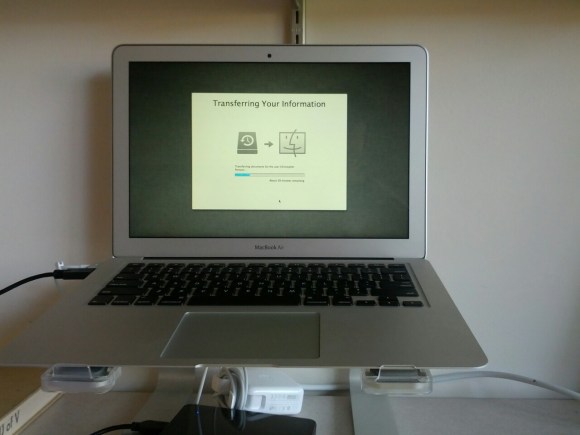
Time Machine Rocks

Time Machine is one of OS X’s most killer features!

Categories
Writing

The DEA, iMessage, and the Broader Significance

It’s been widely reported that the DEA San Jose office is unable to conduct surveillance of Apple iMessages. The note is revealing in its very phrasing; the author(s) state that:

While it is impossible to intercept iMessages between two Apple devices, iMessages between an Apple device and a non-Apple device are transmitted as Short Message Service (SMS) messages and can sometimes be intercepted, depending on where the intercept is placed. The outcome seems to be more successful if the intercept is placed on the non-Apple device. (emphasis added)

Note that despite the ‘encryption’ the agent(s) recognize that they can sometimes intercept messages. Importantly they are ‘more successful’ when the intercept is on the non-Apple device. Their phrasing suggests one of the following:

  1. Authorities are occasionally able to intercept messages between Apple devices; or
  2. Authorities are occasionally able to intercept messages that are inbound to an Apple device that are sent from a non-Apple device.

Either situation is interesting, insofar as the former raises questions of the efficacy of Apple’s encryption process and the latter questions about where a tap is placed pre-encryption in the Apple network.

More broadly, however, the challenge facing the DEA is one that is already encountered by investigators around the world. In fact, the DEA is in a pretty envious position: most of the major ‘messaging’ companies have some degree of corporate presence in the US and can thus be easily served with a wiretap order. Sure, a host of orders might need to be issued (one to Apple, one to Facebook, one to Google, etc etc) but this is a possible course of action.

Officers outside of the US that want similar access to messages that flow outside of SMS channels experience a different reality. They tend to need a MLAT or other cross-national warrant might be needed. Such warrants are incredibly time consuming and, as a result, resource intensive. These kinds of pressures are, in part, responsible for the uptick in discussions around state agents serving malware to mobile and fixed computing systems: it just isn’t practical to ‘wiretap’ many of these communications anymore, on the basis that the companies running the services are beyond the authorities’ jurisdictions.

So, while encryption is (fortunately) becoming more and more common, this isn’t necessarily the ‘solution’ to third-parties intercepting communications. Indeed, all it means is that attackers (in this case, the state) are targeting the far softer domains of the communications infrastructure: everything around the encryption layer itself.

Categories
Links

I still think [Apple] should go back to Dropbox with a blank check and just ask how many zeros they need to put at the end to make it happen.

My friend Dave Zaffrann, practicing the art of Having a Decent Idea while lamenting iCloud’s future (via chartier)

I think that this is on the mark, in the sense that iCloud is gross and Apple needs to do better. I also hope it never comes to be, given how much I use Dropbox on non-Apple devices and products.

Categories
Quotations

2013.1.22

One of my concerns at the time was network reliability. So, I brought Ken Kocienda, the first Safari engineer, with me to troubleshoot since he wrote so much of our networking code. If necessary, Ken could also diagnose and duct tape any other part of Safari too. He coined one of our team aphorisms, “If it doesn’t fit, you’re not shoving hard enough.”

Don Melton, “Safari is released to the world
Categories
Quotations

2013.1.3

You see, the thing about humans is that we have a really short attention span, and really bad memories. It’s actually hard for me to remember a time before I had a phone that could effectively replace my entire computer in most situations. A phone that I could make video calls from from any spot in the world, one that would let me log into our team’s IRC channel while on the floor of a major media event in any city and communicate with our whole staff. A device that was small enough to fit into the front pocket of my arguably-too-tight jeans that would let me connect and share my most important thoughts about developing news and world events — in real time! — with millions of people at once. A device that would underpin and enable modern social movements and political revolutions, generally shrink our sense of the size of humanity, and mesmerize and delight almost everyone who used it.

Joshua Topolsky, “Reasons to be excited