Categories
Links Quotations

Shaw email customers are scrambling after an interruption of Shaw’s email services Thursday led to millions of emails being deleted.

About 70 per cent of Shaw’s email customers were affected when the company was troubleshooting an unrelated email delay problem and an attempted solution caused incoming emails to be deleted, a spokesman told The Sunday Province.

Shaw has about 1.9 million Internet subscribers across Canada, with the majority in Western Canada.

Emails were deleted for a 10-hour period between 7:45 a.m. and 6:15 p.m. Thursday, although customers did not learn about the problem until Friday, and only then by calling customer service or accessing an online forum for Shaw Internet subscribers.

Shaw promised to email affected customers some time over the weekend with a list of deleted messages and details such as sender, subject and time sent. The actual content of the emails, however, is unrecoverable.

Glenda Luymes, “Shaw Internet customers up in arms over lost emails during service ‘interruption’

Count this amongst the many reasons I just don’t trust ISPs to host my email. It’s great that Shaw does this, really, given how it generally interferes with ports used for email: not only are they screwing consumers in how they treat email protocols (you can pay a monthly fee for full port access) but they’re also screwing them by not properly managing their email systems. I bet that Shaw customers don’t receive any restitution beyond an apology.

Categories
Aside Humour

Canada or Child Pornographers?

SFU OpenMedia.ca, Facebook timeline photos

Categories
Quotations

2013.3.1

I meet up with my friend Dan Pashman, who hosts the Sporkful podcast and whom you hear sometimes on Weekend Edition Sunday. He believes poutine would be better if it were served with the gravy on the side, so you could mete out perfect bites and avoid sogginess. I tell him you could also ask for a bunch of cans of paint instead of Starry Night, but I’ll trust van Gogh on it.

Ianan Chillag, “Dispatch From Poutine Fest, Chicago’s ‘Love Letter’ To Canada
Categories
Quotations

There’s A Yawning Need for Boring Professors

While such research is done in a number of countries, Canada seems to be a hotbed of boredom studies. James Danckert, an associate professor of psychology at the University of Waterloo, in Canada, recently conducted a study to compare the physiological effects of boredom and sadness.

To induce sadness in the lab, he used video clips from the 1979 tear-jerker, “The Champ,” a widely accepted practice among psychologists.

But finding a clip to induce boredom was a trickier task. Dr. Danckert first tried a YouTube video of a man mowing a lawn, but subjects found it funny, not boring. A clip of parliamentary proceedings was too risky. “There’s always the off chance you get someone who is interested in that,” he says.

Rachel Emma Silverman, “Interesting Fact: There’s a Yawning Need for Boring Professors

I found the third paragraph particularly amusing as someone who often finds watching parliament interesting. I guess I’d be one of the ‘problem’ participants!

Categories
Aside Links

What Canadian Political Parties Know About You

Colin J. Bennett, writing in Policy Options, explains how Canadian political parties collect and use voters’ personal information. It’s a quick, and valuable, read; highly recommended.

Categories
Aside

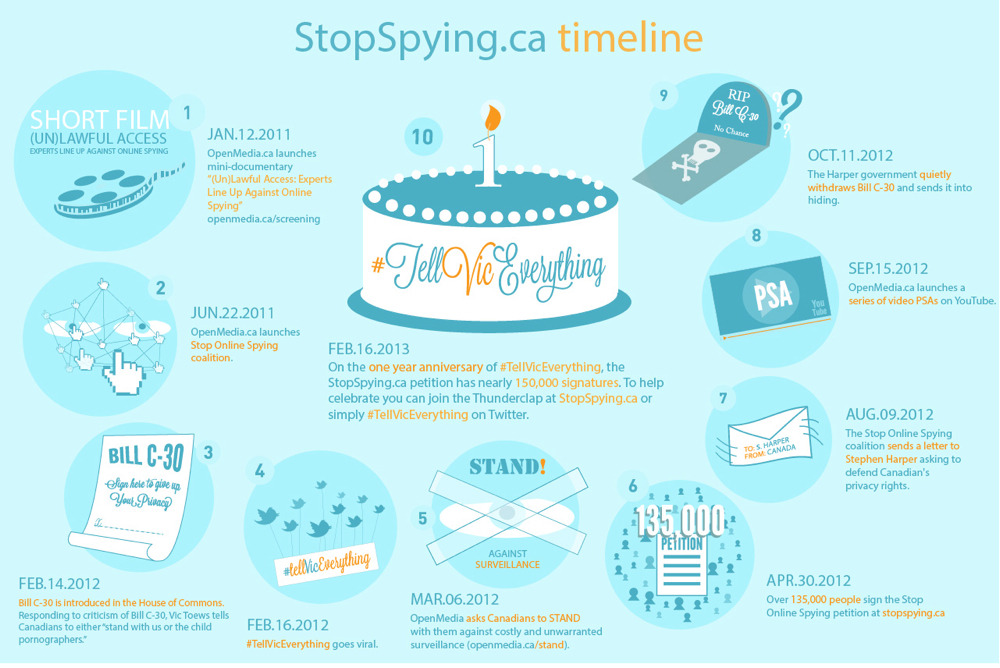
StopSpying.ca Timeline

StopSpying.ca Timeline

Categories
Links Writing

Lawful Access is Dead, Long Live Lawful Intercept!

So, the takeaway from this post is that Industry Canada’s proposed modifications significantly expand the volume and types of communications that ISPs must be able to intercept and preserve. Further, the Department is considering expanding interception requirements across all wireless spectrum holders; it needn’t just affect the LTE spectrum. We also know that Public Safety is modifying how ISPs have to preserve information related to geolocational, communications content, or transmission data. Together, these Departments’ actions are expanding government surveillance capacities in the absence of the lawful access legislation.

Industry Canada’s and Public Safety’s changes to how communications are intercepted should be put on hold until the government can convince Canadians about the need for these powers, and pass legislation authorizing the expansion of government surveillance. Decisions that are made surrounding interception capabilities are not easily reversed because once the technology is in place it is challenging to remove; as such, the government’s proposed modifications to intercept capabilities should be democratically legitimated before they are instantiated in practice.

Categories
Quotations

2013.2.4

Privacy is not simply an individual right or civil liberty; it is a vital component of the social contract between Canadians and their government. Without privacy, without protective boundaries between government and citizens, trust begins to erode. Good governance requires mutual trust between state and citizen. Otherwise, alienation and a sense of inequality begin to spread, circumstances under which no program for public scrutiny can be tenable or effective in the long term. Where citizen trust hits a low point, in fact, such security measures may be undermined, ignored, circumvented – or in the most egregious cases – passively or actively resisted.

Office of the Privacy Commissioner of Canada, “A Matter of Trust: Integrating Privacy and Public Safety in the 21st Century
Categories
Aside Humour

Bell and Internet-Based Security

A dated, but poignant, bit of information from Bell Canada concerning Internet-based computer security threats in Canada

Categories
Quotations

2013.1.11

But an attempt by Canadian ISPs to garner an all-access pass that would let them secretly install software to monitor potentially illicit user activity was thwarted, at least in part.

According to the note accompanying the draft regulations, industry representatives “had argued for exemptions from the requirement for consent to install software to prevent unauthorized or fraudulent use of a service or system, or to update or upgrade systems on their networks.”

Under the revised rules, service providers would only be permitted to install software “where illegal activities pose a threat to [their] networks.”

Kady O’Malley, “Ottawa’s anti-spam proposals prohibit secret monitoring software