Categories
Quotations

2013.3.15

Cheney’s office, according to Leonard, took secrecy to excessive lengths – attempting to classify as much as possible, and often bypassing the system altogether by inventing classification markings. Even documents as ordinary as Cheney’s talking points were marked Treated as Top Secret/SCI or Treated as Top Secret/Codeword.

“That’s not a recognized marking,” said Leonard. “I have no idea if it was the intent, but I can guarantee you what the consequences of those markings are. When any of this material eventually does end up at a presidential library and access demands are being made, or it’s being processed for release, when some poor archivist sees material marked Handle as SCI, it’s going into the bottom of the pile, and it is going to get much more conservative review. Whether it was the intent to retard the eventual release of the information, I know that’s going to be a consequence of it.”

D.B. Grady, “Why We’ll Never Get a Full Account of the War in Iraq
Categories
Aside Humour

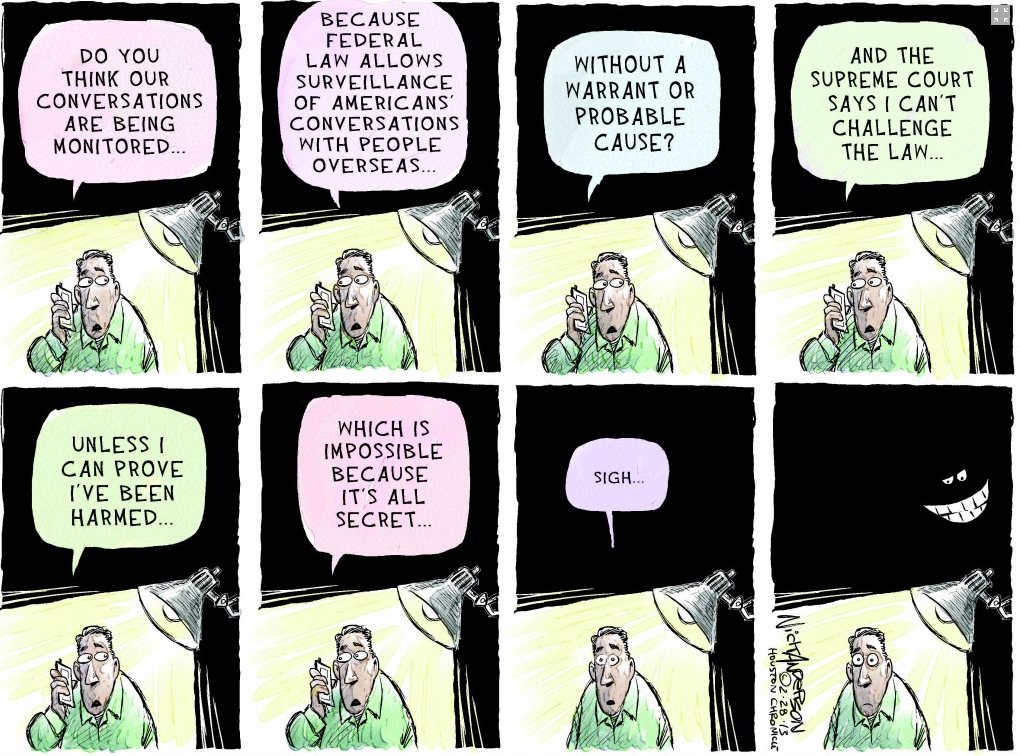
American Surveillance Catch-22

Categories
Links

Powerful men may actually be the worst?:

As a political reporter for GQ, I’ve been jokingly asked whether I ever posed for the magazine and loudly called a porn star by a senior think-tank fellow at his institute’s annual gala. In my prior job as a Hill reporter, one of my best source relationships with a member of Congress ended after I remarked that I looked like a witch who might hop on a broom in my new press-badge photo and he replied that I looked like I was “going to hop on something.” One journalist remembers a group of lobbyists insisting that she was not a full-time reporter at a major publication but a college coed. Another tried wearing scarves and turtlenecks to keep a married K Street type from staring at her chest for their entire meeting. The last time she saw him, his wedding ring was conspicuously absent; his eyes, however, were still fixed on the same spot. Almost everyone has received the late-night e-mail—“You’re incredible” or “Are you done with me yet?”—that she is not entirely sure how to handle. They’re what another lady political writer refers to as “drunk fumbles” or “the result of lonely and insecure people trying to make themselves feel loved and/or important.” … Sometimes they reach the level of stalking: One colleague had a high-profile member of Congress go out of his way to track down her cell-phone number, call and text repeatedly to tell her she was beautiful, offer to take her parents on a tour of the Capitol, and even invite her to go boating back home in his district.

This speaks depressing volumes about many individuals who are deeply invested in the political machinations of nation-states.

Categories
Links

TarenSK: DOJ admits Aaron’s prosecution was political

tarensk:

Even if Aaron’s intention was in fact to distribute the journal articles (to poor people! for zero profit!), that in no way condones his treatment.

But the terrifying fact I’m trying to highlight in this particular blog post is this: According to the DOJ’s testimony, if you express political views that the government doesn’t like, at any point in your life, that political speech act can and will be used to justify making “an example” out of you once the government thinks it can pin you with a crime.

Talk about a chilling effect on freedom of speech.

Chilling of speech is very, very real. And the things we’re learning in the aftermath of Aaron’s death only amplify concerns.

Categories
Quotations

There’s A Yawning Need for Boring Professors

While such research is done in a number of countries, Canada seems to be a hotbed of boredom studies. James Danckert, an associate professor of psychology at the University of Waterloo, in Canada, recently conducted a study to compare the physiological effects of boredom and sadness.

To induce sadness in the lab, he used video clips from the 1979 tear-jerker, “The Champ,” a widely accepted practice among psychologists.

But finding a clip to induce boredom was a trickier task. Dr. Danckert first tried a YouTube video of a man mowing a lawn, but subjects found it funny, not boring. A clip of parliamentary proceedings was too risky. “There’s always the off chance you get someone who is interested in that,” he says.

Rachel Emma Silverman, “Interesting Fact: There’s a Yawning Need for Boring Professors

I found the third paragraph particularly amusing as someone who often finds watching parliament interesting. I guess I’d be one of the ‘problem’ participants!

Categories
Quotations

2013.2.24

How a policy is understood and discussed is its policy image. Policy images play a critical role in the expansion of issues to the previously apathetic. Because all people cannot be equally interested or knowledgeable about all issues facing society, specialists in any area have an advantage over all others. Since they know the issue better, they are sometimes able to portray most of their time communicating with each other, of course, but from time to time they must explain their policies to the larger public or to elites with only a passing interest in the area. This type of communications requires some simplified ways of explaining the issue and justifying public policy approaches to them. As a result, every public policy program is usually understood, even by the politically sophisticated, in simplified and symbolic terms.

Frank R. Baumgartner and Bryan D. Jones, Agendas and Instability in American Politics (Second Edition)
Categories
Aside

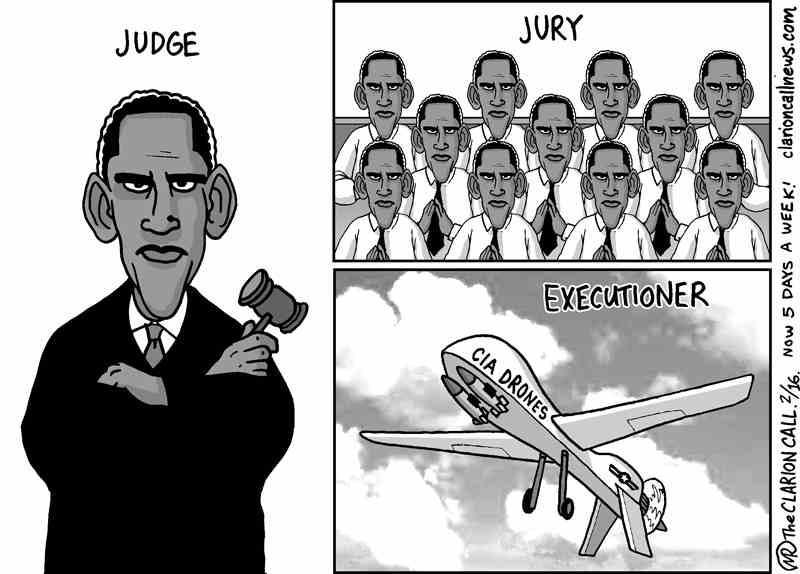
Judge, Jury, Executioner

As long as you’ve got executive privilege and secret interpretations of law, it’s legal, right?

Categories
Links Writing

Lawful Access is Dead, Long Live Lawful Intercept!

So, the takeaway from this post is that Industry Canada’s proposed modifications significantly expand the volume and types of communications that ISPs must be able to intercept and preserve. Further, the Department is considering expanding interception requirements across all wireless spectrum holders; it needn’t just affect the LTE spectrum. We also know that Public Safety is modifying how ISPs have to preserve information related to geolocational, communications content, or transmission data. Together, these Departments’ actions are expanding government surveillance capacities in the absence of the lawful access legislation.

Industry Canada’s and Public Safety’s changes to how communications are intercepted should be put on hold until the government can convince Canadians about the need for these powers, and pass legislation authorizing the expansion of government surveillance. Decisions that are made surrounding interception capabilities are not easily reversed because once the technology is in place it is challenging to remove; as such, the government’s proposed modifications to intercept capabilities should be democratically legitimated before they are instantiated in practice.

Categories
Quotations

2013.1.8

The war on terrorism should not be a war on ethics, integrity, technology and the rule of law. Stopping terrorism should not include terrorizing whistleblowers and truth tellers who raise concern when the government cuts corners to electronically surveill, torture and assassinate its own people. And it is not okay for a president to grant himself the power to play prosecutor, judge, jury and executioner of anyone on the entire fucking planet.

Jesselyn Radack, quoted in “US Whistleblowers on Being Targeted by the Secret Security State
Categories
Quotations

2012.11.24

The issue here is not whether Anonymous activists can be rightfully prosecuted: acts of civil disobedience, by definition, are violations of the law designed to protest or create a cost for injustices. The issue is how selectively these cyber-attack laws are enforced: massive cyber-attacks aimed at a group critical of US policy (WikiLeaks) were either perpetrated by the US government or retroactively sanctioned by it, while relatively trivial, largely symbolic attacks in defense of the group were punished with the harshest possible application of law enforcement resources and threats of criminal punishment.

That the US government largely succeeded in using extra-legal and extra-judicial means to cripple an adverse journalistic outlet is a truly consequential episode: nobody, regardless of one’s views on WikiLeaks, should want any government to have that power. But the manifestly overzealous prosecutions of Anonymous activists, in stark contrast to the (at best) indifference to the attacks on WikiLeaks, makes all of that even worse. In line with its unprecedented persecution of whistleblowers generally, this is yet another case of the US government exploiting the force of law to entrench its own power and shield its actions from scrutiny.

Glenn Greenwald, “Prosecution of Anonymous activists highlights war for Internet control