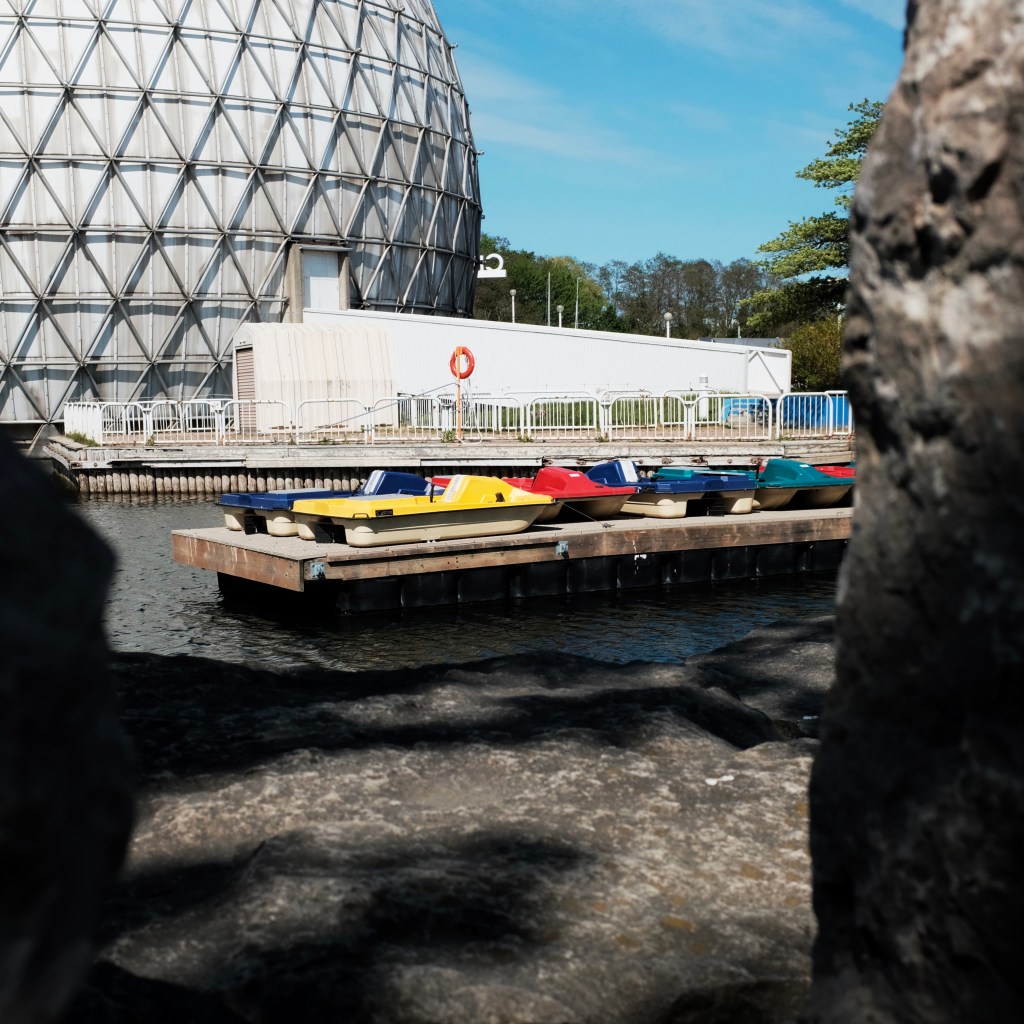
Categories
Photo Essay Photography

Nuit Blanche, 2024

Since 2006 Toronto has hosted Nuit Blanche, where selected artists are invited to set up art installations from sundown at 7pm until sunrise at 7am the following day. For the past decade or so I’ve tried to get out and enjoy the exhibits. I usually try to walking from 1am until 7am when the installations are taken down.

This year many of the installations took place around Toronto’s downtown waterfront. This had the effect of clustering people in a common part of the city and enhancing the sense of togetherness associated with the art exhibits; in past years I often felt like I alone was still out at 7am but not this year!

Bay & Queens Quay, Toronto, 2024

Each year there are food stall and trucks, and this year was no exception. Even at 1 in the morning there were crowds who were looking to have a quick bite to carry them through the evening. I’d just arrived and had yet to feel the bite of hunger or thirst.

Lower Sherbourne & Queens Quay, Toronto, 2024

One of the exhibits this year included a series of skeletal shacks. They stood above us and we looked at what may happen when civilization degrades and this is what we remain left with.

Great Lakes Waterfront & Queen Quay, Toronto, 2024

Of course walking around this late at night meant there were often strong contrasts between shadow and light. I’ve visited this area of Toronto regularly over the past decade and captured people huddled in the same spot, but never with such dynamic contrast between the lit structure and the rest of the environment. I liked how the subjects were huddled away from the darkness that was just beyond the lit structure. Isn’t this the nature of humans: huddling in the light while the darkness is kept at bay?.

Dockside & Knapp, Toronto, 2024

Each year there are some exhibits that are at least slightly interactive. Every person who attended a particular film screening was first asked to pick up a custom hanger and think about it during the performance. It wasn’t self-apparent how this hanger necessarily mapped to film.

Queens Quay & Freeland, Toronto, 2024

This was the only colour image I made through the night. The exhibit projected videos of people’s homes on a condo wall and, beside it, the artist had set up a tent to represent how many of Toronto’s least fortunate must live their nights. This was one of the more poignant exhibits I saw through the evening.

Queens Quay & York, Toronto, 2024

A set of screens were set up in Love Park and rotated the images in them through the night. The eyes that regularly cropped up were eerie at that time of the early morning.

Great Lakes Waterfront & Harbour, Toronto, 2024

Continuing the theme of eyes, this separate video display regularly had an image of an eyeball looking into the audience. When it isolated the older woman I knew I had to hold onto the moment.
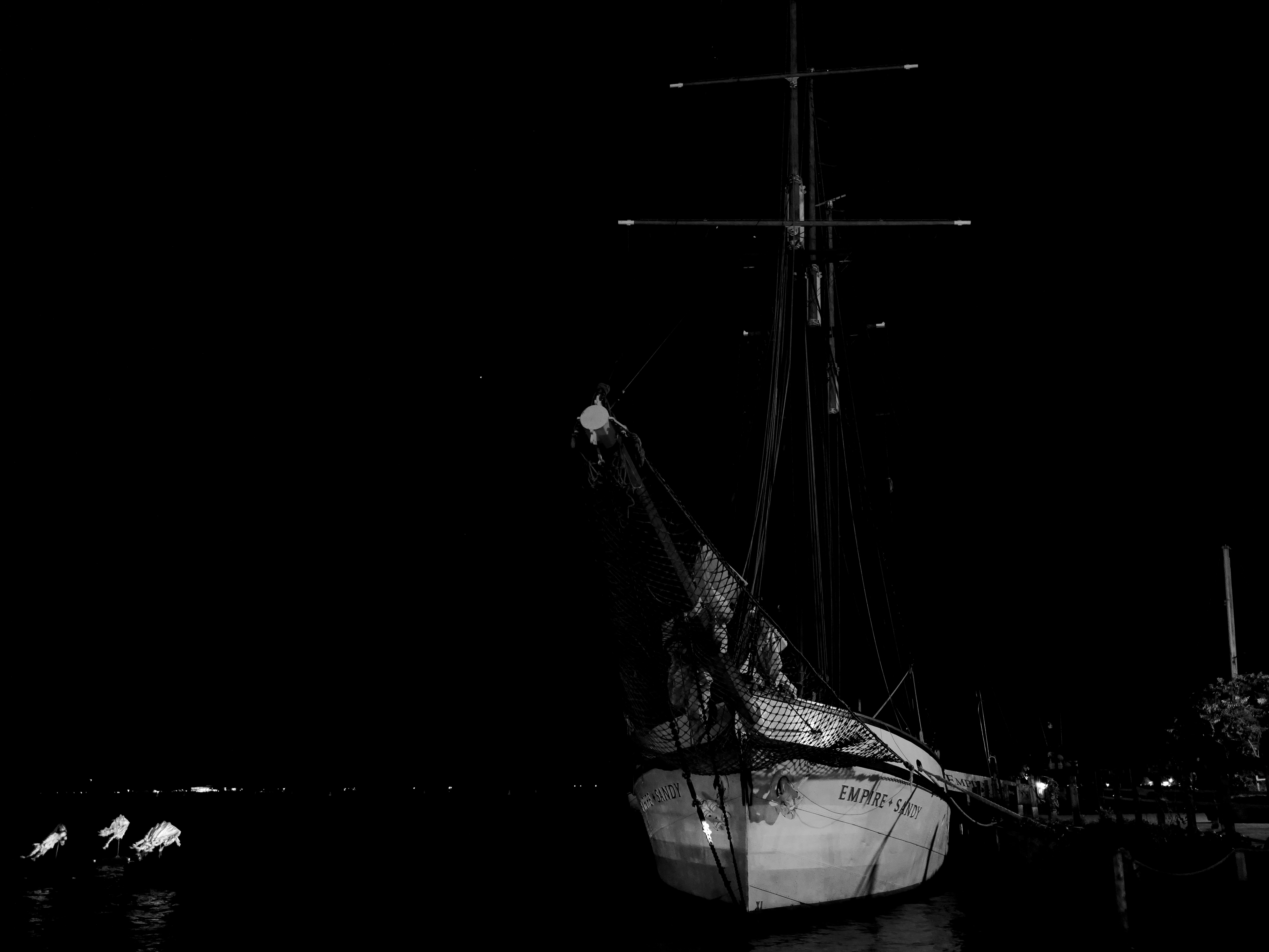
Spadina & Queens Quay, Toronto, 2024

One of the marque exhibits of the year were glowing fish that were placed in the harbour. Here, I’ve captured their luminescent being alongside one of the tall ships that is always docked; the effect is spectral, to my eye, with the fish racing towards the ghost-boat.

Bathurst & Queens Quay, Toronto, 2024

Hosting a project that raised the issue of disability inside a basketball court forced audiences to confront the ableism that permeates our lives, and especially contemporary sport. The exhibit forced audiences to acknowledge that disabled athletes have led the way in more accessible design that is now the norm for all athletes, disabled or not. By this time it was about 5am and the crowds were dying down, though spectators and attendees to the festival were still around in smaller numbers.
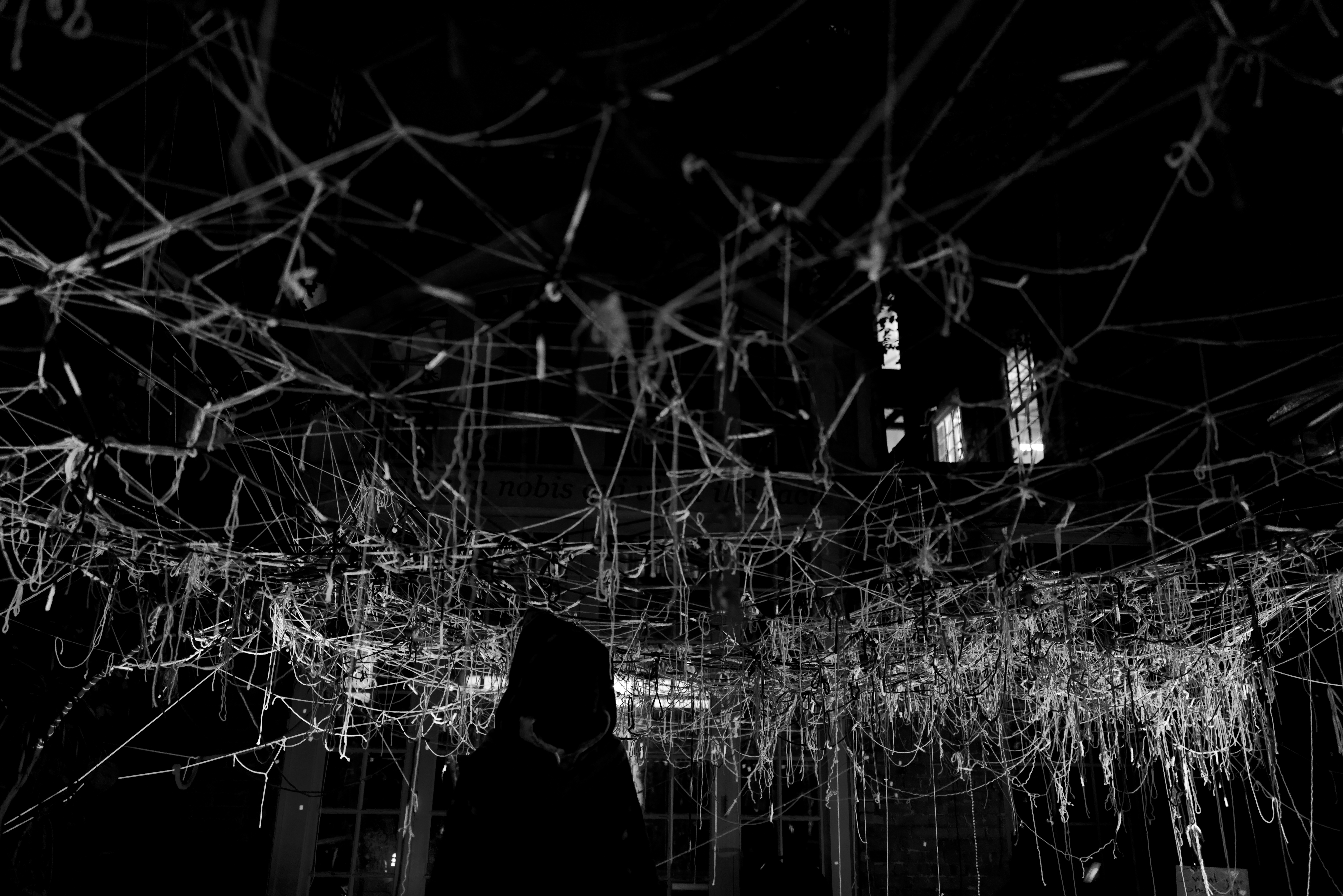
Richmond & Spadina, Toronto, 2024

This was the last exhibit that I documented and left with an image I was satisfied with. The artists were lowering a multi-coloured spider web that had been elevated above the attendees, when a sole last participant walked through the exhibit despite the efforts to tear it down by sundown. The subject is reaper-like in their image and spoke to the end of the exhibit, and the end of Nuit Blanche for 2024.
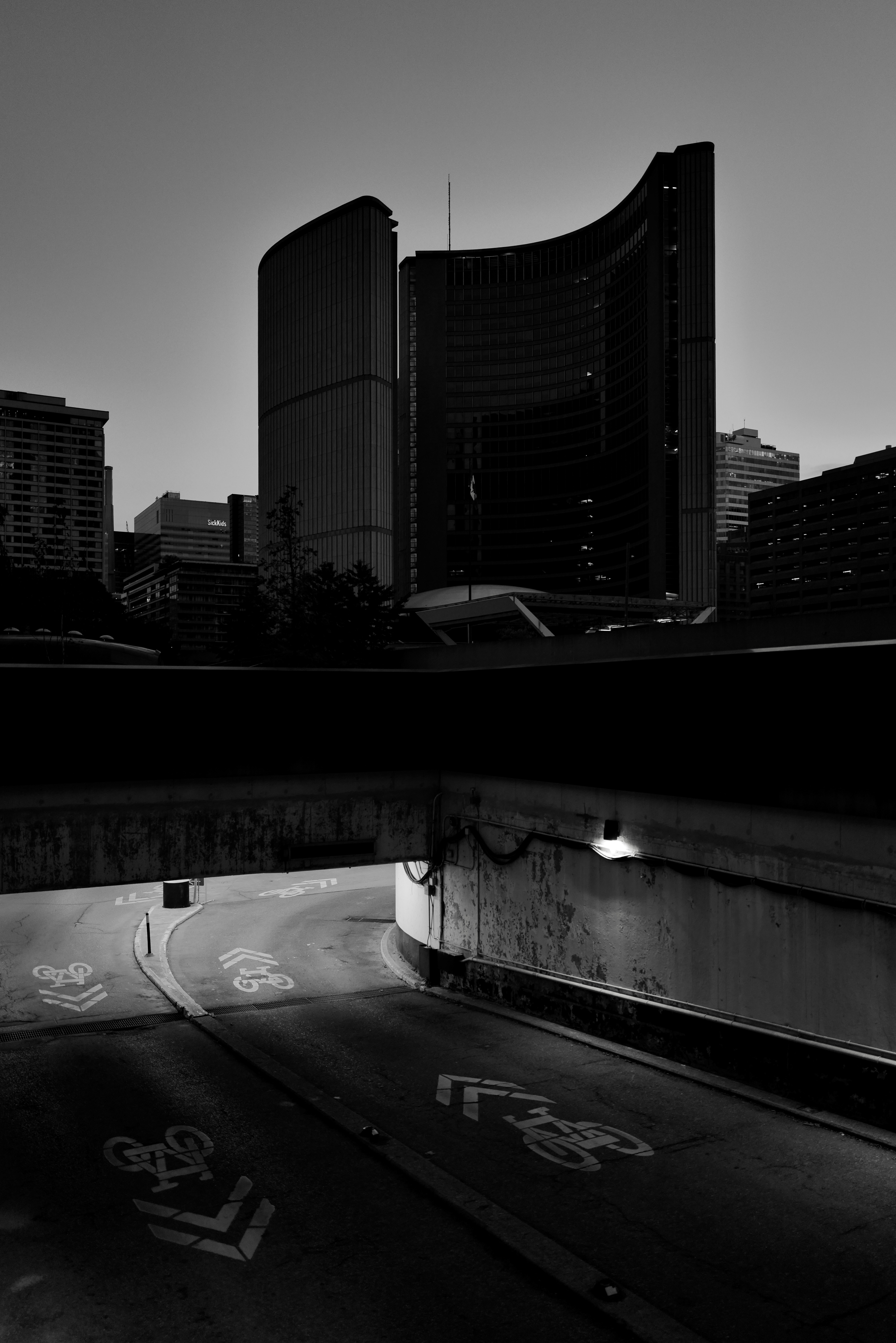
Queen & Chestnut, Toronto, 2024

On my way to breakfast I captured this image of Toronto’s City Hall as the sun was just starting to rise. All was quiet, including the parking garages, though the city had begun coming back to life once I got home an hour or so later to crawl into bed before a short nap ahead of afternoon activities.

Categories
Photography Writing

Tecumseth & Niagara, Toronto, 2023

Tecumseth & Niagara, Toronto, 2023

Toronto is a city of destruction and construction: destruction of the previous era’s architecture (and often industrial buildings) and the construction of housing or glass office towers in their stead. This image by Tecumseth & Niagara shows the destruction of an abattoir that was removed to make room for condos, and the buildings in the background are new rentals in Toronto’s Liberty Village. When I landed in Toronto, in Liberty Village over a decade ago, the land those rentals are on were home to a few artist spaces where the big Toronto samba schools practiced and massive parade puppets were made. Nothing has replaced those artist spaces, to the detriment of artists across the city.

Weirdly I have very intimate memories of the abattoir. Toronto hosts an annual sunset-to-sunrise art festival, Nuit Blanche, and a couple interesting art exhibits were hosted at the abattoir over the years, and I have photos of them that I regularly return to re-experience. After the buildings were designated for destruction a number of community vegetable gardens were maintained on the outside lots. It was always a striking place to come and make images, and was a reminder of the Toronto-that-once-was and was yet-to-become.

For many street photographers, we take images and it is decades later that ‘difference’ is registered because many cities take a long time for major changes to become visible. It’s part of why the habits of the population —what people are wearing, holding, or driving — resonate so strongly with viewers; people and culture change while the built environment persists.

Toronto, by way of contrast, is in a moment of hyper-growth and so an attentive and active street photographer can document things today that may literally be different tomorrow. It turns the street photographer, almost by default, into an urban documentarian. And, also, is one of the many reasons why I think that Toronto offers a subset of street photographers a real opportunity to do novel and rapidly impactful work, as compared to those working in cities that aren’t undergoing the same tempo of destruction and re-construction.

Categories
Links Photography

A Century Caught on Camera

The Globe and Mail has a terrific photographic series entitled "A century caught on camera." As a Toronto resident I was struck by just how many traditions, rituals, and grievances have stuck with the city–or in the city–for over a century.

Further, the way in which the images have been captured has changed substantially over time as a result of the technical capacity of camera equipment, along with the interests or preferences of the photographers at different times. Images in the past decade or two, as an example, clearly draw more commonly from celebrity or artistic portraiture than 50 years ago. Moreover, it’s pretty impressive just how much photographers have done with their equipment over the past century and this, generally, speaks to how easy street and documentary photographers have it today as compared to when our compatriots were using slow lenses and film.

It may take you quite a while to get through all the images but I found the process to be exceedingly worthwhile. Though I admit that the first decade during which the Globe used colour images probably ranks as my least favourite period in the galleries that the paper has published.

Categories
Photo Essay Photography

Winter Stations 2023

For the past five to six years or so I’ve been going to the Winter Stations outdoor art exhibit in the Beaches area of Toronto. Each year there is an international public competition between artists to put up architectural exhibits that include or encompass a lifeguard station that is set up along the Beach. Depending on the year there is, or isn’t, snow on the ground.

Families, children, and dogs all show up to enjoy (and try to understand!) the various exhibits that go up each year. At this point I see it as one of my ‘Toronto rituals’; the exhibition became important to me many years ago and I’ve refused to let that change. This part of the city, for as long as it lasts, is part of my experience of the city of Toronto itself and the ritual of seeing the exhibitions is part of what it is for me to be a Torontonian.

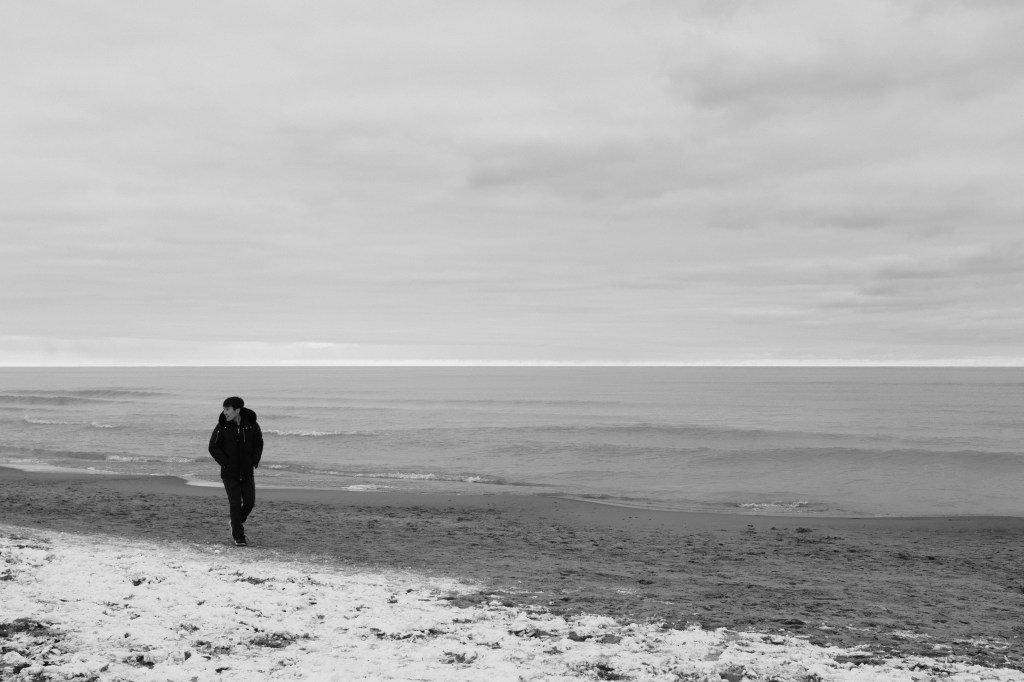
There’s a lot to enjoy about the experience, not the least being the presence of ‘typical’ beach stuff like the Muskoka chairs that people use along with the moderate starkness of the beach in a relatively inhospitable period of time. Some times that I’ve been to the exhibit has seen me shivering despite wearing multiple layers, along with an insulated vest and long wool coat with wool mittens and hat. Others have seen me just get wet with the rain as it pours onto the same kind of outfit. Fortunately it was a relatively balmy -2 degrees (Celsius) with no precipitation and I stayed warm the whole time, this year!

Each time I come to the art exhibit I not only feel a bit like I’m going through a Toronto-ritual I’ve developed but, also, it reminds me a bit of growing up along the Atlantic. The water isn’t salty and the life guard stations are a lot closer to the water, but it’s about the closest I’m likely to get to my historical home as is likely to occur.

One of the things that I always seem to look for when at this event is the kind of starkness or minimalism that is present in the exhibits. They need to stand up to the elements and, also, the destructive nature of children. And so many of the exhibitions are robust without much decoration. Years ago, there was an exhibit that encouraged children to (and I’m quoting) “interact” with the exhibit. It was ruined by the time that I appeared, though kids still liked jumping on all the damaged bits.
I had the pleasure this time of visiting the exhibit with my partner and a friend who generously put up with me making photos while they had conversations with one another. Despite being the person who was responsible for dragging people to the event—though it wasn’t this cold this time!—I was probably less present and/or took too much time doing my own thing than was likely appreciated. Both are long forgiving in their willingness to indulge me in my hobby.

Each time I return to this part of Toronto I’m reminded of my past: this was where I lived, many moons ago, and where some life changing stuff happened in my life. There’s always a sense of renewal—insofar as the art and people are different—along with a sense of the past that haunts me whenever I walked along this part of Lake Ontario.

At the same time, it’s always invigorating: it’s a place that reminds me of what once was and what is, now. And how great that now is!

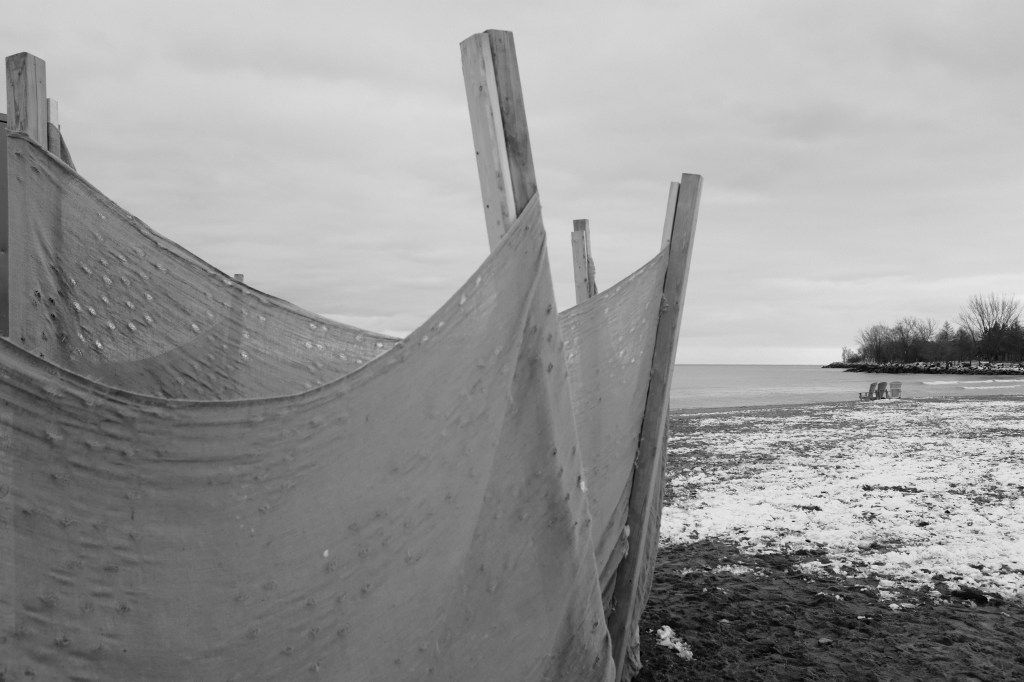
Some of the images I captured while at the exhibition this year, such as the above image of the empty chairs behind the fence, remind me that this space will be renewed soon with beach goers visiting and a liveliness that belies the current (general) absence of humans. Toronto ebbs and flows, and its residents will soon flow back to this part of the city once the weather improves some. I’ll look forward to returning to the Beaches—and capturing them in photographs—when the seasons have shifted!

Categories
Photo Essay Photography Writing

First Snow of 2023 Photowalk

We got our first snow of the year on Sunday. I kept waiting for it to come and as soon as the snow started to fall I grabbed my Fuji X100F with a Cinebloom 10% attached and headed out to make some images.

I live in a densely populated section of Toronto. Notwithstanding the snow there were many people out and about when I first hit the streets. But it was as I moved to side streets, or into parts of the city that tend to be populated by tourists, that it was apparent that huge chunks of the city were largely depopulated as people decided to stay inside where it was warm and dry.

There were, of course, some people out even in the less populated parts of the city. They, however, tended to be trying to get out of the snow—which functionally turned into snow that was almost indistinguishable from rain towards the early evening—and generally wanted to just avoid getting wet or cold.

Somewhat surprisingly I saw almost no other photographers out and about. I’m sure they were there, somewhere. But, at the same time, I wonder how much the weather dissuaded them from getting out and shooting the streets or urban landscapes.

I will never be accused of babying my cameras. My Fuji X100F lacks the weatherproofing of the newest version and, so, when I’m out in the snow I tend to protectively place one hand over it’s screen and eyepiece, and keep the lens pointed downwards and slightly in towards my body. It doesn’t prevent all the precipitation from getting onto the camera but, along with brushing off water when it starts to gather on dials and such, has always seemed good enough to keep the equipment safe.

The mix of heavy coats and umbrellas is something that I’m always curious about, if only because I can’t recall ever seeing something similar while I was growing up or when I visit parts of the country (or world) that receive large volumes of snow. I don’t dispute the potential utility of an umbrella—it will, obviously, help to keep your head wet and my uncovered head certainly got soaked after 3-4 hours outside—but it always seems like an instrument that is out of place. Though they look very distinct in the snow and so I definitely took the chance to make images of people who were carrying them!

Though there were people out and about, and evidence in other cases of someone having been present recently, much of the city felt oddly solitary. When I make my photos I’m often trying to communicate a sense of, on the one hand, the press of other people around and upon us and, on the other, the loneliness or isolation experienced while being in these massive urban environments. Dismal weather almost always draws me to the latter and wanting to express how large our environments are and what they look like with few figures or, alternately, in the absence of humans entirely. What will the city look like when the humans are gone?

When I watched one of James Popsys’ videos recently he mentioned that, when taking his landscapes, he likes putting either a human or a human-made thing in his images. Doing so has the effect of communicating human presence and, often, what the natural environment looks in our absence. Human-made things, also, have the effect of drawing us into an image on the basis that we ‘see’ something of ourselves in the otherwise natural environment.

In an almost modernist way of thinking those solitary human-things have the effect of both showing the attempt to overcome, or start overcoming, nature while often simultaneously showcasing the majesty and longevity of nature against the transitory existence of human-made things. Or at least that’s how I see and study such images.

I don’t know how well I really captured ‘nature’ in my walk—save towards the very end of my walk—but Popsys’ words have resonated in my head for some time. For years when I’ve made images of the city it’s often been with a view that the humans are transitory; they move though the frame, they enter and exit the city, they live and die. The built infrastructure and the protected landscapes interspersed throughout the city, however, will (should?) persist for a far longer period of time. Yes, Toronto is a city undergoing profound construction but looking through historical photos of the city reveal that key things have remained for a century or more in spite of the changes.

Of course that isn’t to say that the old has stayed perfectly the same; the bridge I took the below image from is literally a bridge to nowhere that was disconnected from the surrounding roads in 1964. While there were plans to remove it, apparently it’s more affordable to do minimal maintenance on it than tear it down; it’s only a matter of time, though, until this economic calculus changes. The city keeps putting up fences and warnings to keep people off the bridge but there’s only been once in the past decade where the fences were intact and I was prevented from getting onto the bridge. In the summer you can regularly discover some pretty cool graffiti along its struts.

The bridge sits over the Don River and, looking south, you have a view of a highway that our municipal and provincial governments continue to pour money into, as well as industrial lands which have been in declining operation for a long time. While the specific buildings will almost certainly change—most likely to be replaced by condos—the character of the landscape should remain the same for decades insofar as the highway and walking path should persist. Though it may be that a similar image will only be accessible to those flying small drones when the economic calculus for maintaining the bridge changes.

Categories
Photo Essay Photography Writing

January 1st Graffiti Photowalk

I routinely try and take a bit of a longer photowalk at the start of each year. It’s an opportunity to stretch my legs some and a great way to start of the year while, also, getting a chance to document the city while it’s still recovering from New Years celebrations.

This year was no different, save that I ended up leaving for my walk later than intended and was drawn to a number of Toronto’s alleys throughout the evening.

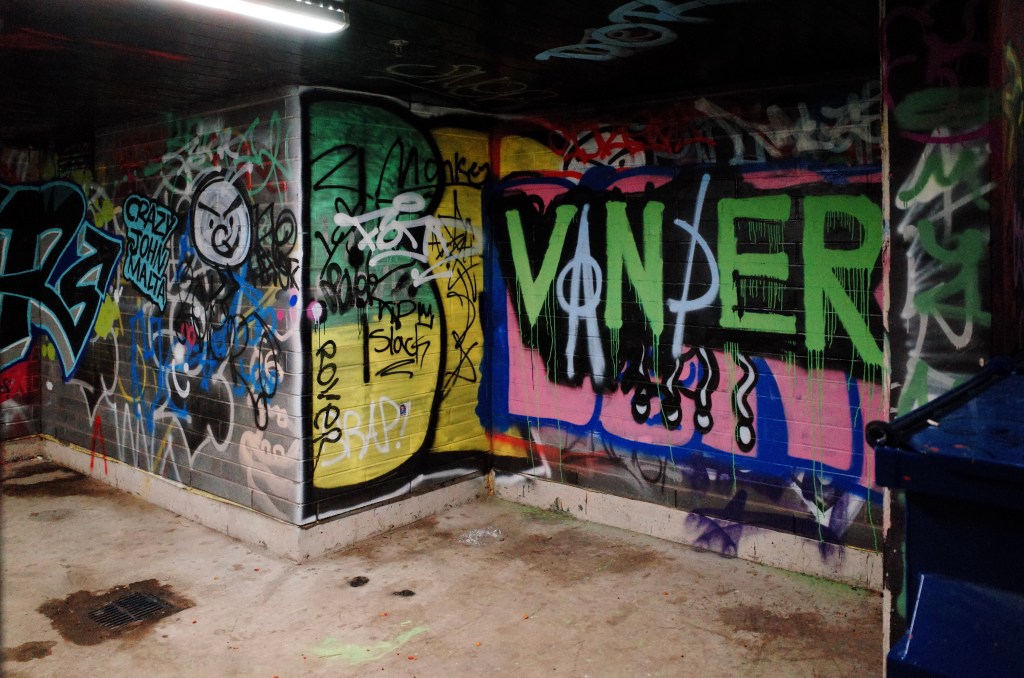
While I did the majority of my shooting through the late afternoon and evening in monochrome, I couldn’t help by see how the positive film simulation in my Ricoh GRs would showcase the vibrant colours of graffiti under artificial lighting situations.

It was only once I’d brought the images home and looked at them that it became apparent that the majority of the photos were made from the same angle. I had no idea I was doing this at the time but, in hindsight, I definitely wish that I’d made images from wider variety of angles.

When I was wandering through some of the alleys I wished that there had been more people about to include in some of the images. Even a wisp of a figure would, I think, have added a bit of a haunting character to many of the photographs.

In their absence, however, I largely (though not completely) tried to channel Tatianna Hopper. She sometimes engages in a kind of street photography that simultaneously showcases the existence and absence of humans. Graffiti and human trash, or waste, expresses this concept to my mind.

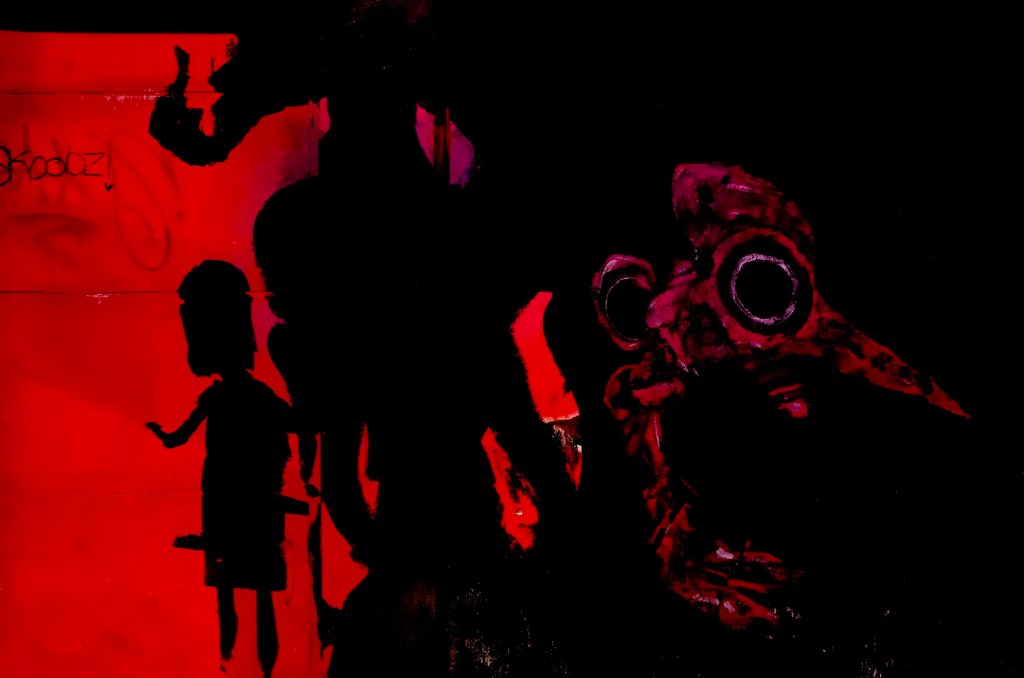
In a number of alleys there were quasi-monstrous or demonic imagery. I see more and more of it around the city and have met the artists of some of it. The effort they’re putting in is amazing with really interesting effects; when shooting with humans in the frame and in monochrome, I find the graffiti adds an interesting graphic element and juxtaposition. Even on its own, however, the juxtaposition between colour and monochrome graffiti causes its own novel contrast.

Almost the entirety of 2022, and the tail end of 2021, saw me shoot 99% of my images in monochrome. I’m happy with the progress I’ve made on the street and can see the very real improvements in composition and ability to ‘see’ in monochrome. However I’m inspired by Alex Webb and Gustavo Minas’ ‘Maximum Shadow Minimal Light’. Both use shadow in colour photography and I’d like to develop similar skills . Maybe that means I’ll experiment some through the year in trying to translate what I’ve learned about light and shadows in monochrome images into colour photos!

Categories
Photo Essay Photography

Vacation Street Photography Challenge

(Come Towards the Light by Christopher Parsons)

This year I took a very late vacation while Toronto was returning to its new normal. I’ve been capturing the city throughout the COVID-19 pandemic and I wanted to focus in on how the streets felt.

During the pandemic we’ve all been attached to our devices, and our phones in particular, and thus decided to document the city through the lens of our ever-present screen: the smartphone. I exclusively shot with my iPhone 12 Pro using the Noir filter. This filter created a strong black and white contrast, with the effect of deepening shadows and blacks and lifting highlights and whites. I choose this, over a monotone, as I wanted to emphasize that while the city was waking up there were still stark divides between the lived experiences of the pandemic and a continuation of strong social distancing from one another.

95% of my photos were captured using ProRaw with the exception of those where I wanted to utilize Apple’s long exposure functionality in the Photos application.

Darkroom Settings

In excess of the default Noir filter, I also created a secondary filter in Darkroom that adjusted what came off the iPhone just a bit to establish tones that were to my liking. My intent was to make the Noir that much punchier, while also trying to reduce a bit of the sharpness/clarity that I associate with Apple’s smartphone cameras. This adjustment reflected, I think, that digital communications themselves are often blurrier or more confused than our face-to-face interactions. Even that which seems clear, when communicated over digital systems, often carries with it a misrepresentation of meaning or intent.

Categories
Photo Essay Photography Writing

A Place That Grew

Toronto is home to Ontario Place, which was once a park that had splash pads, rides, a Legoland, and more. It was opened in 1971 and hugs Lake Ontario. It was closed in 2012 for redevelopment and, since then, has largely languished as successive governments have suggested ideas but none have come to fruition. Ontario’s official motto is “A Place to Grow”, and by extension Ontario Place itself is a place that has since grown up and is now slowly wasting away due to government neglect.

It’s also one of my favourite places in the city to visit and photograph, and especially during the pandemic when it has been relatively quiet and free of people. It’s both a very calming location and one that has very interesting buildings and urban ruins to photograph.

(Highway Views by Christopher Parsons)
(Modes of Locomotion by Christopher Parsons)

It’s getting warmer in Toronto which means that people are inclined to be outdoors; there are more cyclists and skateboarders in Toronto than I think ever before, and they’re all using the paths that are typically used predominantly by people who are walking or jogging.

(Unity Run by Christopher Parsons)
(Light Rails BW by Christopher Parsons)

Each year, I’ve managed to find or access or photograph a new part of the park that’s succumbed to lack of upkeep, and this year is no exception. An enterprising soul laid down some boards to cross over into part of the flume ride which meant I could see it for the first time! I suspect that it’ll only be a matter of time until a provincial government finally gets its way and tears down these ruins.

(Towards the Apex by Christopher Parsons)
(Down We Go by Christopher Parsons)
(Flume(ing) Graffiti by Christopher Parsons)
(Landlocked by Christopher Parsons)

I’m sure that more and more people will be using the park this year it’s limited attractions, and especially as more Torontonians get vaccinated. While I’ll miss feeling like the park is my own, it’ll be terrific to have another part of the city return to normality.

(Goodbye! by Christopher Parsons)

(All photos shot using an iPhone 12 Pro and Fuji x100f, and edited using my presets in Darkroom.)

Categories
Photo Essay Photography Writing

One Year Later

This long form photoessay showcases the absences that have been wrought by the pandemic in my city of Toronto, Ontario. The essay provides a meditation on a world of social isolation and distancing, and how the spaces that have historically united and bound Toronto’s residents have been left empty or made safe in response to being associated with risk and disease. Throughout, people are represented as separate from one another in their efforts to socially and physically distance, with individuals, pairs, or very small groups standing in juxtaposition to the much larger built world they inhabit.

All of the images were created using a combination of a Fuji X100f, Sony rx100ii, iPhone 11 Pro, and iPhone 12 Pro. Images were edited to taste using Apple Photos (for cropping) and Darkroom; two images had some healing applied using Snapseed.

(Parked I by Christopher Parsons)
(Looking to the Past by Christopher Parsons)
(Temporary Gigs by Christopher Parsons)
(Chance of Clouds by Christopher Parsons)
(Pals by Christopher Parsons)
(Unhoused by Christopher Parsons)
(Embracing Walk by Christopher Parsons)
(Time Alone by Christopher Parsons)
(Light and Tunnel by Christopher Parsons)
(Contemporary Ruins by Christopher Parsons)
(Stay Safe by Christopher Parsons)
(Urban Emptiness by Christopher Parsons)
(Comfort Run by Christopher Parsons)
(Down, Not Out by Christopher Parsons)
(Hope by Christopher Parsons)
(Dockside by Christopher Parsons)
(Not So Soon by Christopher Parsons)
(Signs by Christopher Parsons)
(Hydrophobic by Christopher Parsons)
(Social Distancing I by Christopher Parsons)
(Gateless by Christopher Parsons)
(Through a Glass Darkly by Christopher Parsons)
(Riderless by Christopher Parsons)
(Summer I by Christopher Parsons)
(Summer II by Christopher Parsons)
(Closing Time by Christopher Parsons)
(The Visitor by Christopher Parsons)
(Waiting for Next Summer by Christopher Parsons)
(Ride by Christopher Parsons)
(Parked II by Christopher Parsons)
(Christmas 2020 by Christopher Parsons)
(Message by Christopher Parsons)
(Racing the Light by Christopher Parsons)
(Midnight Stroll by Christopher Parsons)
(Spotlights by Christopher Parsons)
(Calm by Christopher Parsons)
(Arachnid Problem by Christopher Parsons)
(Urban Eatery by Christopher Parsons)
(Observer by Christopher Parsons)
(Couples by Christopher Parsons)
(Seeing Stars by Christopher Parsons)
(In The Neighbourhood by Christopher Parsons)
(Closed for New Year by Christopher Parsons)
(Social Distancing II by Christopher Parsons)
(The Walk by Christopher Parsons)
(They Are Legend by Christopher Parsons)
(The Theatre by Christopher Parsons)
(Focused by Christopher Parsons)
(Empty Stage by Christopher Parsons)
Categories
Photography

Images from Toronto Harbour

Sunset Sail by Christopher Parsons
Warnings by Christopher Parsons
Fall Views by Christopher Parsons