At least Britain sort of got it half right. There, to make life easier for stores selling age-restricted items there’s a “Challenge 21″ programme, so anyone looking 21 or under is asked for ID, even if the products are restricted to over-18s. Tesco and other large chain stores championed a “Challenge 25″ programme just in case someone slipped through the net. Finally some idiot in the seaside resort of Blackpool came up with the idea of “Challenge 30″, which is roundly lambasted across Britain.
But at least these outlets demand high-integrity forms of ID such as driving licences. In the US you can show a picture of your dog pasted on the back of a chocolate biscuit and they’re likely to accept it.
That’s because no-one really knows why they are asking for ID in the first place, and no-one up the chain tells them – mainly because they don’t know either. Everyone just goes through the motions. There’s no way to verify the validity of ID, so everyone just plods along with the security theatre.
Simon Davis, “How a dog and some chocolate biscuits reveal an identity crisis in America”
Tag: United States
2013.3.2
In Jewel, the Obama administration has already twice invoked the “state secrets” privilege, a mechanism left behind from the McCarthy-era persecution of Communist sympathizers which effectively lets the government ‘turn off’ the Constitution and the justice system whenever they feel that a case might jeopardize national security. The administration has promised to limit its use of the privilege to situations which present the potential for “significant harm” to the country. But that promise obviously hasn’t stopped them from deflecting recent challenges to warrantless wiretapping and other government counterterrorism initiatives — like indefinite detention provisions, or the secret program for targeted killings carried out by drones — nor will it necessarily restrain future administrations from doing the same.
Jewel may be the last chance for meaningful judicial review of the wiretapping programs in the foreseeable future. Failing that, the only remaining response for journalists and others dealing in sensitive overseas communications may be exactly what digital activists have been advocating for decades: widespread personal encryption. But aside from being somewhat impractical, the necessity of encrypted communications would more broadly underscore just how thoroughly the legal system has failed to protect citizens from unnecessary intrusion.
Joshua Kopstein, “Denied in the Supreme Court, warrantless wiretap opponents are losing ground fast: Does secret surveillance violate the Constitution? Sorry, that’s a secret”
The report finds plenty of blame to go around. The ultimate cause of the fiasco, it says, was the fact the grant implementers did not conduct a capacity or use study before spending $24 million. They also used a “legally unauthorized purchasing process” to buy the routers, which resulted in only modest competition for the bid. Finally, Cisco is accused of knowingly selling the state larger routers than it needed and of showing a “wanton indifference to the interests of the public.”
Getting any of the money back seems unlikely at this point, but the legislative auditor does have one solid recommendation to make. The State Purchasing division should determine whether Cisco’s actions in this matter fall afoul of section 5A-3-33d of the West Virginia Code, and whether the company should be barred from bidding on future projects.
Cisco tells Ars “the criticism of the State is misplaced and fails to recognize the forward-looking nature of their vision. The positive impact of broadband infrastructure on education, job creation, and economic development is well established, and we are committed to working with the State to realize these benefits for the people of West Virginia now and into the future.”
As for that $5+ million the state could have saved—it would have paid for 104 additional miles of fiber.
Nate Anderson, “Why a one-room West Virginia library runs a $20,000 Cisco router: Cisco, West Virginia wasted $5M on enterprise-class routers”
2013.2.28
… test version of a data-mining tool in Delta’s offices, and he was surprised by the technology’s power to collect vast amounts of personal information using one start point. Jackson volunteered his Social Security number and watched the tool retrieve his address, the names of his neighbours, his wife’s name, and the date they were married, all from publicly available information. Some of the Delta employees had been test subjects already, and when his own personal information stated popping up for all to see, Jackson joked he’d seen enough. But the demo convinced him that the government had to have this capacity. Not because he wanted it. But because he was afraid he couldn’t do his job without it.
Shane Harris, The Watchers: The Rise of America’s Surveillance State

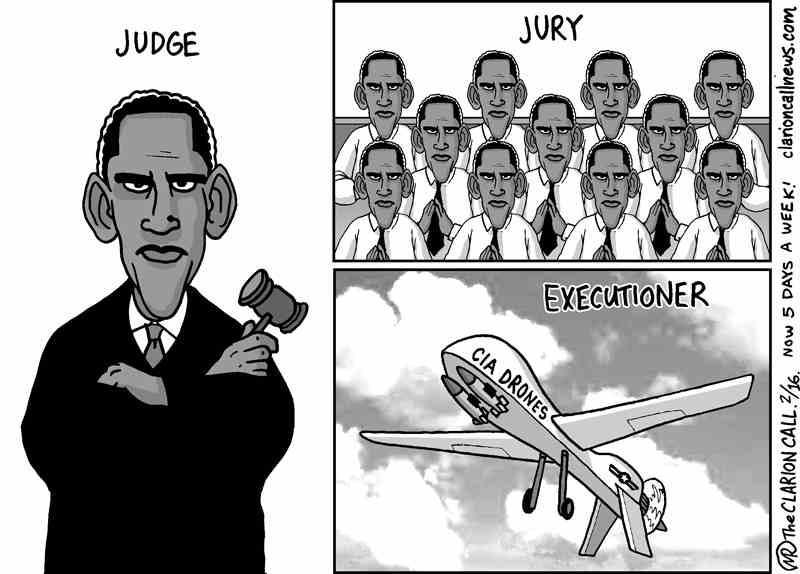
Judge, Jury, Executioner
![]()
As long as you’ve got executive privilege and secret interpretations of law, it’s legal, right?
2013.2.10
It saddens me that America’s so-called government for the people, by the people, and of the people has less compassion and enlightenment toward their fellow man than a corporation. Having been a party myself to subsequent legal bullying by other entities, I am all too familiar with how ugly and gut-wrenching a high-stakes lawsuit can be. Fortunately, the stakes in my cases were not as high, nor my adversaries as formidable as Aaron’s, otherwise I too might have succumbed to hopelessness and fear. A few years ago, I started rebuilding my life overseas, and I find a quantum of solace in the thought that my residence abroad makes it a little more difficult to be served.
Bunnie Huang, “A Moment of Silence for Aaron Swartz”
2013.2.3
Aaron was part of an army of citizens that believes democracy only works when the citizenry are informed, when we know about our rights—and our obligations. An army that believes we must make justice and knowledge available to all—not just the well born or those that have grabbed the reigns of power—so that we may govern ourselves more wisely.
…
When people try to restrict access to the law, or they try to collect tolls on the road to knowledge, or deny education to those without means, those people are the ones who should face the stern gaze of an outraged public prosecutor.
Carl Malamud, “Aaron’s Army”
2013.1.19
It’s not good to be on Power’s bad side, however. When you are on that side, Power piles on charges rather than shrugging off felonies as simple mistakes. Especially if what you do falls into the gray area of enforcing the letter as opposed to the principles of the law.
…
You can file all the petitions you like with the powers that be. You can try to make Power –whether in the form of wiretapping without warrants or violating international conventions against torture — follow its own laws. But Power is, as you might suspect, on the side of Power. Which is to say, Power never pleads guilty.
Ryan Singel, “Aaron Swartz and the Two Faces of Power”