Look, if you think the fact that my Internet of Shit door-lock failed because the company that designed it made no plan to let me into my house if they went out of business would make me sympathetic to that company, you are out of your fucking mind.
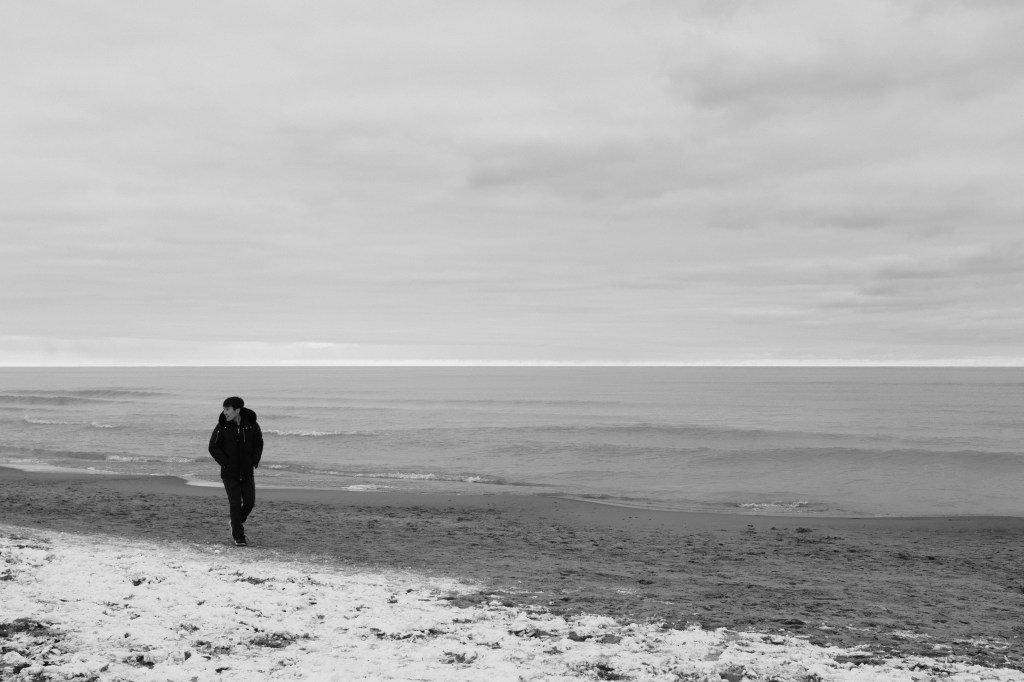
For the past five to six years or so I’ve been going to the Winter Stations outdoor art exhibit in the Beaches area of Toronto. Each year there is an international public competition between artists to put up architectural exhibits that include or encompass a lifeguard station that is set up along the Beach. Depending on the year there is, or isn’t, snow on the ground.
Families, children, and dogs all show up to enjoy (and try to understand!) the various exhibits that go up each year. At this point I see it as one of my ‘Toronto rituals’; the exhibition became important to me many years ago and I’ve refused to let that change. This part of the city, for as long as it lasts, is part of my experience of the city of Toronto itself and the ritual of seeing the exhibitions is part of what it is for me to be a Torontonian.
There’s a lot to enjoy about the experience, not the least being the presence of ‘typical’ beach stuff like the Muskoka chairs that people use along with the moderate starkness of the beach in a relatively inhospitable period of time. Some times that I’ve been to the exhibit has seen me shivering despite wearing multiple layers, along with an insulated vest and long wool coat with wool mittens and hat. Others have seen me just get wet with the rain as it pours onto the same kind of outfit. Fortunately it was a relatively balmy -2 degrees (Celsius) with no precipitation and I stayed warm the whole time, this year!
Each time I come to the art exhibit I not only feel a bit like I’m going through a Toronto-ritual I’ve developed but, also, it reminds me a bit of growing up along the Atlantic. The water isn’t salty and the life guard stations are a lot closer to the water, but it’s about the closest I’m likely to get to my historical home as is likely to occur.
One of the things that I always seem to look for when at this event is the kind of starkness or minimalism that is present in the exhibits. They need to stand up to the elements and, also, the destructive nature of children. And so many of the exhibitions are robust without much decoration. Years ago, there was an exhibit that encouraged children to (and I’m quoting) “interact” with the exhibit. It was ruined by the time that I appeared, though kids still liked jumping on all the damaged bits.
I had the pleasure this time of visiting the exhibit with my partner and a friend who generously put up with me making photos while they had conversations with one another. Despite being the person who was responsible for dragging people to the event—though it wasn’t this cold this time!—I was probably less present and/or took too much time doing my own thing than was likely appreciated. Both are long forgiving in their willingness to indulge me in my hobby.
Each time I return to this part of Toronto I’m reminded of my past: this was where I lived, many moons ago, and where some life changing stuff happened in my life. There’s always a sense of renewal—insofar as the art and people are different—along with a sense of the past that haunts me whenever I walked along this part of Lake Ontario.
At the same time, it’s always invigorating: it’s a place that reminds me of what once was and what is, now. And how great that now is!
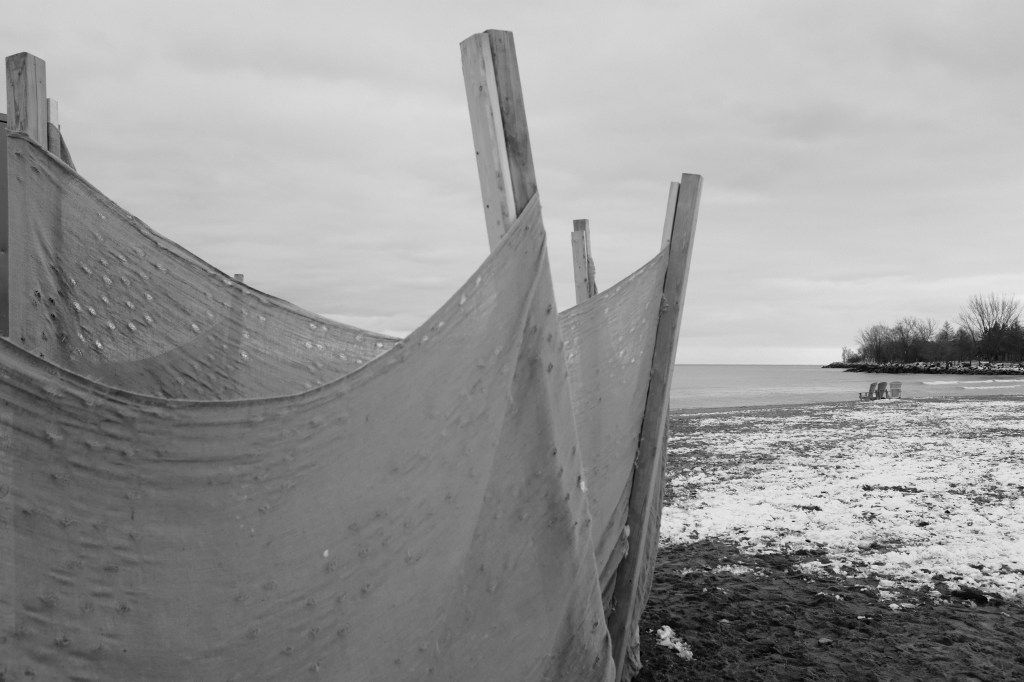
Some of the images I captured while at the exhibition this year, such as the above image of the empty chairs behind the fence, remind me that this space will be renewed soon with beach goers visiting and a liveliness that belies the current (general) absence of humans. Toronto ebbs and flows, and its residents will soon flow back to this part of the city once the weather improves some. I’ll look forward to returning to the Beaches—and capturing them in photographs—when the seasons have shifted!
Cory Doctorow has a great analysis of Netflix and it’s efforts to define (and delimit) what constitutes a family. The real kicker, though, is the final paragraph:
When [Netflix] used adversarial interoperability to build a multi-billion-dollar global company using the movie studios’ products in ways the studios hated, that was progress. When you define “family” in ways that makes Netflix less money, that’s felony contempt of business model.
Netflix: a company the whole family can appreciate. Just perhaps not together.
The Wall Street Journal is reporting that Baidu will soon integrate ChatGPT into the company’s chat/search offerings. The company plans, however, to:
limit its chatbot’s outputs in accordance with the state’s censorship rules, one of the people said. OpenAI also applies restrictions to ChatGPT’s outputs in an effort to avoid toxic hate speech and politically sensitive topics.
While I have no doubt that Baidu will impose censorship, I wonder whether researchers will be able to leverage the learning properties of ChatGPT to gain insight into what is censored by Baidu. Side-channel research has been used to reveal how censorship is undertaken by companies operating in China; I’d expect using these AI models will offer yet another way of interrogating their censorship engines.
All those people who had a certain amount of labour experience prior to or into the early 1990s and then carried on, they weren’t necessarily the ones who have seen that sort of precarity and job loss. Their experience carried them through.
People entering the workforce since then have had to contend with the continual erosion of labour standards, labour law, and collective bargaining, as well as all these different kinds of carveouts, especially around self-employment.
It creates what looks like an age divide, but it’s not really. It’s a deregulation divide.
Toronto ended up getting a proper snowstorm late January. While it wasn’t the first snow of the year it was the first proper storm that saw 15cm of snow (or more) coming down over the course of many hours. In fact, the snow was coming down heavily enough that I didn’t want to risk my non-weather sealed cameras: I’m happy to get them damp by snow but in this weather they were certain to get soaked.
So what was I to do? Despite not being in love with the iPhone 14 Pro it’s a weather sealed camera and capable of making some decent images. So I grabbed it, donned my winter weather gear and some smartphone-compatible gloves, and headed out for a few hours of capturing the city.
When I went out I decided to increase the exposure a bit–set to 0.7–to keep the snow from coming out grey, but I found that exposure kept resetting. I half suspect that this was due to a combination of the somewhat bulky gloves I was using and the water on the screen resetting or modifying the exposure slider. Still, given that I was shooting in ProRAW I could generally modify exposures to my taste when I got home and did some light post-processing.
Speaking of the ProRAWs…I accidentally left the 24mm (equiv.) sensor set to 48MP images from the last time I was shooting with it! Which in hindsight explains why it often took so long to go from pressing the shutter button to capturing an image; I’d thought the delay was because of an issue with the conductive gloves or the cold or the water on the screen but, in fact, was was due to the file size. As always, I should have fully checked my equipment (and its software) before heading out. I’m just glad that I have a 512GB iPhone so at least I didn’t need to worry about running out of space on the device!
I did end up coming home with some smaller files using the main sensor from when I was shooting in burst mode. In burst you will default down to taking 12MP images on the 24mm (equivalent) lens and I used it when shooting faster-action scenes earlier in my walk.
In some notes to myself about the iPhone 14 Pro, I previously wrote:
The 48 megapixel main camera (24mm equivalent) when shot at its full resolution, in ProRAW, doesn’t work well for street photography. I tend to shoot bursts to get people stepping just so in a shot, but there’s an approximately 1 second or so delay in capturing one image and being able to capture another. That’s a shame as this is supposed to be a highlight feature and the A16 processor and specialized ISP just cannot process things fast enough for how I shoot street.
At the time, I didn’t realise the camera app would shift from taking 48MP to 12MP images under burst mode. It’s, also, not something that is apparent in the user interface. Just like, when in the camera app, there’s no indication or warning that you’re shooting at 48MP! All of which is to say that the stock Camera app on iPhone is getting very long in the tooth and is in desperate need of an overhaul.
Lest it sound that I only have negative things to say I should be very clear: I managed to go out and make images for several hours and came back with some that I liked. I couldn’t have gone out with my other camera gear. Since I thought I was shooting with the 12MP 24mm (equiv.) main lens quite often I tried to be fastidious in how I framed shots because I wasn’t going to be able to crop much. By happy accident, this ultimately meant that the images shot on that lens ended up being much higher quality than anticipated due to capturing 48MP images in all of their glory.
I also took the time to use the ultra-wide as well as telephoto lenses. I admit that I just don’t have a huge amount of experience shooting ultra-wide and so this was a fun experience in seeing what I could capture in the scene. Other images that didn’t quite make the cut saw me experiment with cutting the frame in two, with a divider in the centre of the frame and building scenes to the left and right of it. While I didn’t get any publishable-quality photos it was a good experiment and reminded me of just how challenging it is to replicate photographic masters who use this technique, like Sean Penn. The images I made with the 78mm lens, however, often ended up being too soft and ultimately I’ve opted to publish only one of them (above, woman walking away from sign with an arrow on it while looking at her phone).
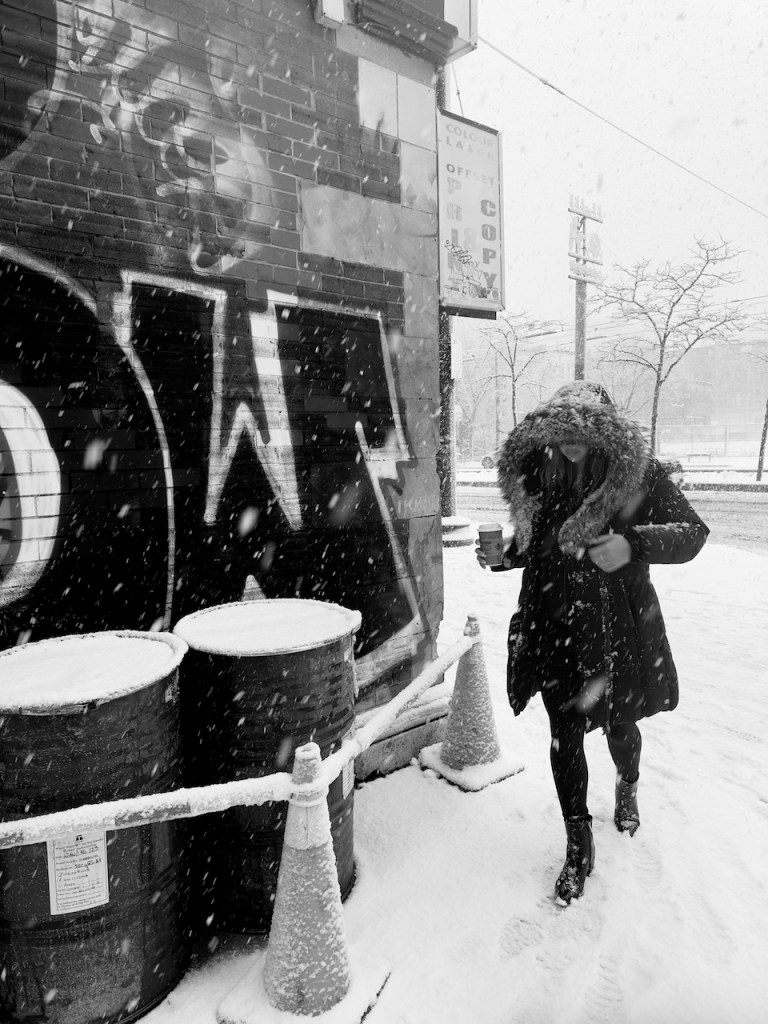
When I went out I had hoped that I’d be able to capture the sense of how much the snow was beating down on everyone in the city. I think this came true as the iPhone didn’t shoot above 1/120 of a second the whole day, and at times was as low as 1/23. The result is that the snow is apparent and the subjects–unless they were relatively unmoving–have a bit of blur to them as they raced from place to place.
At the same time, because of the snow most people couldn’t move as quickly as they would on clear sidewalks and roads. It was an interesting personal lesson, insofar as I realised that in this weather I can probably easily get away with 1/80 to 1/200 and get sufficiently sharp images that still communicate the fury of the weather.
As I kept walking, however, a number of annoyances returned. I absolutely hate how holding your finger on the shutter button in the stock iPhone Camera app records a video instead of firing of a burst shot. This was a problem because when I was trying to take a single image sometimes I’d get a very short video, instead, meaning that I was without a photograph! I get that this is how most people probably want to use the app but it’d be nice to be able to customise the app’s functionality some. Especially if these are supposed to be ‘professional’ devices. Also, for reasons I couldn’t figure out, the Podcasts app also sometimes sped up the episodes I was listening to, or even skipped to the next podcast. Frustrating!
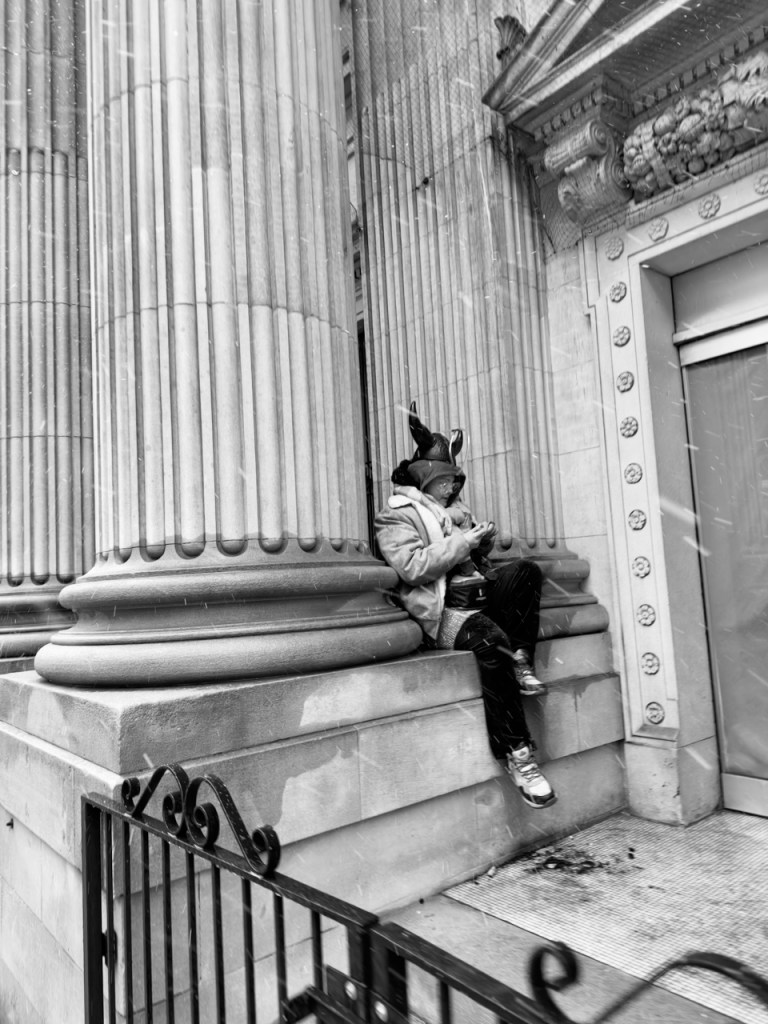
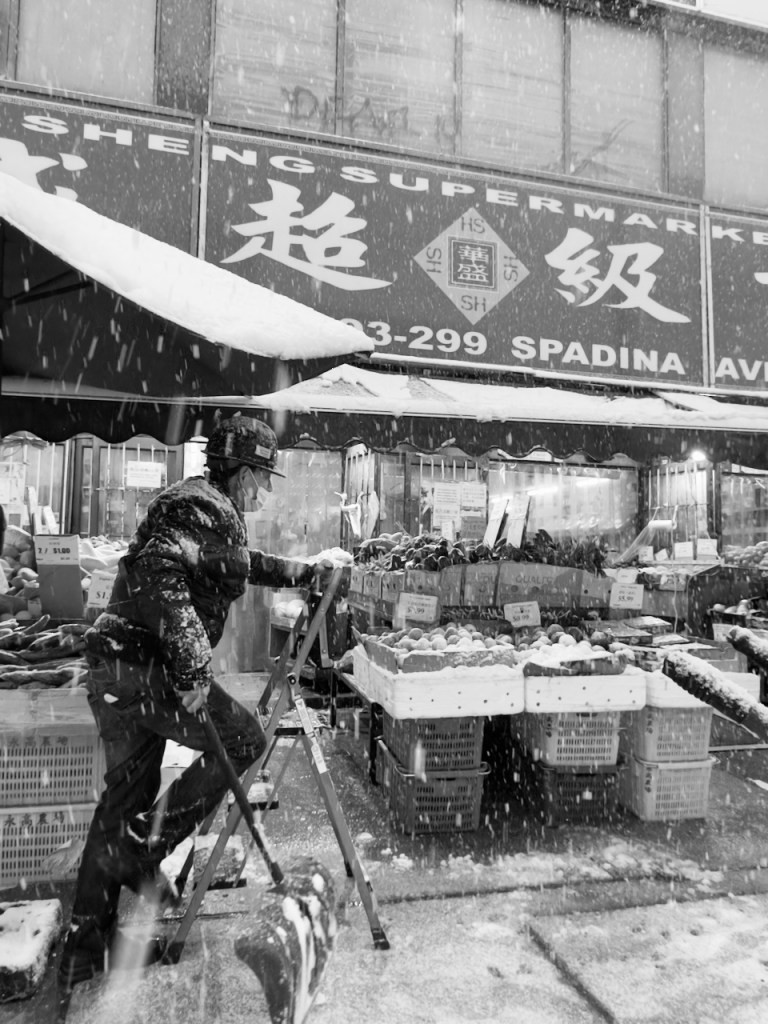
It had been quite some time since I’d walked through Chinatown during a real dropping of snow and it was great to see very familiar scenes in slightly different situations. Catching someone shovelling while, at the same time, a customer was taking refuge in a doorway was a real catch for me. I’m sure I’ve captured images from this location (as in the very spot I was standing in to make the image) dozens of times; this is a very different feel and texture than those I tend to make at this location. Win!
I ended up walking through Kensington Market last year during a slightly-less intense snowstorm and was rewarded with an image that was amongst my favourites of the year. I don’t think that I caught images that will necessarily fall into the same bucket this year, in part because several times I wasn’t able to activate the iPhone camera quickly enough. Still, I liked capturing how desolate the Market was, which was largely reflective of how quiet it was.
I did like how, towards the end of the shoot and into the evening, the snow started to come down even heavier which had the effect of leaving little droplets of water on the lens. While these blotches do upset the ‘perfection’ of the image I think they, also, have the effect of making it that much clearer what the weather was like and ideally put the viewer more firmly into the cold and wet scene.
It was on my return trip home that the worst of the weather was apparent for those who had to brave the wet snow that had piled up over the past many hours. There were relatively few pedestrians out, even at the major intersections, as compared to better-weather times. Hoods were up and high, foot slips were common, and cars were throwing up huge volumes of grey and brown slush onto anyone who happened to get too close to the curb.
Amongst the bravest of the brave were the few cyclists who continued to try and share the road with Toronto drivers. Between the streets that hadn’t been cleared and the erratic behaviour of vehicles whose owners hadn’t driven in the snow in over a year, it seemed risky and not that much faster than just walking. Still, they made for interesting subjects when they were waiting for a chance to get onto the road and make their way to their destination, and especially with the streetcar lines overhead layered with snow.
While cyclists arguably had a hard time of things, even harder times were surely experienced by the parents I saw who were trying to push strollers around. The snow routinely got into the wheels with the effect that parents were just pushing the strollers without the help of the wheels. Still, almost every stroller had a plastic barrier separating the child from the storm which at least meant that the little one’s weren’t getting soaked on their ways home.
Ultimately the images that I came back with after several hours of shooting are qualitatively different from anything I’d have made with my Fuji X100F or Ricoh GR or GRiiix. At least to my eye, they have a feel of an older camera and, due to the slow shutter speeds, many of the images remind me of film photographs I’ve seen of past Toronto winter storms from the 1970s and 1980s. Many also have an almost more intimate quality, to my eye, due to the technical imperfections that resulted from lighting conditions and occasional focus challenges. Still, I feel like they present the experience of the storm that lasted throughout the day and night, and which left the city blanketed in white by the following morning.
Steve Saideman has a good, short, thought on why doing a PhD is rarely a good idea for Canadians who want to get into policy work. Specifically, he writes:
In Canada, alas, there is not that much of a market for policy-oriented PhDs. We don’t have much in the way of think tanks, there are only a few govt jobs that either require PhDs or where the PhD gives one an advantage over an MA, and, the govt does not pay someone more if they have a PhD.
I concur that there are few places, including think tanks or civil society organizations, where you’re likely to find a job if you have a policy-related PhD. Moreover, when you do find one it can be challenging, if not impossible, to find promotion opportunities because the organizations tend to be so small.
That said, I do in fact think that doing a policy-related PhD can sometimes be helpful if you stay pretty applied in your outputs while pursuing your degree. In my case, I spent a lot of time during my PhD on many of the same topics that I still focus on, today, and can command a premium in consulting rates and seniority for other positions because I’ve been doing applied policy work for about 15 years now, inclusive of my time in my PhD. I, also, developed a lot of skills in my PhD—and in particular the ability to ask and assess good questions, know how questions or policy issues had been previously answered and to what effect, and a reflexive or historical thinking capacity I lacked previously—that are all helpful soft skills in actually doing policy work. Moreover, being able to study policy and politics, and basically act as an independent agent for the time of my PhD, meant I had a much better sense of what I thought about issues, why, and how to see them put into practice than I would have gained with just a master’s degree.
Does that mean I’d recommend doing a PhD? Well…no. There are huge opportunity costs you incur in doing them and, also, you can narrow you job market searches by appearing both over-educated and under-qualified. The benefits of holding a PhD tend to become more apparent after a few years in a job as opposed to being helpful in netting that first one out of school.
I don’t regret doing a PhD but, if someone is particularly committed to doing one, I think that they should hurl themselves into it with absolute abandon and treat it as a super-intensive 40-65 hour/week job, and be damn sure that you have a lot of non-academic outputs to prove to a future employer that you understand the world and not just academic journals. It’s hard work, which is sometimes rewarding, and there are arguably different (and less unpleasant) ways of getting to a relatively similar end point. But if someone is so motivated by a hard question that they’d be doing the research and thinking about it, regardless of whether they were in a PhD program? Then they might as well go and get the piece of paper while figuring out the answer.
Black Tap Magazine has a helpful article that distinguishes between photojournalism, documentary photography, and street photography. I found it particularly helpful to see the author grapple with the differences (and commonalities) between documentary and street photography, with the former focusing more on projects and potentially posed/non-urban photography, and the latter being cast as more spontaneous and less project-driven. While I think good street photography should be emotive and tell a story over time, I appreciate that the core assertion is that documentary photography must tell (or try to tell) some story, often as a photo set, whereas street photography is not similarly bound by these conditions.
We got our first snow of the year on Sunday. I kept waiting for it to come and as soon as the snow started to fall I grabbed my Fuji X100F with a Cinebloom 10% attached and headed out to make some images.
I live in a densely populated section of Toronto. Notwithstanding the snow there were many people out and about when I first hit the streets. But it was as I moved to side streets, or into parts of the city that tend to be populated by tourists, that it was apparent that huge chunks of the city were largely depopulated as people decided to stay inside where it was warm and dry.
There were, of course, some people out even in the less populated parts of the city. They, however, tended to be trying to get out of the snow—which functionally turned into snow that was almost indistinguishable from rain towards the early evening—and generally wanted to just avoid getting wet or cold.
Somewhat surprisingly I saw almost no other photographers out and about. I’m sure they were there, somewhere. But, at the same time, I wonder how much the weather dissuaded them from getting out and shooting the streets or urban landscapes.
I will never be accused of babying my cameras. My Fuji X100F lacks the weatherproofing of the newest version and, so, when I’m out in the snow I tend to protectively place one hand over it’s screen and eyepiece, and keep the lens pointed downwards and slightly in towards my body. It doesn’t prevent all the precipitation from getting onto the camera but, along with brushing off water when it starts to gather on dials and such, has always seemed good enough to keep the equipment safe.
The mix of heavy coats and umbrellas is something that I’m always curious about, if only because I can’t recall ever seeing something similar while I was growing up or when I visit parts of the country (or world) that receive large volumes of snow. I don’t dispute the potential utility of an umbrella—it will, obviously, help to keep your head wet and my uncovered head certainly got soaked after 3-4 hours outside—but it always seems like an instrument that is out of place. Though they look very distinct in the snow and so I definitely took the chance to make images of people who were carrying them!
Though there were people out and about, and evidence in other cases of someone having been present recently, much of the city felt oddly solitary. When I make my photos I’m often trying to communicate a sense of, on the one hand, the press of other people around and upon us and, on the other, the loneliness or isolation experienced while being in these massive urban environments. Dismal weather almost always draws me to the latter and wanting to express how large our environments are and what they look like with few figures or, alternately, in the absence of humans entirely. What will the city look like when the humans are gone?
When I watched one of James Popsys’ videos recently he mentioned that, when taking his landscapes, he likes putting either a human or a human-made thing in his images. Doing so has the effect of communicating human presence and, often, what the natural environment looks in our absence. Human-made things, also, have the effect of drawing us into an image on the basis that we ‘see’ something of ourselves in the otherwise natural environment.
In an almost modernist way of thinking those solitary human-things have the effect of both showing the attempt to overcome, or start overcoming, nature while often simultaneously showcasing the majesty and longevity of nature against the transitory existence of human-made things. Or at least that’s how I see and study such images.
I don’t know how well I really captured ‘nature’ in my walk—save towards the very end of my walk—but Popsys’ words have resonated in my head for some time. For years when I’ve made images of the city it’s often been with a view that the humans are transitory; they move though the frame, they enter and exit the city, they live and die. The built infrastructure and the protected landscapes interspersed throughout the city, however, will (should?) persist for a far longer period of time. Yes, Toronto is a city undergoing profound construction but looking through historical photos of the city reveal that key things have remained for a century or more in spite of the changes.
Of course that isn’t to say that the old has stayed perfectly the same; the bridge I took the below image from is literally a bridge to nowhere that was disconnected from the surrounding roads in 1964. While there were plans to remove it, apparently it’s more affordable to do minimal maintenance on it than tear it down; it’s only a matter of time, though, until this economic calculus changes. The city keeps putting up fences and warnings to keep people off the bridge but there’s only been once in the past decade where the fences were intact and I was prevented from getting onto the bridge. In the summer you can regularly discover some pretty cool graffiti along its struts.
The bridge sits over the Don River and, looking south, you have a view of a highway that our municipal and provincial governments continue to pour money into, as well as industrial lands which have been in declining operation for a long time. While the specific buildings will almost certainly change—most likely to be replaced by condos—the character of the landscape should remain the same for decades insofar as the highway and walking path should persist. Though it may be that a similar image will only be accessible to those flying small drones when the economic calculus for maintaining the bridge changes.
Embracing novelty and ambition in the face of huge problems is to be lauded, but the unhinged variety of these admirable traits that we have seen so much of in recent years is counterproductive. The fundamentals of business have not changed merely because of new technologies or low interest rates. The way to prosper is still by solving problems in new ways that sustainably deliver value to employees, capital providers and customers. Over-promising the scope of change created by technology and the possibilities of business and finance to a new generation will lead only to disaffection as these promises falter.1
A whole generation has seen exploding home prices, outrageous explosions in the costs of education, deeply challenging labour markets, and is facing down ecological catastrophe. These changes have taken place during a time of unprecedented financial gain for an older segment of the economy while the younger generations is, also, being routinely told that it is the first that will generally live a worse life than their parents.
So, in the face of ‘fundamentals’ falling apart a whole range of people—often though not always younger—have sought to find new ways of generating wealth in the face of the exploding challenges to living in Western society. Shockingly, the new companies that depend on exploiting regulatory blind spots to ‘find value’ (or, instead, just act illegally and dare governments to take the time and effort to rule that their operations are illegal) or that offer new lottery-like “currencies” have become popular as ways that may enable younger people to generate wealth and enjoy the (perceived) good life of their parents.
The fundamentals of businesses, and currencies and interest, however are just that: fundamental. The effect, however, is that while the promised wealth-generation opportunities may in fact be dead in the water, the explosion of costs and challenges to younger generations are not. Under-regulated capitalism has, also, become a fundamental of business with the effect that unless new regulations are developed and deployed we can expect further, and ongoing, attempts to evade the fundamentals of business if only so as to overcome the fundamental unfairness of capitalism and its logics of accumulation.
All of which is to say: sure, business fundamentals are just that. But an increasingly desperate and younger population will keep throwing fundamentals to the wind in the face of a business systems that is fundamentally and structurally designed to inhibit that same population from enjoying the Western ideal of the good life.










 Excited Pixels