This is one of the clearer assessments of the efficacy (and lack thereof) of influencing social groups and populations using propaganda communicated over social media. While a short article can’t address every dimension of propaganda and influence operations, and their potential effects, this does a good job discussing some of the weaknesses of these operations and some of the less robust arguments about why we should be concerned about them.1
Key points in the article include:
Individuals are actually pretty resistant to changing their minds when exposed to new or contradictory information which can have the effect of impeding the utility of propaganda/influence operations.
While policy options tend to focus on the supply side of things (how do we stop propaganda/influence?) it is the demand side (I want to read about an issue) that is a core source of the challenge.
Large scale one-time pushes to shift existing attitudes are likely to be detected and, subsequently, de-legitimize any social media source that exhibits obvious propaganda/influence operations.
This said, the article operates with a presumption that people’s pre-existing views are being challenged by propaganda/influence operations and that they will naturally resist such challenges. By way of contrast, where there are new or emerging issues, where past positions have been upset, or where information is sought in response to a significant social or political change, there remains an opportunity to affect change in individuals’ perceptions of issues.2 Nevertheless, those most likely to be affected will be those who are seeking out particular kinds of information on the basis that they believe something has epistemically or ontologically changed in their belief structures and, thus, they have shifted from a closed to open position to receive new positions/update their beliefs.
In the past I have raised questions about the appropriateness of focusing so heavily on TikTok as a national security threat. ↩︎
This phenomenon is well documented in the agenda-setting literatures. ↩︎
There have been any number of concerns about Elon Musk’s behaviour, and especially in the recent weeks and months. This has led some commentators to warn that his purchase of Twitter may raise national security risks. Gill and Lehrich try to make this argument in their article, “Elon Musk Owning Twitter is A National Security Threat.” They give three reasons:
First, Musk is allegedly in communication with foreign actors – including senior officials in the Kremlin and Chinese Communist Party – who could use his acquisition of Twitter to undermine American national security.
…
Will Musk’s foreign investors have influence over Twitter’s content moderation policies? Will the Chinese exploit their significant leverage over Musk to demand he censor criticism of the CCP, or turn the dials up for posts that sow distrust in democracy?
…
Finally, it’s not just America’s information ecosystem that’s at stake, it’s also the private data of American citizens.
It’s worth noting that at no point do the authors provide a definition for ‘national security’, which causes the reader to have to guess what they likely mean. More broadly, in journalistic and opinion circle communities there is a curious–and increasingly common–conjoining of national security and information security. The authors themselves make this link in the kicker paragraph of their article, when they write
It is imperative that American leaders fully understand Musk’s motives, financing, and loyalties amidst his bid to acquire Twitter – especially given the high-stakes geopolitical reality we are living in now. The fate of American national security and our information ecosystem hang in the balance.1
Information security, generally, is focused on dangers which are associated with true or false information being disseminated across a population. It is distinguished from cyber security, and which is typically focused on the digital security protocols and practices that are designed to reduce technical computer vulnerabilities. Whereas the former focuses on a public’s mind the latter attends to how their digital and physical systems are hardened from being technically exploited.
Western governments have historically resisted authoritarian governments attempts to link the concepts of information security and cyber security. The reason is that authoritarian governments want to establish international principles and norms, whereby it becomes appropriate for governments to control the information which is made available to their publics under the guise of promoting ‘cyber security’. Democratic countries that emphasise the importance of intellectual freedom, freedom of religion, freedom of assembly, and other core rights have historically been opposed to promoting information security norms.
At the same time, misinformation and disinformation have become increasingly popular areas of study and commentary, especially following Donald Trump’s election as POTUS. And, in countries like the United States, Trump’s adoption of lies and misinformation was often cast as a national security issue: correct information should be communicated, and efforts to intentionally communicate false information should be blocked, prohibited, or prevented from massively circulating.
Obviously Trump’s language, actions, and behaviours were incredibly destabilising and abominable for an American president. And his presence on the world stage arguably emboldened many authoritarians around the world. But there is a real risk in using terms like ‘national security’ without definition, especially when the application of ‘national security’ starts to stray into the domain of what could be considered information security. Specifically, as everything becomes ‘national security’ it is possible for authoritarian governments to adopt the language of Western governments and intellectuals, and assert that they too are focused on ‘national security’ whereas, in fact, these authoritarian governments are using the term to justify their own censorious activities.
Now, does this mean that if we are more careful in the West about our use of language that authoritarian governments will become less censorious? No. But being more careful and thoughtful in our language, public argumentation, and positioning of our policy statements we may at least prevent those authoritarian governments from using our discourse as a justification for their own activities. We should, then, be careful and precise in what we say to avoid giving a fig leaf of cover to authoritarian activities.
And that will start by parties who use terms like ‘national security’ clearly defining what they mean, such that it is clear how national security is different from informational security. Unless, of course, authors and thinkers are in fact leaning into the conceptual apparatus of repressive governments in an effort to save democratic governance. For any author who thinks such a move is wise, however, I must admit that I harbour strong doubts of the efficacy or utility of such attempts.
There is an ongoing debate as to which central banks will launch digital currencies, by which date, and how currencies will be interoperable with one another. Simon Sharwood, writing for The Register, is reporting that China’s Digital Yuan is taking big steps to answering many of those questions:
According to an account of the meeting in state-controlled media, Fan said standardization across payment systems will be needed to ensure the success of the Digital Yuan.
The kind of standardization he envisioned is interoperability between existing payment systems – whether they use QR codes, NFC or Bluetooth.
That’s an offer AliPay and WeChat Pay can’t refuse, unless they want Beijing to flex its regulatory muscles and compel them to do it.
…
With millions of payment terminals outside China already set up for AliPay and WeChat Pay, and the prospect of the Digital Yuan being accepted in the very same devices, Beijing has the beginnings of a global presence for its digital currency.
When I walk around my community I very regularly see options to use AliPay or WeChat Pay, and see many people using these options. The prospect that the Chinese government might be able to take advantage of existing payment structures to also use a government-associated digital fiat currency would be a remarkable manoeuvre that could theoretically occur quite quickly. I suspect that when/if some Western politicians catch wind of this they will respond quickly and bombastically.
Other governments’ central banks should, ideally, be well underway in developing the standards for their own digital fiat currencies. These standards should be put into practice in a meaningful way to assess their strengths and correct their deficiencies. Governments that are not well underway in launching such digital currencies are running the risk of seeing some of their population move away from domestically-controlled currencies, or basket currencies where the state determines what composes the basket, to currencies managed by foreign governments. This would represent a significant loss of policy capacity and, arguably, economic sovereignty for at least some states.
Why might some members of their population shift over to, say, the Digital Yuan? In the West this might occur when individuals are travelling abroad, where WeChat Pay and AliPay infrastructure is often more usable and more secure than credit card infrastructures. After using these for a while the same individuals may continuing to use those payment methods for ease and low cost when they return home. In less developed parts of the world, where AliPay and WeChat Pay are already becoming dominant, it could occur as members of the population continue their shift to digital transactions and away from currencies controlled or influenced by their governments. The effect would be, potentially, to provide a level of influence to the Chinese government while potentially exposing sensitive macro-economic consumer habits that could be helpful in developing Chinese economic, industrial, or foreign policy.
Western government responses might be to bar the use of the Digital Yuan in their countries but this could be challenging should it rely on common standards with AliPay and WeChat Pay. Could a ban surgically target the Digital Yuan or, instead, would it need to target all payment terminals using the same standard and, thus, catch AliPay and WeChat Pay as collateral damage? What if a broader set of states all adopt common standards, which happen to align with the Digital Yuan, and share infrastructure: just how many foreign and corporate currencies could be disabled without causing a major economic or diplomatic incident? To what extent would such a ban create a globally bifurcated (trifurcated? quadfurcated?) digital payment environment?
Though some governments might regard this kind of ‘burn them all’ approach as desirable there would be an underlying question of whether such an effect would be reasonable and proportionate. We don’t ban WeChat in the West, as an example, in part due to such an action being manifestly disproportionate to risks associated with the communications platform. It is hard to imagine how banning the Digital Yuan, along with WeChat Pay or AliPay or other currencies using the same standards, might not be similarly disproportionate where such a decision would detrimentally affect hundreds of thousands, or millions, of people and businesses that already use these payment systems or standards. It will be fascinating to see how Western central banks move forward to address the rise of digital fiat currencies and, also, how their efforts intersect with the demands and efforts of Western politicians that regularly advocate for anti-China policies and laws.
Charley Johnson has a good line of questions and critique for any organization or group which is promoting a ‘technology for good’ program. The crux is that any and all techno-utopian proposals suggest a means of technology to solve a problem as defined by the party making the proposal. Put another way, these kinds of solutions do not tend to solve real underlying problems but, instead, solve the ‘problems’ for which hucksters have build a pre-designed a ‘solution’.
This line of analysis isn’t new, per se, and follows in a long line of equity, social justice, feminism, and critical theory writers. Still, Johnson does a good job in extracting key issues with techno-utopianism. Key, is that any of these solutions tend to present a ‘tech for good’ mindset that:
… frames the problem in such a way that launders the interests, expertise, and beliefs of technologists…‘For good’ is problematic because it’s self-justifying. How can I question or critique the technology if it’s ‘for good’? But more importantly, nine times out of ten ‘for good’ leads to the definition of a problem that requires a technology solution.
One of the things that we are seeing more commonly is the use of data, in and of itself, as something that can be used for good: data for good initiatives are cast as being critical to solving climate change, making driving safer, or automating away the messier parties of our lives. Some of these arguments are almost certainly even right! However, the proposed solutions tend to rely on collecting, using, or disclosing data—derived from individuals’ and communities’ activities—without obtaining their informed, meaningful, and ongoing consent. ‘Data for good’ depends, first and often foremost, on removing the agency to say ‘yes’ or ‘no’ to a given ‘solution’.
In the Canadian context efforts to enable ‘good’ uses of data have emerged through successively introducedpieces of commercial privacy legislation. The legislation would permit the disclosure of de-identified personal information for “socially beneficial purposes.” Information could be disclosed to government, universities, public libraries, health care institutions, organizations mandated by the government to carry out a socially beneficial purpose, and other prescribed entities. Those organizations could use the data for a purpose related to health, the provision or improvement of public amenities or infrastructure, the protection of the environment or any other prescribed purpose.
Put slightly differently, whereas Johnson’s analysis is towards a broad concept of ‘data for good’ in tandem with elucidating examples, the Canadian context threatens to see broad-based techno-utopian uses of data enabled at the legislative level. The legislation includes the ability to expand whom can receive de-identified data and the range of socially beneficial uses, with new parties and uses being defined by regulation. While there are a number of problems with these kinds of approaches—which include the explicit removal of consent of individuals and communities to having their data used in ways they may actively disapprove of—at their core the problems are associated with power: the power of some actors to unilaterally make non-democratic decisions that will affect other persons or communities.
This capacity to invisibly express power over others is the crux of most utopian fantasies. In such fantasies, power relationships are resolved in the absence of making them explicit and, in the process, an imaginary is created wherein social ills are fixed as a result of power having been hidden away. Decision making in a utopia is smooth and efficient, and the power asymmetries which enable such situations is either hidden away or just not substantively discussed.
Johnson’s article concludes with a series of questions that act to re-surface issues of power vis-a-vis explicitly raising questions of agency and the origin and nature of the envisioned problem(s) and solution(s):
Does the tool increase the self-determination and agency of the poor?
Would the tool be tolerated if it was targeted at non-poor people?
What problem does the tool purport to solve and who defined that problem?
How does the way they frame the problem shape our understanding of it?
What might the one framing the problem gain from solving it?
We can look to these questions as, at their core, raising issues of power—who is involved in determining how agency is expressed, who has decision-making capabilities in defining problems and solutions—and, through them, issues of inclusion and equity. Implicit through his writing, at least to my eye, is that these decisions cannot be assigned to individuals but to individuals and their communities.
One of the great challenges for modern democratic rule making is that we must transition from imagining political actors as rational, atomic, subjects to ones that are seen as embedded in their community. Individuals are formed by their communities, and vice versa, simultaneously. This means that we need to move away from traditional liberal or communitarian tropes to recognize the phenomenology of living in society, alone and together simultaneously, while also recognizing and valuing the tilting power and influence of ‘non-rational’ aspects of life that give life much of its meaning and substance. These elements of life are most commonly those demonized or denigrated by techno-utopians on the basis that technology is ‘rational’ and is juxtaposed against the ‘irrationality’ of how humans actually live and operate in the world.
Broad and in conclusion, then, techno-utopianism is functionally an issue of power and domination. We see ‘tech bros’ and traditional power brokers alike advancing solutions to their perceived problems, and this approach may be further reified should legislation be passed to embed this conceptual framework more deeply into democratic nation-states. What is under-appreciated is that while such legislative efforts may make certain techno-utopian activities lawful the subsequent actions will not, as a result, necessarily be regarded as legitimate by those affected by the lawful ‘socially beneficial’ uses of de-identified personal data.
The result? At best, ambivalence that reflects the population’s existing alienation from democratic structures of government. More likely, however, is that lawful but illegitimate expressions of ‘socially beneficial’ uses of data will further delegitimize the actions and capabilities of the states, with the effect of further weakening the perceived inclusivity of our democratic traditions.
Cameron F. Kerry has a helpful piece in Brookings that unpacks the recently published ‘Declaration on the Future of the Internet.’ As he explains, the Declaration was signed by 60 States and is meant, in part, to rebut a China-Russia joint statement. Those countries’ statement would support their positions on ‘securing’ domestic Internet spaces and removing Internet governance from multi-stakeholder forums to State-centric ones.
So far, so good. However, baked into the Kerry’s article is language suggesting that either he misunderstands, or understates, some of the security-related elements of the Declaration. He writes:
There are additional steps the U.S. government can take that are more within its control than the actions and policies of foreign states or international organizations. The future of the Internet declaration contains a series of supporting principles and measures on freedom and human rights, Internet governance and access, and trust in use of digital network technology. The latter—trust in the use of network technology— is included to “ensure that government and relevant authorities’ access to personal data is based in law and conducted in accordance with international human rights law” and to “protect individuals’ privacy, their personal data, the confidentiality of electronic communications and information on end-users’ electronic devices, consistent with the protection of public safety and applicable domestic and international law.” These lay down a pair of markers for the U.S. to redeem.
I read this, against the 2019 Ministerial and recent Council of Europe Cybercrime Convention updates, and see that a vast swathe of new law enforcement and security agency powers would be entirely permissible based on Kerry’s assessment of the Declaration and States involved in signing it. While these new powers have either been agreed to, or advanced by, signatory States they have simultaneously been directly opposed by civil and human rights campaigners, as well as some national courts. Specifically, there are live discussions around the following powers:
the availability of strong encryption;
the guarantee that the content of communications sent using end-to-end encrypted devices cannot be accessed or analyzed by third-parties (include by on-device surveillance);
the requirement of prior judicial authorization to obtain subscriber information; and
the oversight of preservation and production powers by relevant national judicial bodies.
Laws can be passed that see law enforcement interests supersede individuals’ or communities’ rights in safeguarding their devices, data, and communications from the State. When or if such a situation occurs, the signatories of the Declaration can hold fast in their flowery language around protecting rights while, at the same time, individuals and communities experience heightened surveillance of, and intrusions into, their daily lives.
In effect, a lot of international policy and legal infrastructure has been built to facilitate sweeping new investigatory powers and reforms to how data is, and can be, secured. It has taken years to build this infrastructure and as we leave the current stage of the global pandemic it is apparent that governments have continued to press ahead with their efforts to expand the powers which could be provided to law enforcement and security agencies, notwithstanding the efforts of civil and human rights campaigners around the world.
The next stage of things will be to asses how, and in what ways, international agreements and legal infrastructure will be brought into national legal systems and to determine where to strategically oppose the worst of the over reaches. While it’s possible that some successes are achieved in resisting the expansions of state powers not everything will be resisted. The consequence will be both to enhance state intrusions into private lives as well as to weaken the security provided to devices and data, with the resultant effect of better enabling criminals to illicitly access or manipulate our personal information.
The new world of enhanced surveillance and intrusions is wholly consistent with the ‘Declaration on the Future of the Internet.’ And that’s a big, glaring, and serious problem with the Declaration.
The history of Canada is linked to settle colonialism and white supremacy. Only recently have elements of Canada come to truly think through what this means: Canada, and settler Canadians, owe their existence to the forceful removal of indigenous populations from their terrorities.
Toronto is currently hosting an art exhibit, “Built on Genocide.” It’s created by the indigenous artist, Jay Soule | CHIPPERWAR,1 and provides a visual record of the link between the deliberate decimation of the buffalo and its correlation with the genocide of indigenous populations. From the description of the exhibit:
Built on Genocide is a powerful visual record of the 19th-century buffalo genocide that accompanied John A. MacDonald’s colonial expansion west with the railroad. In the mid-19th century, an estimated 30 to 60 million buffalo roamed the prairies, by the late 1880s, fewer than 300 remained. As the buffalo were slaughtered and the prairie ecosystem decimated, Indigenous peoples were robbed of their foods, lands, and cultures. The buffalo genocide became a genocide of the people.
Working from archival records, Soule combines installation and paintings to connect the past with the present, demanding the uncomfortable acknowledgement that Canada is a nation built on genocide.
What follows are a series of photographs that I made while visiting the exhibit on October 13, 2021. All images were made using an iPhone 12 Pro using the ‘Noir’ filter in Apple Photos, and subsequently edited using a Darkroom App filter.
(Built on Genocide 1 by Christopher Parsons)(Built on Genocide 2 by Christopher Parsons)(Built on Genocide 3 by Christopher Parsons)(Built on Genocide 4 by Christopher Parsons)(Built on Genocide 5 by Christopher Parsons)
Canada is, and needs to be, going through a reckoning concerning its past. This process is challenging for settlers, both to appreciate their actual histories and to be made to account for how they arrived at their current life situations. There are, obviously, settlers who are in challenging life situations—som experience poverty and are otherwise disadvantaged in society—but their challenges routinely pale in comparison to what is sadly normal and typical in Canada’s indigenous societies. As just one example, while poverty is a real issue for some white and immigrant Canadians, few lack routine access to safe and clean drinking water. None have lacked access to safe and clean water for over 26 years but this is the lived reality of indigenous populations in Canada.
Jay creates art under the name CHIPPEWAR, which represents the hostile relationship that Canada’s Indigenous peoples have with the government of the land they have resided in since their creation. CHIPPEWAR is also a reminder of the importance of the traditional warrior role that exists in Indigenous cultures across North America that survives into the present day. ↩︎
Steven Chaplin has a really great explanation of whether the Canadian government can rely on national security and evidentiary laws to lawfully justify refusing to provide documents to the House of Commons, and to House committees. His analysis and explanation arose as a result of the Canadian government doing everything it could to, first, refuse to provide documents to the Parliamentary Committee which was studying Canadian-Chinese relations and, subsequently, refusing to provide the documents when compelled to do so by the House of Commons itself.
Rather than releasing the requested documents the government turned to the courts to adjudicate whether the documents in question–which were asserted to contain sensitive national security information–must, in fact, be released to the House or whether they could instead be sent to an executive committee, filled with Members of Parliament and Senators, to assess the contents instead. As Chaplin notes,
Having the courts intervene, as proposed by the government’s application in the Federal Court, is not an option. The application is clearly precluded by Article 9 of the Bill of Rights, 1689, which provides that a proceeding in Parliament ought not to be impeached or questioned in court. Article 9 not only allows for free speech; it is also a constitutional limit on the jurisdiction of the courts to preclude judicial interference in the business of the House.
The House ordered that the documents be tabled without redaction. Any decision of the court that found to the contrary would impeach or question the proceeding that led to the Order. And any attempt by the courts to balance the interests involved would constitute the courts becoming involved in ascertaining, and thereby questioning, the needs of the House and why the House wants the documents.
Beyond the Court’s involvement impeding into the territory of Parliament, there could be serious and long-term implications of letting the court become a space wherein the government and the House fight to obtain information that has been demanded. Specifically,
It may be that at the end of the day the government will continue to refuse to produce documents. In the same way that the government cannot use the courts to withhold documents, the House cannot go to court to compel the government to produce them, or to order witnesses to attend proceedings. It could also invite disobedience of witnesses, requiring the House to either drop inquiries or involve the courts to compel attendance or evidence. Allowing, or requiring, the government and the House to resolve their differences in the courts would not only be contrary to the constitutional principles of Article 9, but “would inevitably create delays, disruption, uncertainties and costs which would hold up the nation’s business and on that account would be unacceptable even if, in the end, the Speaker’s rulings were vindicated as entirely proper” (Canada (House of Commons) v. Vaid [2005]). In short, the courts have no business intervening one way or the other.
Throughout the discussions that have taken place about this issue in Canada, what has been most striking is that the national security commentators and elites have envisioned that the National Security and Intelligence Committee of Parliamentarians (NSICOP) could (and should) be tasked to resolve any and all particularly sensitive national security issues that might be of interest to Parliament. None, however, seems to have contemplated that Parliament, itself, might take issue with the government trying to exclude Parliament from engaging in assessments of the government’s national security decisions nor that issue would be taken when topics of interest to Parliamentarians were punted into an executive body, wherein their fellow Members of Parliament on the body were sworn to the strictest secrecy. Instead, elites have hand waved to the importance of preserving secrecy in order for Canada to receive intelligence from allies, as well as asserted that the government would never mislead Parliament on national security matters (about which, these same experts explain, Members of Parliament are not prepared to receive, process, or understand given the sophistication of the intelligence and the apparent simplicity of most Parliamentarians themselves).
This was the topic of a recent episode of the Intrepid Podcast, where Philippe Lagassé noted that the exclusion of parliamentary experts when creating NSICOP meant that these entirely predictable showdown situations were functionally baked into how the executive body was composed. As someone who raised the issue of adopting an executive, versus a standing House, committee and was rebuffed as being ignorant of the reality of national security it’s with more than a little satisfaction that the very concerns which were raised when NSICOP was being created are, in fact, arising on the political agenda.
With regard to the documents that the House Committee was seeking, I don’t know or particularly care what their contents include. From my own experience I’m all too well aware that ‘national security’ is often stamped on things that either governments want to keep from the public because they can be politically damaging, be kept from the public just generally because of a culture of non-transparency and refusal of accountability, as well as (less often) be kept from the public on the basis that there are bonafide national security interests at stake. I do, however, care that the Government of Canada has (again) acted counter to Parliament’s wishes and has deliberately worked to impede the House from doing its work.
Successive governments seem to genuinely believe that they get to ‘rule’ Canada absolutely and with little accountability. While this is, in function, largely true given how cowed Members of Parliament are to their party leaders it’s incredibly serious and depressing to see the government further erode Parliament’s powers and abilities to fulfil its duties. A healthy democracy is filled with bumps for the government as it is held to account but, sadly, the Government of Canada–regardless of the party in power–is incredibly active in keeping itself, and its behaviours, from the public eye and thus held to account.
If only a committee might be struck to solve this problem…
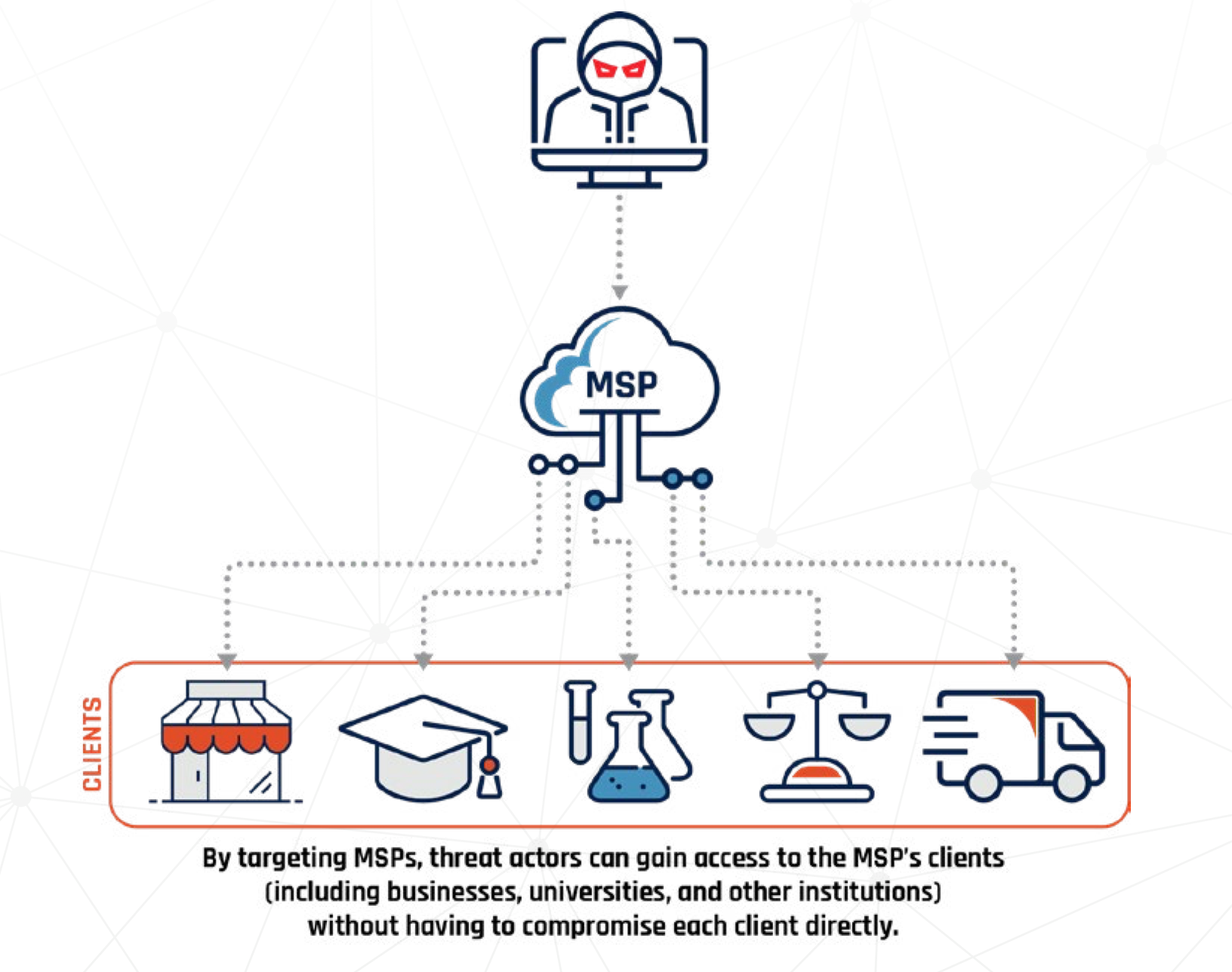
(Managed Service Provider image by the Canadian Centre for Cybersecurity)
Matt Tait, as normal, has good insights into just why the Kaseya ransomware attack1 was such a big deal:
In short, software supply chain security breaches don’t look like other categories of breaches. A lot of this comes down to the central conundrum of system security: it’s not possible to defend the edges of a system without centralization so that we can pool defensive resources. But this same centralization concentrates offensive action against a few single points of failure that, if breached, cause all of the edges to fall at once. And the more edges that central failure point controls, the more likely the collateral real-world consequences of any breach, but especially a ransomware breach will be catastrophic, and cause overwhelm the defensive cybersecurity industry’s ability to respond.
Managed Service Providers (MSPs) are becoming increasingly common targets. It’s worth noting that the Canadian Centre for Cybersecurity‘s National Cyber Threat Assessment 2020 listed ransomware as well as the exploitation of MSPs as two of the seven key threats to Canadian financial and economic health. The Centre went so far as to state that it expected,
… that over the next two years ransomware campaigns will very likely increasingly target MSPs for the purpose of targeting their clients as a means of scaling targeted ransomware campaigns.
Sadly, if not surprisingly, this assessment has been entirely correct. It remains to be seen what impact the 2020 threats assessment has, or will have, on Canadian organizations and their security postures. Based on conversations I’ve had over the past few months the results are not inspiring and the threat assessment has generally been less effective than hoped in driving change in Canada.
As discussed by Steven Bellovin, part of the broader challenge for the security community in preparing for MSP operations has been that defenders are routinely behind the times; operators modify what and who their campaigns will target and defenders are forced to scramble to catch up. He specifically, and depressingly, recognizes that, “…when it comes to target selection, the attackers have outmaneuvered defenders for almost 30 years.”
These failures are that much more noteworthy given that the United States has trumpeted for years that the NSA will ‘defend forward‘ to identify and hunt threats, and respond to them before they reach ‘American cybershores’.2 The seemingly now routine targeting of both system update mechanisms as well as vendors which provide security or operational controls for wide swathes of organizations demonstrates that things are going to get a lot worse before they’re likely to improve.
A course correction could follow from Western nations developing effective and meaningful cyber-deterrence processes that encourage nations such as Russia, China, Iran, and North Korea to punish computer operators who are behind some of the worst kinds of operations that have emerged in public view. However, this would in part require the American government (and its allies) to actually figure out how they can deter adversaries. It’s been 12 years or so, and counting, and it’s not apparent that any American administration has figured out how to implement a deterrence regime that exceeds issuing toothless threats. The same goes for most of their allies.
Absent an actual deterrence response, such as one which takes action in sovereign states that host malicious operators, Western nations have slowly joined together to issue group attributions of foreign operations. They’ve also come together to recognize certain classes of cyber operations as particularly problematic, including ransomware. Must nations build this shared capacity, first, before they can actually undertake deterrence activities? Should that be the case then it would strongly underscore the need to develop shared norms in advance of sovereign states exercising their latent capacities in cyber and other domains and lend credence to the importance of the Tallinn manual process . If, however, this capacity is built and nothing is still undertaken to deter, then what will the capacity actually be worth? While this is a fascinating scholarly exercise–it’s basically an opportunity to test competing scholarly hypotheses–it’s one that has significant real-world consequences and the danger is that once we recognize which hypothesis is correct, years of time and effort could have been wasted for little apparent gain.
What’s worse is that this even is a scholarly exercise. Given that more than a decade has passed, and that ‘cyber’ is not truly new anymore, why must hypotheses be spun instead of states having developed sufficient capacity to deter? Where are Western states’ muscles after so much time working this problem?
As a point of order, when is an act of ransomware an attack versus an operation? ↩︎
I just made that one up. No, I’m not proud of it. ↩︎
Roland Paris and Jennifer Walsh have an excellent, and thought-provoking, column in the Globe and Mail where they argue that Western democracies need to adopt a ‘democratic support’ agenda. Such an agenda has multiple points comprising:
States getting their own democratic houses in order;
States defending themselves and other democracies against authoritarian states’ attempts to disrupt democracies or coerce residents of democracies;
States assisting other democracies which are at risk of slipping toward authoritarianism.
In principle, each of these points make sense and can interoperate with one another. The vision is not to inject democracy into states but, instead, to protect existing systems and demonstrate their utility as a way of weaning nations towards adopting and establishing democratic institutions. The authors also assert that countries like Canada should learn from non-Western democracies, such as Korea or Taiwan, to appreciate how they have maintained their institutions in the face of the pandemic as a way to showcase how ‘peer nations’ also implement democratic norms and principles.
While I agree with the positions the authors suggest, far towards the end of the article they delicately slip in what is the biggest challenge to any such agenda. Namely, they write:
Time is short for Canada to articulate its vision for democracy support. The countdown to the 2024 U.S. presidential election is already under way, and no one can predict its outcome. Meanwhile, two of Canada’s closest democratic partners in Europe, Germany and France, may soon turn inward, preoccupied by pivotal national elections that will feature their own brands of populist politics.1
In warning that the United States may be an unreliable promoter of democracy (and, by extension, human rights and international rules and order which have backstopped Western-dominated world governance for the past 50 years) the authors reveal the real threat. What does it mean when the United States is regarded as likely to become more deeply mired in internecine ideological conflicts that absorbs its own attention, limits its productive global engagements, and is used by competitor and authoritarian nations to warn of the consequences of “American-style” democracy?
I raise these questions because if the authors’ concerns are fair (and I think they are) then any democracy support agenda may need to proceed with the presumption that the USA may be a wavering or episodic partner in associated activities. To some extent, assuming this position would speak more broadly to a recognition that the great power has significantly fallen. To even take this as possible–to the extent that contingency planning is needed to address potential episodic American commitment to the agenda of buttressing democracies–should make clear that the American wavering is the key issue: in a world where the USA is regarded as unreliable, what does this mean for other democracies and how they support fellow democratic states? Do countries, such as Canada and others with high rule-of-law democratic governments, focus first and foremost on ‘supporting’ US democracy? And, if so, what does this entail? How do you support a flailing and (arguably) failing global hegemon?
I don’t pretend to have the answers. But it seems that when we talk about supporting democracies, and can’t rely on the USA to show up in five years, then the metaphorical fire isn’t approaching our house but a chunk of the house is on fire. And that has to absolutely be our first concern: can we put out the fire and save the house, or do we need to retreat with our children and most precious objects and relocate? And, if we must retreat…to where do we retreat?
Elizabeth Dubois has a great episode of Wonks and War Rooms where she interviews Etienne Rainville of The Boys in Short Pants podcast, former Hill staffer, and government relations expert. They unpack how government staffers collect information, process it, and identify experts.
Broadly, the episode focuses on how the absence of significant policy expertise in government and political parties means that social media—and Twitter in particular—can play an outsized role in influencing government, and why that’s the case.
While the discussion isn’t necessarily revelatory to anyone who has dealt with some elements of government of Canada, and especially MPs and their younger staffers, it’s a good and tight conversation that could be useful for students of Canadian politics, and also helpfully distinguishes of of the differences between Canadian and American political cultures. I found the forthrightness of the conversation and the honesty of how government operates was particularly useful in clarifying why Twitter is, indeed, a place for experts in Canada to spend time if they want to be policy relevant.








 Excited Pixels