
Research conducted by Christopher Soghoian demonstrated that Dropbox lacks a security model that genuinely protects user data. As a consequence, while Dropbox is a convenient service it isn’t one that can really be trusted. Regardless, individuals around the world do, and will, continue to use the service.
Recognizing the user-constrains around cloud file-storage solutions, BoxCryptor has provided the tools to encrypt files before they are sent to Dropbox. This lets users rely on Dropbox for convenient storage while also reducing their risk profiles. All in all, it’s a win-win for the consumer.
The instructions are for OS X, Leopard, Snow Leopard, and Lion, and are relatively easy to follow. If you want to secure yourself a little bit better than you likely are right now you’d be well served to set up automatic encryption now. As an added bonus, the instructions will let you also choose Microsoft’s or Google’s cloud services so long as you point the “EncFS Raw Path” to the file path of these other services (don’t worry: it’ll be super clear what that refers to as you go through the instructions!).
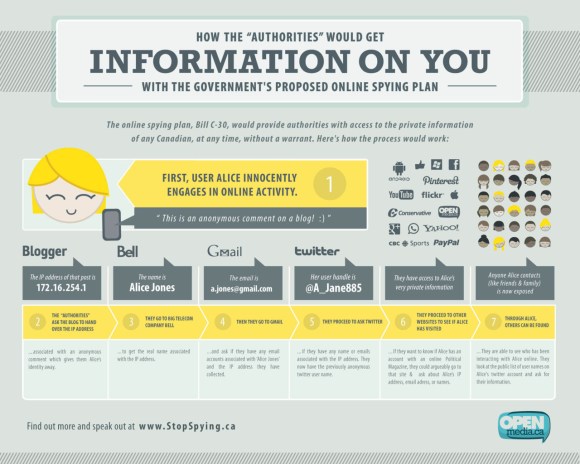
An infographic that depicts surveillance creep under Bill C-30

It is not for innocent people to justify why the state should not spy on them.
Steve Stecklow, for Reuters, has an special report discussing how Chinese vendor ZTE was able to resell American network infrastructure and surveillance products to the Iranian government. The equipment sold is significant;
Mahmoud Tadjallimehr, a former telecommunications project manager in Iran who has worked for major European and Chinese equipment makers, said the ZTE system supplied to TCI was “country-wide” and was “far more capable of monitoring citizens than I have ever seen in other equipment” sold by other companies to Iran. He said its capabilities included being able “to locate users, intercept their voice, text messaging … emails, chat conversations or web access.”
The ZTE-TCI documents also disclose a backdoor way Iran apparently obtains U.S. technology despite a longtime American ban on non-humanitarian sales to Iran – by purchasing them through a Chinese company.
ZTE’s 907-page “Packing List,” dated July 24, 2011, includes hardware and software products from some of America’s best-known tech companies, including Microsoft Corp, Hewlett-Packard Co, Oracle Corp, Cisco Systems Inc, Dell Inc, Juniper Networks Inc and Symantec Corp.
ZTE has partnerships with some of the U.S. firms. In interviews, all of the companies said they had no knowledge of the TCI deal. Several – including HP, Dell, Cisco and Juniper – said in statements they were launching internal investigations after learning about the contract from Reuters.
The sale of Western networking and surveillance equipment/software to the Iranian government isn’t new. In the past, corporate agents for major networking firms explained to me the means by which Iran is successfully importing the equipment; while firms cannot positively know that this is going on, it’s typically because of an intentional willingness to ignore what they strongly suspect is happening. Regardless, the actual sale of this specific equipment – while significant – isn’t the story that Western citizens can do a lot to change at this point.
Really, we should be asking: do we, as citizens of Western nations, believe that manufacturing of these kinds of equipment is permissible? While some degree of surveillance capacity is arguably needed for lawful purposes within a democracy it is theoretically possible to design devices such that they have limited intercept and analysis capability out of the box. In essence, we could demand that certain degrees of friction are baked into the surveillance equipment that is developed, and actively work to prevent companies from producing highly scaleable and multifunctional surveillance equipment and software. Going forward, this could prevent the next sale of significant surveillance equipment to Iran on grounds that the West simply doesn’t have any for (legal) sale.
In the case of government surveillance inefficiency and lack of scaleability are advantageous insofar as they hinder governmental surveillance capabilities. Limited equipment would add time and resources to surveillance-driven operations, and thus demand a greater general intent to conduct surveillance than when authorities have access to easy-to-use, advanced and scalable, surveillance systems.
Legal frameworks are insufficient to protect citizens’ rights and privacy, as has been demonstrated time and time again by governmental extensions or exploitations of legal frameworks. We need a normatively informed limitation of surveillance equipment that is included in the equipment at the vendor-level. Anything less will only legitimize, rather than truly work towards stopping, the spread of surveillance equipment that is used to monitor citizens across the globe.
Anne Rector gives voice to many who were systematically abused as children and who, often as a result of the abuse, are now ardent protectors of basic privacy rights. From her piece:
While I’m fairly openly about many things, my privacy has been savagely breached quite enough in this life. I should be able to preserve the tatters of personal privacy that remain, as I wish.
But this Conservative crime bill targets my privacy’s safeguards, and it’s inappropriate of politicians to use ‘pedophiles’ to strip me of them.
Just try claiming that I support child pornographers… and I’ll impart what fierce really is.
Go read the piece. It’s short. It does a good job identifying just how hurtful and harmful the Canadian Government’s equivalency of privacy advocates and child pornographers is for those who have suffered at the hands of child abusers.
In the context of big data, overconfidence can lead people with good intentions to base big policy decisions on faulty logic. We live in an era of soft paternalism, with policy makers eager to bake into policy new default settings for society. Mostly these are good ideas, but now and then we make big mistakes.
Big Data and the Stalker Economy – Forbes (via tkudo)
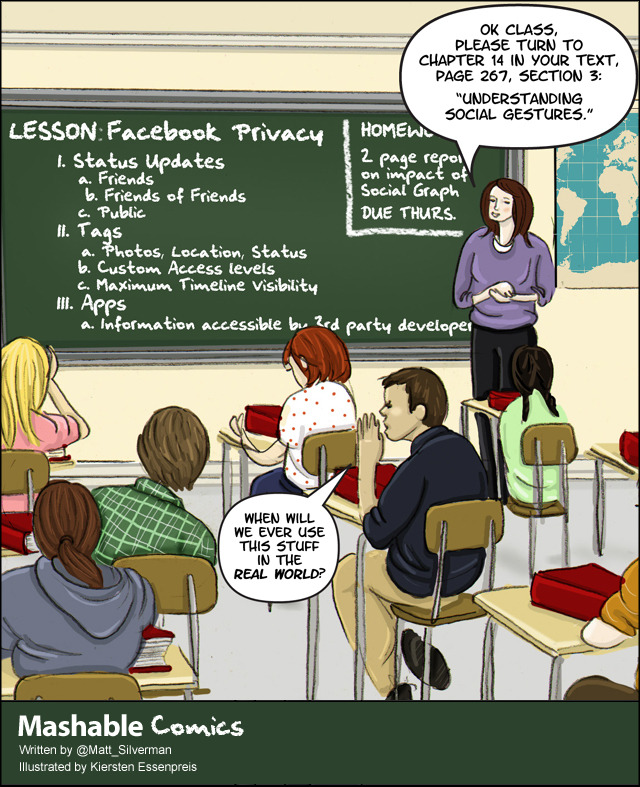
Lesson: Facebook Privacy

Charts: Sexy Ladies of the TSA
Don’t be alarmed..
This invasion of privacy is for your safety..
Trust us..

 Excited Pixels