Categories
Quotations Writing

“Commercially Friendly” Privacy Rules

Dr. Pentland, an academic adviser to the World Economic Forum’s initiatives on Big Data and personal data, agrees that limitations on data collection still make sense, as long as they are flexible and not a “sledgehammer that risks damaging the public good.”

He is leading a group at the M.I.T. Media Lab that is at the forefront of a number of personal data and privacy programs and real-world experiments. He espouses what he calls “a new deal on data” with three basic tenets: you have the right to possess your data, to control how it is used, and to destroy or distribute it as you see fit.

Personal data, Dr. Pentland says, is like modern money — digital packets that move around the planet, traveling rapidly but needing to be controlled. “You give it to a bank, but there’s only so many things the bank can do with it,” he says.

His M.I.T. group is developing tools for controlling, storing and auditing flows of personal data. Its data store is an open-source version, called openPDS. In theory, this kind of technology would undermine the role of data brokers and, perhaps, mitigate privacy risks. In the search for a deep fat fryer, for example, an audit trail should detect unauthorized use.

Steve Lohr, “Big Data Is Opening Doors, but Maybe Too Many

So, I don’t really get how Pentland’s system is going to work any better than the Platform for Privacy Preferences (P3P) work that was done a decade ago. Spoiler alert: P3P failed. Hard. And it was intended to simultaneously enhance users’ privacy online (by letting them establish controls on how their personal information was accessed and used) whilst simultaneously giving industry something to point to, in order to avoid federal regulation.

There is a prevalent strain of liberalism that assumes that individuals, when empowered, are best suited to control the dissemination of their personal information. However, it assumes that knowledge, time, and resourcing are equal amongst all parties. This clearly isn’t the case, nor is it the case that individuals are going to be able to learn when advertisers and data miners don’t respect privacy settings. In effect: control does not necessarily equal knowledge, nor does it necessarily equal capacity to act given individuals’ often limited fiscal, educational, temporal, or other resources.

Categories
Aside Quotations

2013.3.24

With drones, the question is how long before the dozens of states with the aircraft can arm and then operate a weaponized version. “Pretty much every nation has gone down the pathway of, ‘This is science fiction; we don’t want this stuff,’ to, ‘OK, we want them, but we’ll just use them for surveillance,’ to, ‘Hmm, they’re really useful when you see the bad guy and can do something about it, so we’ll arm them,’ ” Singer said. He listed the countries that have gone that route: the United States, Britain, Italy, Germany, China. “Consistently, nations have gone down the pathway of first only surveillance and then arming.”

When the Whole World Has Drones – NationalJournal.com (via thisistheverge)

It’s the creeping use, combined with perceptions of citizens’ inability to affect government behavior that, combined, arguably are provoking resistance to drones in Canada and the US.

Categories
Links

FBI: Smart Meter Hacks Likely to Spread

Though a little over a year old, this post concerning the security of smartmeters is particularly valuable considering the rapid adoption of the technologies throughout Canada. Particularly pertinent:

Citing confidential sources, the FBI said it believes former employees of the meter manufacturer and employees of the utility were altering the meters in exchange for cash and training others to do so. “These individuals are charging $300 to $1,000 to reprogram residential meters, and about $3,000 to reprogram commercial meters,” the alert states.

The FBI believes that miscreants hacked into the smart meters using an optical converter device — such as an infrared light — connected to a laptop that allows the smart meter to communicate with the computer. After making that connection, the thieves changed the settings for recording power consumption using software that can be downloaded from the Internet.

“The optical converter used in this scheme can be obtained on the Internet for about $400,” the alert reads. “The optical port on each meter is intended to allow technicians to diagnose problems in the field. This method does not require removal, alteration, or disassembly of the meter, and leaves the meter physically intact.”

The bureau also said another method of attacking the meters involves placing a strong magnet on the devices, which causes it to stop measuring usage, while still providing electricity to the customer.

So, this suggests that insider threats and poor shielding enable significant fraud. Can’t say it’s surprising given how often these meters have been compromised when deployed in other jurisdictions.

Categories
Quotations

2013.3.15

Cheney’s office, according to Leonard, took secrecy to excessive lengths – attempting to classify as much as possible, and often bypassing the system altogether by inventing classification markings. Even documents as ordinary as Cheney’s talking points were marked Treated as Top Secret/SCI or Treated as Top Secret/Codeword.

“That’s not a recognized marking,” said Leonard. “I have no idea if it was the intent, but I can guarantee you what the consequences of those markings are. When any of this material eventually does end up at a presidential library and access demands are being made, or it’s being processed for release, when some poor archivist sees material marked Handle as SCI, it’s going into the bottom of the pile, and it is going to get much more conservative review. Whether it was the intent to retard the eventual release of the information, I know that’s going to be a consequence of it.”

D.B. Grady, “Why We’ll Never Get a Full Account of the War in Iraq
Categories
Quotations

2013.3.13

In January, the government filed a declaration [PDF] signed by Mark Bradley, the FOIA director of DOJ’s National Security Division, explaining what records would be responsive to EFF’s request. The descriptions of the documents are extremely basic. For instance, Bradley explains that there are 200 relevant documents dated from May 2006 to Sept. 2011 that were provided to a key House intelligence committee, and that they total 799 pages. It goes on in that fashion.

At today’s hearing in Oakland federal court, US District Judge Yvonne Gonzalez Rogers suggested that the document wasn’t going to be sufficient.

“Why can’t I have a basic categorization of what the documents are?” asked Gonzalez Rogers.

“That list itself is classified,” responded Mark Bressler, the DOJ attorney present for the hearing.

“Are you suggesting the number of pages of each document is classified?” asked the judge. “What’s been provided is: ‘200 documents consisting of 799 pages.’ That doesn’t tell me anything. It doesn’t tell the public anything. It was never explained to me how something as basic as a list with page numbers could, in any way, shape, or form, be contrary to the interests of the government.”

“Mr. Bradley has sworn, under penalty of perjury, that to say more would tend to reveal classified information,” said Bressler. “A wealth of information is available for in camera review.” Information like page numbers and timing of documents “may be put together by targets of investigation, or adversaries of the United States,” he said.

Joe Mullin, “Gov’t won’t even give page counts of secret PATRIOT Act documents

The heights of absurdity that the American government reaches concerning the non-revelation of government documents, seemingly on a weekly basis, continues to swell.

Categories
Videos

Culture of Fear

Thievery Corporation – Culture of Fear (feat. Mr. Lif)

Categories
Writing

FUD and NSA Cybersecurity

I’ve been in too many meetings where popular articles led to a string of false – and intensely problematic – baseline ‘truths’ that subsequently led to damaging policy proposals. One of the worst recent articles was by Marc Ambinder, who wrote a piece for Foreign Policy about why the NSA has to support Deep Packet Inspection (DPI) appliances in businesses network. The general premise is that NSA assistance is critical if American companies are to effectively filter out foreign nations’ espionage behaviour. This ‘support’ is supposedly driven by the most recent revelations concerning Chinese attacks against predominantly American business interests.

So, in what follows I’ll pull out offending paragraphs and explain what’s factually problematic and, then, the significance of the false or misleading claims.

[The NSA] has some pretty nifty tools to use in terms of protecting cyberspace. In theory, it could probe devices at critical Internet hubs and inspect the patterns of data packets coming into the United States for signs of coordinated attacks. The recently declassified Comprehensive National Cyberspace Initiative describes the government’s plan, informally known as Einstein 3, to address the threats to government data that run through private computer networks – an admission that the NSA will have to perform deep packet inspection on private networks at some point. But, currently, the NSA only does this for a select group of companies that work with the Department of Defense. It is legally prohibited from setting up filters around all of the traffic entry points.

The issue is that Einstein, even if it is working (which remains unclear, at best), is invasive and isn’t a panacea. It might identify some traffic, but the core kind of data analysis that is required today isn’t so much inbound network traffic as outbound; what is leaving the network, why is it leaving, and do characteristics of the data exiting the network correspond with the authorized users’ normal network behaviours? To be blunt, there is no DPI appliance on the market that is genuinely capable of this kind of user- and network-centric surveillance. There are lots of companies that sell things claiming to perform these actions, but the sales language has not yet met the hype. Moreover, if you’re dealing with state-level actors it isn’t clear why, with their immense resources, they can’t simply purchase the DPI appliances and figure out how they work, and how to subvert their analytics protocols.

Why does this quoted section matter? Because it preps an audience for a magic (networked) bullet, and one that to-date doesn’t exist. And because it convinces an audience that if we just brought NSA-grade Einstein surveillance to bear that we’re figure out how to stop the evil hackers.

The next step may be letting the NSA conduct deep-packet monitoring of private networks. It’s undeniable that Congress and the public probably wouldn’t be comfortable knowing that the NSA has its hardware at the gateways to the Internet. And yet there may be no other workable way to detect and defeat major attacks. Thanks to powerful technology lobbies, Congress is debating a bill that would give the private sector the tools to defend itself, and it has been slowly peeling back the degree of necessary government intervention. As it stands, DHS lacks the resources to secure the dot-com top-level domain even if it wanted to. It competes for engineering minds with the NSA and with private industry; the former has more cachet and the latter has better pay.

The NSA already has it’s hardware at the core choke points of the American Internet infrastructure. This deployment led the Congress to retroactively grant immunity to American ISPs for participating in the NSA’s warrantless wiretapping. It’s what’s led a host of whistleblowers to come forward and disclose the extent of the NSA’s surveillance on Americans. The Agency is already using DPI appliances at Internet choke points: what is being proposed is extending the surveillance to the networks of corporations that are not Internet companies. This means that, rather than just filtering at AT&T’s network, The NSA will also filter at Ford’s network.

The author also asserts that it’s important to leave this to NSA on the basis that DHS cannot presently fulfil this defensive task. NSA knows this. DHS knows this. And, on the mutual basis of this knowledge, NSA is already permitted to assist DHS in securing American companies’ networks so long as DHS takes the lead. What is really changing here is that a foreign intelligence body would be given authority to act independently of DHS. Such a move would be intensely problematic on the basis that NSA is highly secretive, even more than DHS, and is routinely involved in bypassing or finding ways around American’s existing legal protections. The notion that the institution’s ongoing bad behaviour should lend credence and authority to its missions is absurd.

Some private-sector companies are good corporate citizens and spend money and time to secure their networks. But many don’t. It’s costly, both in terms of buying the protection systems necessary to make sure critical systems don’t fail and also in terms of the interaction between the average employee and the software. Security and efficiency diverge, at least in the short run.

While this is true, to an extend, it fails to account for the magnitude of scale. Most large-sized businesses have security staff and dedicated network administrators; there is some defence taking place. It’s the mid-sized businesses that tend to be disastrously under protected. Is the proposal that pretty well all businesses with under, say, 1,000 people will get the benefit of NSA-grade security and surveillance? If so, that’s an awful lot of NSA-compliant gear.

If the NSA were simply to share with the private sector en masse the signatures its intelligence collection obtains about potential cyber-attacks, cybersecurity could measurably improve in the near term. But outside the companies who regularly do business with the intelligence community and the military, few firms have people with the clearances required by the NSA to distribute threat information. (Under the new initiative, the NSA’s intelligence will be filtered through the FBI and DHS.)

It’s important to recognize the DPI equipment isn’t cheap. In addition to NSA signatures you’d likely need an ongoing service contract with the appliance manufacturer. Moreover, to actually run the appliance you’ll either need in house staff or contract out the job; in either case, businesses will see an increase in the cost of business. They may not see a return. Moreover, DPI signatures are not foolproof, and they are often particular to specific appliance vendors. So…will your appliance be ‘compatible’ with NSA intelligence? Moreover, how do you check the NSA’s own signatures to ensure that the Agency isn’t doing something sneaky?

By the end of the article what we’re really missing is critical any analysis of the security properties of the DPI appliances themselves or of the NSA in general. DPI devices exploit the vulnerability of data packets to run analyses/modifications of data either in real-time or, if offloaded to a temporary storage device, offline. In either case, when and if these devices are compromised all of the network traffic coursing through the appliances becomes compromised. So, you can in effect move from dealing with significantly placed compromised devices in your network or dealing with that plus having your sophisticated routers turned against you. And the author’s final lines in the article – yeah, NSA’s been bad in the past, but hey: they’re really on ‘our’ side now! – doesn’t exactly fill a reader with much confidence.
 

Categories
Quotations

2013.3.10

But documents released by the Electronic Privacy Information Center (and an unredacted version of the same unearthed by CNET) late last week show that the DHS has been doing a lot more with drones in the intervening ten years, including tricking them out with cellphone sniffing equipment, sensors that can distinguish between humans and animals, and technology that tells authorities whether someone on the ground is packing a gun.

Frighteningly, the records also show that the DHS’ Predator drones are ready to be equipped with weapons, although a spokesman for DHS sub-agency Customs, Border Protection (CBP) told CNET’s Declan McCullagh that the drones are currently unarmed. McCullagh reports that the DHS has been loaning its drones to domestic law enforcement agencies with criminal justice missions, “including the FBI, the Secret Service, the Texas Rangers, and local police.” Requests from those agencies are becoming more and more common, he writes:

“[DHS drone] use domestically by other government agencies has become routine enough – and expensive enough – that Homeland Security’s inspector general said (pdf) last year that CBP needs to sign agreements ‘for reimbursement of expenses incurred fulfilling mission requests’.”

The DHS told McCullagh that it isn’t using “signals interception” on its drones – yet – and that “[a]ny potential deployment of such technology in the future would be implemented in full consideration of civil rights, civil liberties, and privacy interests and in a manner consistent with the law and long-standing law enforcement practices.” But if “longstanding law enforcement practices” are any indication of where the DHS is headed, we are in trouble.

That’s because often “long-standing law enforcement practice” has been to get away with whatever it can using the loosest interpretation of the fourth amendment possible, before legislators or courts act to correct the problem (if they ever do).

Kade Crockford, “Drones are coming home to skies near you: feel safer?
Categories
Quotations

2013.3.5

Once your life is inside a federal investigation, there is no space outside of it. The only private thing is your thoughts, and even they don’t feel safe anymore. Every word you speak or write can be used, manipulated, or played like a card against your future and the future of those you love. There are no neutral parties, no sources of unimpeachable wisdom and trust.

The lawyers tell you: take no notes.

The lawyers tell you: talk to no one.

It is the loneliest of lonely things to be surrounded by your loved ones, in danger, and forced to be silent.

May you never experience a Federal investigation. I did, and it consumed me, and changed everyday that will come after it for the rest of my life.

Quinn Norton, “Life Inside the Aaron Swartz Investigation
Categories
Aside Humour

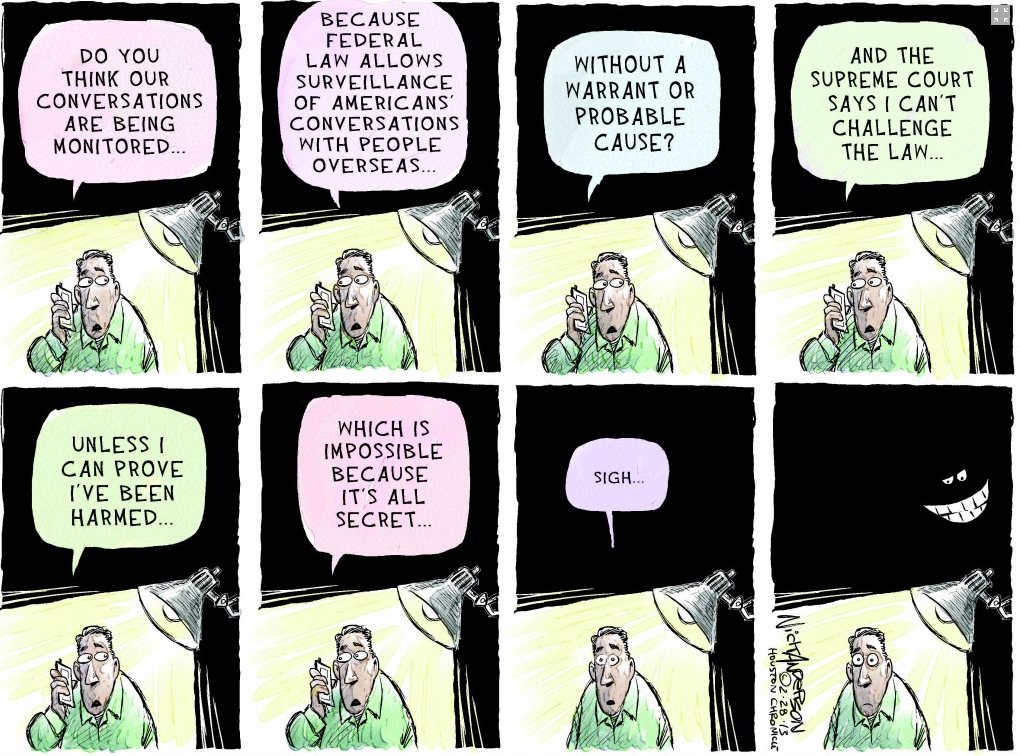
American Surveillance Catch-22