Categories
Links Writing

Encryption Use Hits a New Height in Canada

In a continuing demonstration of the importance of strong and privacy-protective communications, the federal Foreign Interference Commission has created a Signal account to receive confidential information.

Encrypted Messaging
For those who may feel more comfortable providing information to the Commission using encrypted means, they may do so through the Signal – Private Messenger app. Those who already have a Signal account can contact the Commission using our username below. Others will have to first download the app and set up an account before they can communicate with the Commission.

The Commission’s Signal Username is signal_pifi_epie20.24

Signal users can also scan QR Code below for the Commission’s username:

The Commission has put strict measures in place to protect the confidentiality of any information provided through this Signal account.

Not so long ago, the Government of Canada was arguing for an irresponsible encryption policy that included the ability to backdoor end-to-end encryption. It’s hard to overstate the significance of a government body now explicitly adopting Signal.

Categories
Links Writing

The Ongoing Problems of Placing Backdoors in Telecommunications Networks

In a cyber incident reminiscent of Operation Aurora,1 threat actors successfully penetrated American telecommunications companies (and a small number of other countries’ service providers) to gain access to lawful interception systems or associated data. The result was that:

For months or longer, the hackers might have held access to network infrastructure used to cooperate with lawful U.S. requests for communications data, according to people familiar with the matter, which amounts to a major national security risk. The attackers also had access to other tranches of more generic internet traffic, they said.

The surveillance systems believed to be at issue are used to cooperate with requests for domestic information related to criminal and national security investigations. Under federal law, telecommunications and broadband companies must allow authorities to intercept electronic information pursuant to a court order. It couldn’t be determined if systems that support foreign intelligence surveillance were also vulnerable in the breach.

Not only is this a major intelligence coup for the adversary in question, but it once more reveals the fundamental difficulties in deliberately establishing lawful access/interception systems in communications infrastructures to support law enforcement and national security investigations while, simultaneously, preventing adversaries from taking advantage of the same deliberately-designed communications vulnerabilities.

Categories
Links

Measuring the Effects of Active Disinformation Operations

This is a good long form piece by Thomas Rid on disinformation activities, with a particular focus on Russian operations. A key takeaway for me is that there is a real potential for the exposure of disinformation campaigns to beget subsequent campaigns, as the discovery (and journalistic coverage) of the initial campaign can bestow a kind of legitimacy upon adversaries in the eyes of their paymasters.

A way to overcome this ends up being the adoption of tactics that not just expose disinformation campaigns but, also, actively work to disable campaigners’ operational capacities at technical as well as staff levels. Merely revealing disinformation campaigns, by way of contrast, can serve as fuel for additional funding of disinformation operators and their abilities to launch subsequent campaigns or operations.

Categories
Writing

Computers-on-Wheels and Web-Based Vulnerabilities

While there can be significant efficiencies gained by increasing the amount of data that is accessible by motor vehicles, connecting these computers-on-wheels to the Internet can have notable consequences.

Recent reporting by Wired reveals, as an example, that:

… a group of independent security researchers revealed that they’d found a flaw in a web portal operated by the carmaker Kia that let the researchers reassign control of the internet-connected features of most modern Kia vehicles—dozens of models representing millions of cars on the road—from the smartphone of a car’s owner to the hackers’ own phone or computer. By exploiting that vulnerability and building their own custom app to send commands to target cars, they were able to scan virtually any internet-connected Kia vehicle’s license plate and within seconds gain the ability to track that car’s location, unlock the car, honk its horn, or start its ignition at will.

“If someone cut you off in traffic, you could scan their license plate and then know where they were whenever you wanted and break into their car,” says Curry. “If we hadn’t brought this to Kia’s attention, anybody who could query someone’s license plate could essentially stalk them.” For Kias that come installed with a 360-degree camera, that camera, too, was accessible to hackers. Beyond allowing the hijacking of connected features in cars themselves, Curry says, the web portal flaw also allowed hackers to query a broad range of personal information about Kia customers—names, email addresses, phone numbers, home addresses, and even past driving routes in some cases—a potentially massive data leak.

The nature of the vulnerability is particularly concerning:

When the researchers sent commands directly to the API of that website—the interface that allows users to interact with its underlying data—they say they found that there was nothing preventing them from accessing the privileges of a Kia dealer, such as assigning or reassigning control of the vehicles’ features to any customer account they created.

I do have to admit that I appreciate that this started with discovering issues with APIs used by scooters, which led the researchers to become “super interested in trying more ways to make more things honk.”

Categories
Photography Writing

10 Tips for Starting to Photograph on the Street

2014

The democratization of photography means that there are a lot of people who are interested in making images on the streets. However, many are scared of the possible confrontations they may have after taking other people’s images without first getting their permission. There are innumerable videos and essays that offer a lot of tips, but many of the common “tips” just wouldn’t work for me when I was starting out.

By way of background, I’ve been making images in Toronto since 2014 and have used a range of cameras, focal lengths, and so forth. I started out being very hesitant to take people’s images whereas, today, I am pretty comfortable and they are in the majority of the images that I take each week. You can see my most recent images on my Glass profile.

So here are 10 tips that can help you get used to making images on the street based on my own trepidations when I started out.

1. Just Walk Around With Your Camera

When I first purchased my Olympus EM10-II I was really nervous to actually use it in downtown Toronto. What if someone got mad that I was taking their photo?

2015

So my solution at the outset was just to always be carrying my camera to and from work. I had about a 2-3 km walk each way through urban areas and ensured that I had my camera in my hand the whole time.

For me, just always holding the camera in public normalized how it felt to me. It also helped me better appreciate the weight and how it moved in my hand.

2. Don’t Focus on Being “Stealthy”

So many street photography tips focus on being “stealthy”. That can mean using a long lens so that people don’t know you’re taking their photo, to shooting exclusively from waist height, never raising your camera to your eye, and so forth. But when you’re shooting in a stealthy way and someone approaches you, then you’re put in a position of potentially lying to them if you say you weren’t making images.

2016

By being “stealthy” — especially if you’re nervous about confrontation — and getting caught the potential confrontation may be a lot more emotionally charged. By way of contrast, if you’re not sneaking about and you’re being confronted then the emotions are going to be lower at the outset than if you were caught sneaking a shot of someone.

3. Don’t Focus on the People

If you’re anything like me when I started making images in my downtown core, taking images of people was something I aspired to but wasn’t comfortable with. But I lived in a big urban city and there was always lots to see and make images of…and so I made images of graffiti, of buildings, or of art exhibitions, and so forth. And in all cases the images that I captured were in public with other people around.

2017

Again, the focus (no pun intended) was just to get comfortable using my camera in public. I liked capturing ambient images of the city and its life, but really this was me practicing and just getting used to holding and using my camera in public, with the ultimate ambition of including people in my images.

Bonus Sub-Tip: As part of not focusing on people you can also consider looking for scenes and then waiting for people to just wander through the scene. I often will do this, myself: I’ll find a location, raise my camera to my eye, hold it for a minute or two, and only then start making images. Anyone who comes through the scene knows that I was there first — I wasn’t chasing them to make their image — and if someone asks what I’m doing, I can talk about the scene and what drew me to it. This helps to orient any conversations around specific individuals in your photographs being incidental to the image being taken, as opposed to the individuals being the primary focus of the image itself.

4. Practice With a 50mm or Wider Lens

It’s pretty routine advice to get a prime lens and learn with it, especially when taking images of metropolitan areas. To my mind there are a few good reasons for this approach to learning.

2018

First, just in terms of training, a prime prevents you from certain kinds of indecisiveness. When you’re operating a zoom lens you have to wonder which of the focal lengths are “best” and you don’t necessarily learn to “see” in any particular focal lengths. If you only have a 50mm focal length, by way of comparison, then you quickly learn to “see” in that length. And you can still zoom — it just requires using your feet!

Second, a prime lens helps you determine what kinds of images you are, or are not, looking to make. If you’re using a 50mm lens then very wide street images that you can capture with a 28mm are just not going to be made. And that’s fine — you learn to look for images that align with that particular focal length. By imposing a series of restrictions on how you can make an image you can expand your creativity by just focusing on what that focal length can produce.

2019

Third, using a single prime lens will mean that you’re carrying less weight and you won’t end up carrying a whole pile of kit with you. Which brings us to the next tip…

5. Don’t Trudge Around with More Than 1-2 Lenses

If you’re going to wander around the streets then you will benefit from not carrying too many lenses. I’d recommend only stepping out the door with your one prime lens. Not only does having a few lenses lead to creative ambiguity — is lens 1 or 2 or 3 “right” for this scene? — but it means you have to carry more stuff on your person.

Down But Not Out, 2020

Less weight and fewer focal lengths options means that you may be out making images longer and with more creative discipline. And by really leaning into 1 or 2 fixed focal lengths you’ll learn a lot about whether you like those focal lengths and, as importantly, how you can use them when making images.1

6. Go to Events Where Taking Photographs is Normalized

If there’s a parade, or public art show, or whatever then try to get there and practice taking images of people in those venues. Because it’s a big public event people will tend to be pretty OK with their images being taken. And it will also expose you, a budding photographer, to the challenge of sometimes grabbing a shot in changing light, moving crowds, and so forth.

Joy In Dark Times, 2021

If you’re feeling particularly daring then you might consider walking alongside a parade or protest, and make images of those who are viewing the event. It’s the “one step up” from making images of the participants of parades and events but still pretty comfortable. Most people in crowds are going to be OK with their images being captured and you’ll have walked past anyone who happened to be annoyed at your photographing them before they emerge from the crowds.

7. Go Out a Lot

I try to get onto the streets for a couple hours every weekend. I have a busy full-time job and photography is my hobby, so I don’t worry about not being able to devote a hour or more every day into making images. I’d love to be able to do so but it’s just not my reality.

Fix, Found, 2022

This having been said I am always out each weekend. Every year I make thousand of frames and often keep returning to the same spots year over year over year in the hopes of some scenes finally producing an image that I like. And by going out you both get a sense for how light falls in your environments, how people move in them, as well as how the urban environment changes through the year. The more you can predict about the environment and its inhabitants the more likely it is that you’ll collect images that speak to you.

8. Review Your Work

Figure out a review tempo for your work and then keep to it. There are at least two parts to this.

First, you need to review the images that you’re making on the streets. I tend to do quick reviews when I come back but other folks do so days or weeks later. Whatever your tempo is it’ll be important to look to see what you’re capturing. It’s the only way to really understand how your creative vision is being interpreted using the camera and lens that you’re carrying.

Toronto, 2023

Second, I’d encourage you to do either monthly, quarterly, bi-annual, or annual assessments of the images that you’re taking. Go through and pick out your top 10-20 images and really think about why they’re your favourites. And, also, how would you want them to be improved? What more might you have done?

As you go through more of these reviews also do comparisons to past favourite images — it’s by undertaking this kind of self-assessment or critique that you’ll be able to see whether you are growing or stretching as a photographer, as well as detect themes or commonalities in what you are being attracted towards.

9. Post Some of Your Work Online

Lots of photographers use some kind of online service to post their images. What you use doesn’t really matter. But having a published set of images means that if someone does ask you what you’re doing on the streets, you can quickly direct them to your online work so they can see you’re doing something artistic and genuine.

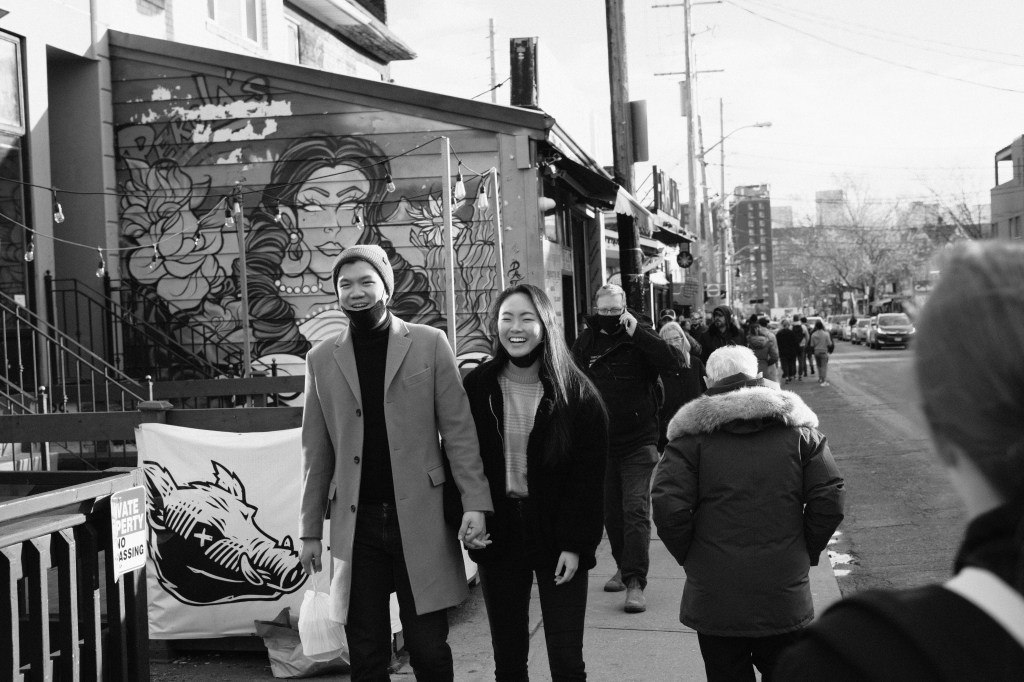
Cumberland & Bellair, Toronto, 2024

If someone does ask about you about what you’re doing just be honest: you’re starting out as a photographer and like capturing urban environments. Maybe the person in question looked interesting. And you can show them a selection of your work which will reveal you are treating photography at least somewhat seriously as opposed to just taking creepy shots of people on the street.2

10. Have Fun and Ignore Equipment

Street photography is a fun hobby whether you’re out with a smartphone camera, using a film camera or DSLR, or playing with a mirrorless camera. Don’t worry about having “the right” camera or one that is sufficiently new. Any camera that has been made in the past 10 years is going to be more than enough when you’re in the streets for the first time. Don’t focus on the equipment and, instead, just enjoy the fun that comes from focusing intently on the built environment, light, and the people who pass through the streets.

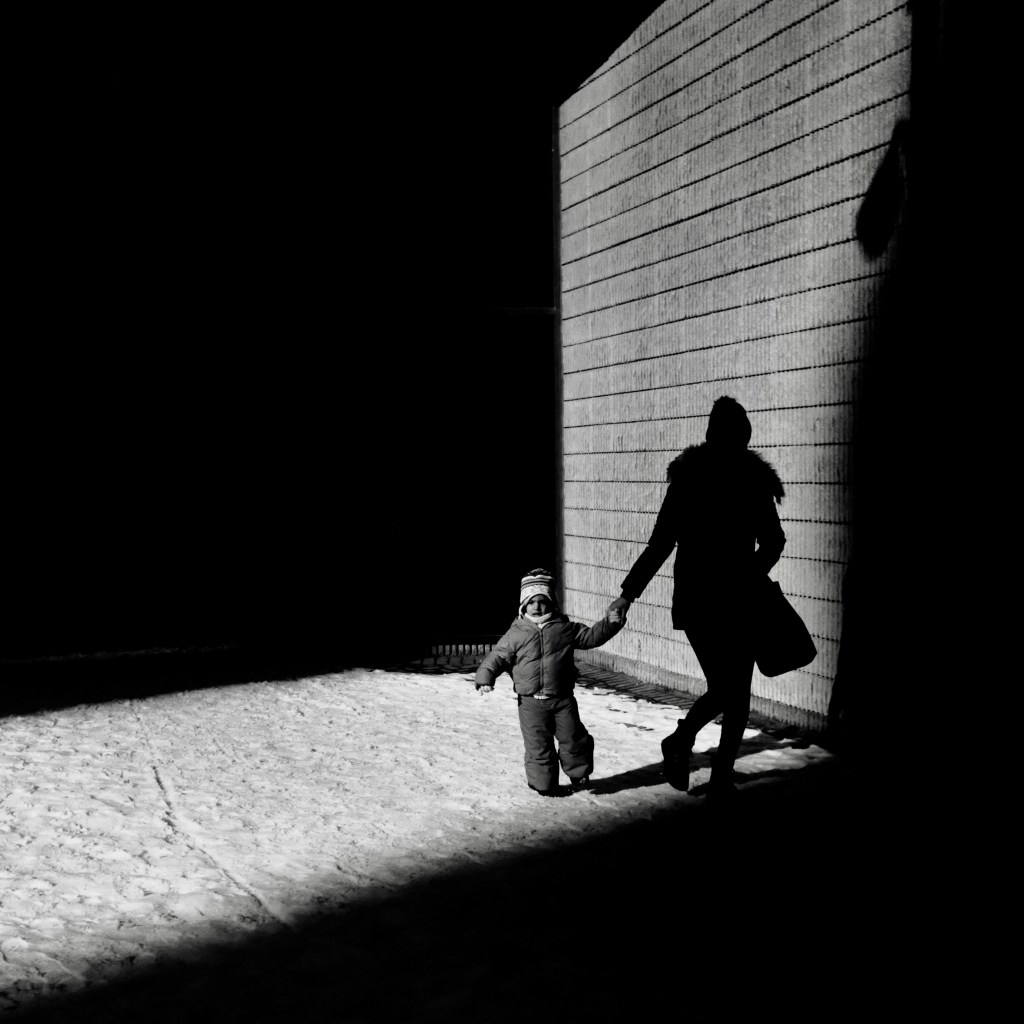
Princess & Nunavut (CNE), Toronto, 2024

Those are my own 10 tips — what tips would you give a younger version of yourself, today, based on your experiences to date?


  1. If you just want to use the kit lens that came with your camera — likely a zoom lens — then just set it to a single fixed focal lens and restrict in in place with some electrical tape. ↩︎
  2. Of course, if you are just taking creepy shots of people — such as some street photographers who use massive zoom lenses to exclusively take long distance photographs of attractive people — then this will just “out” you and what you’re up to. Don’t be one of those people! ↩︎
Categories
Aside

2024.9.17

In an unexpected but pleasant twist, tonight, I chatted with a friend about what I saw in the images I’d posted to Glass throughout the year. He has an artistic background and was often able to see — and speak to — things that I’d not considered previously. It’s also clear that I’m getting better at explaining and outlining what’s in my images, the common thematics and how they’re developing over time, and able to provide critique to past work.

So a pleasant twist and progress!

Categories
Aside

Putting in the Work

For better or worse, I tend to be decent enough at adding routines or processes into my life and then just maintaining them. When I was in grad school — prior to getting the first Series 0 Apple Watch — I personally committed to a particular fitness regime.

Fast forward to today and that has me putting in 5-6 hours a week in our (petite!) home gym. And typically if I don’t make it to our gym I’m, instead, adding in some long hours outside and moving about during the day or night.

Only a few years until I hit 4,000!

Categories
Writing

What is the Role of Cyber Operators in Assessing Effectiveness or Shaping Cyber Policy?

An anonymous European Intelligence Official wrote an oped in July entitled, “Can lawyers lose wars by stifling cyber capabilities?” The article does a good job in laying out why a cyber operator — that is, someone who is presumably relatively close to either planning or undertaking cyber operations — is deeply frustrated by the way in which decision-making is undertaken.

While I admit to having some sympathy for the author’s plight I fundamentally disagree with much of their argument, and think that the positions they hold should be taken up and scrutinised. In this post, I’m really just pulling out quotations from the article and then providing some rebuttal or analysis — you’re best off reading it, first, if you want to more fully follow along and assess whether I’m being fair to the author and the points they are making.

With that out of the way, here we go….

Law is no longer seen as a system of checks and balances but as a way to shape state behaviour in cyberspace

Yes, this is one of the things that laws are actually supposed to do. You may (reasonably in some cases) disagree with the nature of the laws and their effects, but law isn’t a mere “check and balance.” And, especially where there is no real ability to contest interpretations of law (because they are administered by government agencies largely behind closed doors) it is particularly important for law to have a stronger guiding function in order to maintain democratic legitimacy and social trust in government operations.

Idealistic legalism causes legal debates on cyber capabilities to miss a crucial discussion point: what operational constraints are we willing to accept and what consequences does that have for our national security?

Sure, but some of this is because the USA government is so closed mouthed about its capacities. Consider if there was a more robust effort to explain practice such as in the case of some European agencies? I would note that the Dutch, as an example, are sometimes pretty explicit about their operations which is then helpful for considering their activities with respect to authorising laws and associated national and international norms.

Laws attempt to capture as many activities in cyberspace as possible. To do so, legal frameworks must oversimplify. This is ill-suited to such a complex domain

This seems to not appreciate how law tends, at least in some jurisdictions, to be broader in scope and then supplemented by regulations or policies. However, where regulations or policies have been determined as regularly insufficient there may be a decision that more detailed laws are now necessary. To an extent, this is the case post-Snowden and with very good reason, and as demonstrated in the various non-compliance reports that has been found with certain NSA (and other American intelligence community) operations over time.

The influence of practitioners slowly diminishes as lawyers increasingly take the lead in shaping senior leadership opinions on proposed cyber operations rather than merely advising.

I can appreciate the frustration of seeing the leadership move from operations practitioners to policy/legal practitioners.1 But that shift between whether organisations are being led by operations practitioners or those focused in law/policy can be a normal back and forth.

And to be entirely honest the key thing — and the implicit critique throughout this whole piece — is that the decision makers understand what the ops folks are saying.2 Those in decision making roles have a lot of responsibilities and, often, a bigger or different picture of the implications of operations.

I’m in no way saying that lawyers should be the folks to always call the shots3 but just because you’re in operations doesn’t mean that you necessarily are making the right calls broadly and, instead, may be seeing the right calls through your particular lens and mission. That lens and mission may not always be sufficient in coming to a conclusion that aligns more broadly with agency or national or international policy intents/goals.

… a law might stipulate that a (foreign) intelligence agency cannot collect information from systems owned by the citizens of its country. But what if, as Chinese and Russian cyber threat actors do, a system belonging to a citizen is being abused to route attack traffic through? Such an operational development is not foreseen, and thus not prescribed, by law. To collect information would then be illegal and require judicial overhaul – a process that can take years in a domain that can see modus operandi shift in a matter of days.

There may be cases where you have particularly risk adverse decision makers or, alternately, particularly strong legal limitations that preclude certain kinds of operations.

I would note that it is against the law to simply target civilians in conflict scenarios on grounds that doing so runs counter to the agreed-upon laws of war (recognising they are often not adhered to). Does this have the effect of impeding certain kinds of military activities? Yes. And that may still be the right decisions notwithstanding the consequences it may have on the ability to conduct some operations and/or reduce their efficacy.

In the cyber context, the complaint is that certain activities are precluded on the basis that the law doesn’t explicitly recognise and authorise them. Law routinely leaves wiggle rooms and part of the popular (and sometimes private…) problem has been how intelligence lawyers are perceived of as abusing that wiggle room — again, see the NSA and other agencies as they were denuded in some of the Snowden revelations, and openly opposite interpretations of legislation that was adopted to authorise actions that legislators had deliberately sought to preclude.4 For further reasons the mistrust may exist between operators and legislators, in Canada you can turn to the ongoing historical issues between CSIS and the Federal Court which suggests that the “secret law and practices” adopted by Canada’s IC community may counter to the actual law and legal processes, and then combine that with some NSIRA findings that CSE activities may have taken place in contravention of Canadian privacy law.

In the above context, I would say that lots of legislators (and publics) have good ground to doubt the good will or decision-making capacity of the various parties within national ICs. You don’t get to undertake the kind of activities that happened, previously, and then just pretend that “it was all in the recent past, everything’s changed, trust us guys.”

I would also note: the quoted material makes an assumption that policy makers have not, in fact, considered the scenario the author is proposing and then rejected it as a legitimate way of operating. The fact that a decision may not have gone your way is not the same as your concerns not being evaluated in the process of reaching a conclusion.

When effectiveness is seen as secondary, cyber activities may be compliant, but they are not winning the fight.

As I have been writing in various (frustrating) peer reviews I’ve been doing: evidence of this, please, as opposed to opinion and supposition. Also, “the fight” will be understood and perceived by different people in different positions in different agencies: a universal definition should not be presumed.

…constraints also incur costs due to increased bureaucratic complexity. This hampers operational flexibility and innovation – a trade-off often not adequately weighed by, or even visible to, law- and decision-makers. When appointing ex-ante oversight boards or judicial approval, preparation time for conducting cyber operations inevitably increases, even for those perfectly legal from the beginning.

So, in this case the stated problem is that legislators and decision makers aren’t getting the discrete kinds of operational detail that this particular writer thinks are needed to make the “right” trade off decisions.

In some cases….yeah. That’ll be the case. Welcome to the hell of people not briefing up properly, or people not understanding because briefing materials weren’t scoped or prepared right, and so forth. That is: welcome to the government (or any sufficiently large bureaucracy)!

But more broadly, the complaint is that the operator in question knows better than the other parties but without, again, specific and clear evidence that the trade offs are incorrect. I get that spooky things can’t be spoken aloud without them becoming de-spookified, but picture a similar kind of argument in any other sector of government and you’ll get the same kind of complaint. Ops people will regularly complain about legislators or decision makers when they don’t get their way, their sandcastles get crushed, or they have to do things in less-efficient ways in their busy days. And sometimes they’re right to complain and, in others, there is a lot more at stake than what they see operationally going on.

This is a losing game because, as Calder Walton noted, ‘Chinese and Russian services are limited only by operational effectiveness’.

I don’t want to suggest I disagree! But, at the same time, this is along the lines of “autocracies are great because they move faster than democracies and we have to recognise their efficiency” arguments that float around periodically.5

All of which is to say: autocracies and dictatorships have different internal logics to their bureaucracies that can have corresponding effects on their operations.

While it may be “the law” that impedes some Five Eyes/Western agencies’ activities, you can picture the need to advance the interests of kleptocrats or dictators’ kids, gin up enough ransomware dollars to put food on the team’s table, and so forth, as establishing some limits on the operational effectiveness of autocratic governments’ intelligence agencies.

It’s also worth noting that “effectiveness” can be a contested concept. If you’re OK blundering around and burning your tools and are identified pretty often then you may have a different approach to cyber operations, generally, as opposed to situations where being invisible is a key part of operational development. I’m not trying to suggest that the Russians, Chinese, and other adversaries just blunder about, nor that the FVEY are magical ghosts that no one sees on boxes and undertaking operations. However, how you perceive or define “effective” will have corresponding consequences for the nature and types of operations you undertake and which are perceived as achieving the mission’s goals.

Are agencies going to publicly admit they were unable to collect intelligence on certain adversary cyber actors because of legal boundaries?

This speaks to the “everything is secret and thus trust us” that is generally antithetical to democratic governance. To reverse things on the author: should there be more revelation of operations that don’t work so that they can more broadly be learned from? The complaint seems to be that the lawyers et al don’t know what they’re doing because they aren’t necessarily exposed to the important spooky stuff, or understand its significance and importance. To what extent, then, do the curtains need to open some and communicate this in effective ways and, also, the ways in which successes have previously happened.

I know: if anything is shown then it blows the whole premise of secret operations. But it’s hard to complain that people don’t get the issues if no facts are brought to the table, whereas the lawyers and such can point to the laws and at least talk to them. If you can’t talk about ops, then don’t be surprised that people will talk about what is publicly discussable…and your ops arguments won’t have weight because they don’t even really exist in the room where the substantive discussions about guardrails may be taking place.


In summary: while I tend to not agree with the author — and disagree as someone who has always been more on the policy and/or law side of the analytic space — their article was at least thought provoking. And for that alone I think that it’s worth taking the time to read their article and consider the arguments within it.


  1. I would, however, would hasten to note that the head of NSA/Cyber Command tends to be a hella lot closer to “ops” by merit of a military leadership. ↩︎
  2. And, also, what the legal and policy teams are saying… ↩︎
  3. Believe me on this point… ↩︎
  4. See, as example: “In 2006, after Congress added the requirement that Section 215 orders be “relevant to” an investigation, the DOJ acknowledged that language was intended to impose new protections. A fact sheet about the new law published by the DOJ stated: “The reauthorizing legislation’s amendments provide significant additional safeguards of Americans’ civil liberties and privacy,” in part by clarifying, “that a section 215 order cannot be issued unless the information sought is relevant to an authorized national security investigation.” Yet just months later, the DOJ convinced the FISC that “relevant to” meant “all” in the first Section 215 bulk dragnet order. In other words, the language inserted by Congress to ​limit ​the scope of what information could be gathered was used by the government to say that there were ​no limits​.” From: Section 215: A Brief History of Violations. ↩︎
  5. See, as examples, the past 2-4 years ago when there was a perception that the Chinese response to Covid-19 and the economy was superior to everyone else that was grappling with the global pandemic. ↩︎
Categories
Links Writing

TikTok and the “Problem” of Foreign Influence

This is one of the clearer assessments of the efficacy (and lack thereof) of influencing social groups and populations using propaganda communicated over social media. While a short article can’t address every dimension of propaganda and influence operations, and their potential effects, this does a good job discussing some of the weaknesses of these operations and some of the less robust arguments about why we should be concerned about them.1

Key points in the article include:

  1. Individuals are actually pretty resistant to changing their minds when exposed to new or contradictory information which can have the effect of impeding the utility of propaganda/influence operations.
  2. While policy options tend to focus on the supply side of things (how do we stop propaganda/influence?) it is the demand side (I want to read about an issue) that is a core source of the challenge.
  3. Large scale one-time pushes to shift existing attitudes are likely to be detected and, subsequently, de-legitimize any social media source that exhibits obvious propaganda/influence operations.

This said, the article operates with a presumption that people’s pre-existing views are being challenged by propaganda/influence operations and that they will naturally resist such challenges. By way of contrast, where there are new or emerging issues, where past positions have been upset, or where information is sought in response to a significant social or political change, there remains an opportunity to affect change in individuals’ perceptions of issues.2 Nevertheless, those most likely to be affected will be those who are seeking out particular kinds of information on the basis that they believe something has epistemically or ontologically changed in their belief structures and, thus, they have shifted from a closed to open position to receive new positions/update their beliefs.


  1. In the past I have raised questions about the appropriateness of focusing so heavily on TikTok as a national security threat. ↩︎
  2. This phenomenon is well documented in the agenda-setting literatures. ↩︎
Categories
Solved

Solved: Setting Up a Nanoleaf Essentials A19 Smart Bulb with a Dimmer Switch

When we first moved into our apartment several years ago I purchased a bunch of ‘smarthome’ equipment. One of those items was a Nanoleaf Essentials A19 Smart Bulb.

It never really worked. At the time it was because our kitchen light was on a dimmer switch and — as I learned — smart lights do not tend to work (well) on dimmers. The only solution was to replace the switch or, instead, not be able to have a smart light.

We couldn’t replace out the switch given that we live in an apartment. And so the Smart Bulb instead acted as a (not very good) dumb bulb for several years. Until now.

The Issue

When I installed the Nanoleaf Essentials A19 Smart Bulb into the kitchen light that was on a dimmer switch I was able to turn on the Smart Bulb. However, I could never get it to connect to my smart home environment. This is a documented issue on Nanoleaf’s support webpage.

I exclusively use Apple products and, in this case, was unable to get the smart bulb to connect to Apple Home or to the Nanoleaf app.

The Environment

The items that I was dealing with included:

The Solution

Fortunately this ended up being a surprisingly easy thing for which to solve.

  1. Remove your Nanoleaf Essentials A19 Smart Bulb and record the 8-digit code that is below the QR code on the bulb.
  2. Remove front plate over the Lutron AYCL-153P Dimmer switch.
  3. There will be a small ‘dial’ that you can turn on the switch, to the right of the toggle switch. Turn it all the way to the right.1
  4. Factory reset your Nanoleaf Essentials A19 Smart Bulb2
  5. Disable the 5Ghz wifi radio temporarily on your Eero Pro 6. This involves: Open Eero App >> Settings >> Troubleshooting >> My Device Won’t Connect >> My Device is 2.4 GHz Only >> Click ‘Temporarily Pause 5GHz’. You must do this so that you can connect the Nanoleaf Essentials A19 Smart Bulb to your wireless network, because it only has a 2.4GHz radio.
  6. Add the device to Apple Home on an iOS device. This involves: Click the ‘ ’ icon in the upper right corner of the Apple Home app >> Add Accessory >> More options >> My Accessory Isn’t Shown Here >> Enter Code >> Continue >> Finalize adding the bulb to your Apple Home application.

You will now be able to access your Nanoleaf Essentials A19 Smart Bulb from Apple Home.


  1. IMG_0015
  2. From Nanoleaf: Turn off, wait for 3 seconds, turn back on for no more than 3 seconds. Repeat for a total of 5 power cycles. Bulb will flash red three times if successful. Note that it may take 2-3 second for this flashing to occur after the final power cycle. ↩︎