Categories
Photography

Eyeshot 2024 Street and Documentary Photography Competition

As part of my ongoing efforts to get more comfortable sharing my photographs with a wider audience I started to participate in photographic competitions last year. While I didn’t receive any awards the very act of submitting my work was the personal award that I took away.

This year, for the first time, I’m submitted to a contest with a small fee. I appreciate that many photographers take issue with the “pay to compete” models but this is normal, and I enjoy a level of disposable income that means I can afford to submit to a few contests a year. This post includes the images that I submitted to the Eyeshot 2024 competition, the descriptions I included with the images, and an artist’s statement.

Submitted Images

All of my images are part of a broader documentary project that traces how built environments that I inhabit develop and transform through the seasons, and across the years that I have been photographing my surroundings. As befits this objective, all of my images are titled by their rough location (based on major street intersections), geographic region or city, and the year made.

Great Lakes Waterfront Trail, Toronto, 2024

Toronto is home to a vast waterfront trail which was renovated in 2024 to include a large splash and mist park. On a swelteringly hot day I passed by after it had recently been re-opened and was delighted to see the silhouettes of people — mostly children — playing in the mist, while the looming under-construction condo towers of downtown Toronto provided a sense of youthfulness and activity to the cityscape itself. This photograph captures the youthful energy of Toronto as manifest in its residents and built infrastructures while simultaneously possessing a kind of timelessness as a result of capturing the moment in black and white.

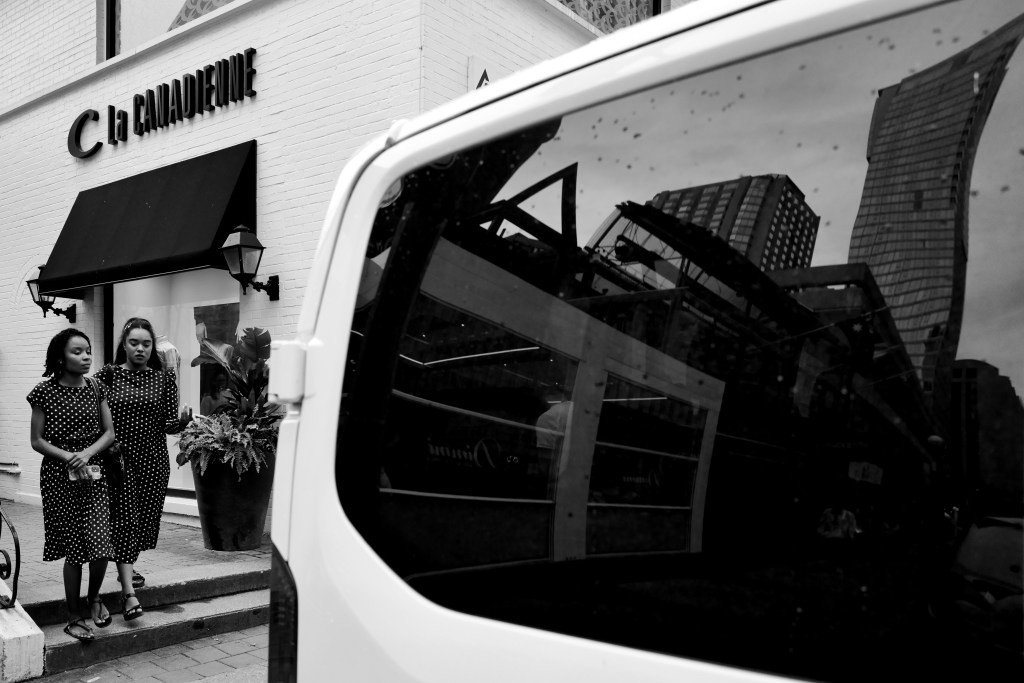
Cumberland & Bellair, Toronto, 2024

One of Toronto’s most posh shopping areas is Yorkville, where the affluent come out to spend and be seen. I like how this monochromatic photograph results in the two women looking like they could have come from 40 or 60 years ago, while the reflection in the window reveals some of the built infrastructure surrounding them. It speaks to a timelessness that is specifically located to being within a large urban environment.

Yonge & Dundas, Toronto, 2024

The Saint Patrick’s Day parade is a major event in Toronto. I’ve been photographing it for years and always march in it to make images of the crowds. I like how the woman in this photograph is almost posing in her winter jacket — it gives her a sense of elegance and self-importance — while, above her, the sign suggests that she is happy we’ve ranked her #1. But in addition to her, the man who is looking on in the right-hand side of the frame adds a degree of electricity to the image with his dourness contrasting with the woman’s own more-positive energy.

Gerrard & Galt, Toronto, 2024

When was this photograph taken? 2024 or 1964? The use of black and white has the effect of confusing the viewer as to when the photograph was made. This is accentuated by the sign in the photograph being from another generation. Adding power to the image are the two figures who are wandering through the early January snow, with the young woman looking down and over to the city’s garbage, and the little boy looking up past the trash to the graffiti on the wall. This speaks to the hopes and ambitions of youth and the practicality of maturity, while they are both literally passing by the abandoned garbage of the day.

Queen & Peter, Toronto, 2023

This photograph is only made possible because of the advertising-heavy urban landscapes in which we live. Taken in downtown Toronto, this photograph juxtaposes a question about one’s life with an idealised (and unrealistic) advertised imagination of excitement, along with a man contemplating his possible future. Him exiting the frame leaves us to wonder whether he will do something to change his life or if, instead, he will continue to live the same life that he always has. We are already left with some sense of his trajectory, however: his walking out to the left of the frame imposes on us a question of whether his movements will take him back to something he once enjoyed in life, or if his retreat through that side of the frame instead symbolises a staidness. Regardless, he will not be moving forward into the future — into the right of the frame — to see some change to his life.

Nathan Phillips Square, Toronto, 2023

Yonge and Dundas Square is Toronto’s imagined equivalent to
Times Square. In this photograph we see it at peak energy: the two women hiding under a transparent umbrella are huddling together with somewhat shocked looks on their faces, while behind them a woman is running from something out of scene and a giant in white strolls behind them. Photographs like this capture the dynamism of our urban landscapes while, simultaneously, not explaining what is specifically occurring. Instead the viewer is merely left with an ever-growing cascade of questions: Why are the women drinking out of a pineapple in the rain? Why are they shocked? Who is chasing the woman in the background? Why is there a tall white giant wandering around? What is going on with the squatting man in the advertisement? These questions draw the viewer in and invite them to create their own stories of what was before, and followed, the 1/320s that this frame holds together.

Artist’s Statement

I’m an amateur Toronto-based documentary and street photographer, and have been making images for over a decade. I make monochromatic photographs that focus on little moments that happen on the streets and which document the ebb and flow of the city over the course of years and decades. My work often deliberately plays with the temporality of photographs and calls into question when images were made, and invites the viewer to ask what specifically happened immediately prior to and following the pressing of the shutter button.

Categories
Photography Writing

Editing and Viewing Smartphone Images Versus Dedicated Camera Images

Manitoba & Nova Scotia, Toronto, 2023

In 2023, Andrea Bianco wrote a lovely long-form meditation on the difference in practice between excellent smart phone cameras (i.e., iPhone 11 Pro) and excellent compact cameras (i.e., Ricoh GR 2). I appreciated that it wasn’t a “smartphones bad and dedicated cameras good” (or the vice versa) kind of assessment. He, instead, considered the utility and capabilities of both classes of cameras. He often noted how phone cameras were best consumed on smaller screens but that their limitations became more apparent when viewed on larger screens.

His post reminded me of some longer-term considerations I’ve had for the past year about the screens on which we assess the images that we make.

Cherry & Polson, Toronto, 2024

Our camera’s screen size, or viewfinder resolution, has an effect on how we compose images. We may try to squeeze in (or exclude) content based on what we can see. However, the screen on which we edit images also affects how we perceive and present the images we have captured.

Editing on smaller screens, such as those used with phones, can lead to presenting images differently than when editing on a larger tablet or computer monitor screen. A figure that is apparent on a 12” or 24” display and is poignant to the photo editing process may functionally be a near-invisible dot on a 6” phone screen.

Eireann Quay & Queens Quay, Toronto, 2024

How we see when editing images, then, will often affect the images which are produced using dedicated cameras by merit of photographers often editing them on larger tablet or laptop screens. By editing on these larger screens we will often make very different editorial or cropping decisions based (in part) on the sheer size of the screen we are reviewing and editing photographs on. The size of the screen (and its quality) affects how we read and interpret our own photographs.

Queen & Bay, Toronto, 2019

The effects of screen size then expand, further, when we consider what screens we use to view other photographers’ work, and correspondingly lead to very different perceptions of work that photographers are digitally displaying. If a photographer edits all their work on a display of 11” or greater, should we not view it with the same size screen to truly read what they are communicating? And, by way of contrast, if a photographer’s photos are all edited on a smartphone then should we view them primarily at the size of a phone? And either way, shouldn’t we view other photographers’ work at peak screen brightness?

Of course we will all use a variety of different screens, of different sizes and luminosity and quality, to look at one another’s work. But because we are both unaware of one another’s editing and viewing defaults it is imperative to think carefully when looking at photographers’ works and ask ourselves: “Do I have the same equipment as they do, to approximate an attempt to see the photograph and scene as they intended for it to be viewed?”


Note: Updated to correctly refer to Andrea’s gender. Apologies!

Categories
Aside

2024.10.14

I’ve been reading Minimalissimo for at least a decade now and have significantly honed my sense of design and style from the work they’ve curated through the years. As of today, however, the website is shifting into archival mode and no new content will be published.

It’s not the first long-term website closing that has hurt — arguably it is Ming Thein’s that still lingers the worse, followed by Andrew Kim’s Minimally Minimal— but at least the archives of Minimalissimo will remain to reflect on in the coming months and years.

Categories
Links Writing

Encryption Use Hits a New Height in Canada

In a continuing demonstration of the importance of strong and privacy-protective communications, the federal Foreign Interference Commission has created a Signal account to receive confidential information.

Encrypted Messaging
For those who may feel more comfortable providing information to the Commission using encrypted means, they may do so through the Signal – Private Messenger app. Those who already have a Signal account can contact the Commission using our username below. Others will have to first download the app and set up an account before they can communicate with the Commission.

The Commission’s Signal Username is signal_pifi_epie20.24

Signal users can also scan QR Code below for the Commission’s username:

The Commission has put strict measures in place to protect the confidentiality of any information provided through this Signal account.

Not so long ago, the Government of Canada was arguing for an irresponsible encryption policy that included the ability to backdoor end-to-end encryption. It’s hard to overstate the significance of a government body now explicitly adopting Signal.

Categories
Links Writing

The Ongoing Problems of Placing Backdoors in Telecommunications Networks

In a cyber incident reminiscent of Operation Aurora,1 threat actors successfully penetrated American telecommunications companies (and a small number of other countries’ service providers) to gain access to lawful interception systems or associated data. The result was that:

For months or longer, the hackers might have held access to network infrastructure used to cooperate with lawful U.S. requests for communications data, according to people familiar with the matter, which amounts to a major national security risk. The attackers also had access to other tranches of more generic internet traffic, they said.

The surveillance systems believed to be at issue are used to cooperate with requests for domestic information related to criminal and national security investigations. Under federal law, telecommunications and broadband companies must allow authorities to intercept electronic information pursuant to a court order. It couldn’t be determined if systems that support foreign intelligence surveillance were also vulnerable in the breach.

Not only is this a major intelligence coup for the adversary in question, but it once more reveals the fundamental difficulties in deliberately establishing lawful access/interception systems in communications infrastructures to support law enforcement and national security investigations while, simultaneously, preventing adversaries from taking advantage of the same deliberately-designed communications vulnerabilities.

Categories
Links

Measuring the Effects of Active Disinformation Operations

This is a good long form piece by Thomas Rid on disinformation activities, with a particular focus on Russian operations. A key takeaway for me is that there is a real potential for the exposure of disinformation campaigns to beget subsequent campaigns, as the discovery (and journalistic coverage) of the initial campaign can bestow a kind of legitimacy upon adversaries in the eyes of their paymasters.

A way to overcome this ends up being the adoption of tactics that not just expose disinformation campaigns but, also, actively work to disable campaigners’ operational capacities at technical as well as staff levels. Merely revealing disinformation campaigns, by way of contrast, can serve as fuel for additional funding of disinformation operators and their abilities to launch subsequent campaigns or operations.

Categories
Writing

Computers-on-Wheels and Web-Based Vulnerabilities

While there can be significant efficiencies gained by increasing the amount of data that is accessible by motor vehicles, connecting these computers-on-wheels to the Internet can have notable consequences.

Recent reporting by Wired reveals, as an example, that:

… a group of independent security researchers revealed that they’d found a flaw in a web portal operated by the carmaker Kia that let the researchers reassign control of the internet-connected features of most modern Kia vehicles—dozens of models representing millions of cars on the road—from the smartphone of a car’s owner to the hackers’ own phone or computer. By exploiting that vulnerability and building their own custom app to send commands to target cars, they were able to scan virtually any internet-connected Kia vehicle’s license plate and within seconds gain the ability to track that car’s location, unlock the car, honk its horn, or start its ignition at will.

“If someone cut you off in traffic, you could scan their license plate and then know where they were whenever you wanted and break into their car,” says Curry. “If we hadn’t brought this to Kia’s attention, anybody who could query someone’s license plate could essentially stalk them.” For Kias that come installed with a 360-degree camera, that camera, too, was accessible to hackers. Beyond allowing the hijacking of connected features in cars themselves, Curry says, the web portal flaw also allowed hackers to query a broad range of personal information about Kia customers—names, email addresses, phone numbers, home addresses, and even past driving routes in some cases—a potentially massive data leak.

The nature of the vulnerability is particularly concerning:

When the researchers sent commands directly to the API of that website—the interface that allows users to interact with its underlying data—they say they found that there was nothing preventing them from accessing the privileges of a Kia dealer, such as assigning or reassigning control of the vehicles’ features to any customer account they created.

I do have to admit that I appreciate that this started with discovering issues with APIs used by scooters, which led the researchers to become “super interested in trying more ways to make more things honk.”

Categories
Photography Writing

10 Tips for Starting to Photograph on the Street

2014

The democratization of photography means that there are a lot of people who are interested in making images on the streets. However, many are scared of the possible confrontations they may have after taking other people’s images without first getting their permission. There are innumerable videos and essays that offer a lot of tips, but many of the common “tips” just wouldn’t work for me when I was starting out.

By way of background, I’ve been making images in Toronto since 2014 and have used a range of cameras, focal lengths, and so forth. I started out being very hesitant to take people’s images whereas, today, I am pretty comfortable and they are in the majority of the images that I take each week. You can see my most recent images on my Glass profile.

So here are 10 tips that can help you get used to making images on the street based on my own trepidations when I started out.

1. Just Walk Around With Your Camera

When I first purchased my Olympus EM10-II I was really nervous to actually use it in downtown Toronto. What if someone got mad that I was taking their photo?

2015

So my solution at the outset was just to always be carrying my camera to and from work. I had about a 2-3 km walk each way through urban areas and ensured that I had my camera in my hand the whole time.

For me, just always holding the camera in public normalized how it felt to me. It also helped me better appreciate the weight and how it moved in my hand.

2. Don’t Focus on Being “Stealthy”

So many street photography tips focus on being “stealthy”. That can mean using a long lens so that people don’t know you’re taking their photo, to shooting exclusively from waist height, never raising your camera to your eye, and so forth. But when you’re shooting in a stealthy way and someone approaches you, then you’re put in a position of potentially lying to them if you say you weren’t making images.

2016

By being “stealthy” — especially if you’re nervous about confrontation — and getting caught the potential confrontation may be a lot more emotionally charged. By way of contrast, if you’re not sneaking about and you’re being confronted then the emotions are going to be lower at the outset than if you were caught sneaking a shot of someone.

3. Don’t Focus on the People

If you’re anything like me when I started making images in my downtown core, taking images of people was something I aspired to but wasn’t comfortable with. But I lived in a big urban city and there was always lots to see and make images of…and so I made images of graffiti, of buildings, or of art exhibitions, and so forth. And in all cases the images that I captured were in public with other people around.

2017

Again, the focus (no pun intended) was just to get comfortable using my camera in public. I liked capturing ambient images of the city and its life, but really this was me practicing and just getting used to holding and using my camera in public, with the ultimate ambition of including people in my images.

Bonus Sub-Tip: As part of not focusing on people you can also consider looking for scenes and then waiting for people to just wander through the scene. I often will do this, myself: I’ll find a location, raise my camera to my eye, hold it for a minute or two, and only then start making images. Anyone who comes through the scene knows that I was there first — I wasn’t chasing them to make their image — and if someone asks what I’m doing, I can talk about the scene and what drew me to it. This helps to orient any conversations around specific individuals in your photographs being incidental to the image being taken, as opposed to the individuals being the primary focus of the image itself.

4. Practice With a 50mm or Wider Lens

It’s pretty routine advice to get a prime lens and learn with it, especially when taking images of metropolitan areas. To my mind there are a few good reasons for this approach to learning.

2018

First, just in terms of training, a prime prevents you from certain kinds of indecisiveness. When you’re operating a zoom lens you have to wonder which of the focal lengths are “best” and you don’t necessarily learn to “see” in any particular focal lengths. If you only have a 50mm focal length, by way of comparison, then you quickly learn to “see” in that length. And you can still zoom — it just requires using your feet!

Second, a prime lens helps you determine what kinds of images you are, or are not, looking to make. If you’re using a 50mm lens then very wide street images that you can capture with a 28mm are just not going to be made. And that’s fine — you learn to look for images that align with that particular focal length. By imposing a series of restrictions on how you can make an image you can expand your creativity by just focusing on what that focal length can produce.

2019

Third, using a single prime lens will mean that you’re carrying less weight and you won’t end up carrying a whole pile of kit with you. Which brings us to the next tip…

5. Don’t Trudge Around with More Than 1-2 Lenses

If you’re going to wander around the streets then you will benefit from not carrying too many lenses. I’d recommend only stepping out the door with your one prime lens. Not only does having a few lenses lead to creative ambiguity — is lens 1 or 2 or 3 “right” for this scene? — but it means you have to carry more stuff on your person.

Down But Not Out, 2020

Less weight and fewer focal lengths options means that you may be out making images longer and with more creative discipline. And by really leaning into 1 or 2 fixed focal lengths you’ll learn a lot about whether you like those focal lengths and, as importantly, how you can use them when making images.1

6. Go to Events Where Taking Photographs is Normalized

If there’s a parade, or public art show, or whatever then try to get there and practice taking images of people in those venues. Because it’s a big public event people will tend to be pretty OK with their images being taken. And it will also expose you, a budding photographer, to the challenge of sometimes grabbing a shot in changing light, moving crowds, and so forth.

Joy In Dark Times, 2021

If you’re feeling particularly daring then you might consider walking alongside a parade or protest, and make images of those who are viewing the event. It’s the “one step up” from making images of the participants of parades and events but still pretty comfortable. Most people in crowds are going to be OK with their images being captured and you’ll have walked past anyone who happened to be annoyed at your photographing them before they emerge from the crowds.

7. Go Out a Lot

I try to get onto the streets for a couple hours every weekend. I have a busy full-time job and photography is my hobby, so I don’t worry about not being able to devote a hour or more every day into making images. I’d love to be able to do so but it’s just not my reality.

Fix, Found, 2022

This having been said I am always out each weekend. Every year I make thousand of frames and often keep returning to the same spots year over year over year in the hopes of some scenes finally producing an image that I like. And by going out you both get a sense for how light falls in your environments, how people move in them, as well as how the urban environment changes through the year. The more you can predict about the environment and its inhabitants the more likely it is that you’ll collect images that speak to you.

8. Review Your Work

Figure out a review tempo for your work and then keep to it. There are at least two parts to this.

First, you need to review the images that you’re making on the streets. I tend to do quick reviews when I come back but other folks do so days or weeks later. Whatever your tempo is it’ll be important to look to see what you’re capturing. It’s the only way to really understand how your creative vision is being interpreted using the camera and lens that you’re carrying.

Toronto, 2023

Second, I’d encourage you to do either monthly, quarterly, bi-annual, or annual assessments of the images that you’re taking. Go through and pick out your top 10-20 images and really think about why they’re your favourites. And, also, how would you want them to be improved? What more might you have done?

As you go through more of these reviews also do comparisons to past favourite images — it’s by undertaking this kind of self-assessment or critique that you’ll be able to see whether you are growing or stretching as a photographer, as well as detect themes or commonalities in what you are being attracted towards.

9. Post Some of Your Work Online

Lots of photographers use some kind of online service to post their images. What you use doesn’t really matter. But having a published set of images means that if someone does ask you what you’re doing on the streets, you can quickly direct them to your online work so they can see you’re doing something artistic and genuine.

Cumberland & Bellair, Toronto, 2024

If someone does ask about you about what you’re doing just be honest: you’re starting out as a photographer and like capturing urban environments. Maybe the person in question looked interesting. And you can show them a selection of your work which will reveal you are treating photography at least somewhat seriously as opposed to just taking creepy shots of people on the street.2

10. Have Fun and Ignore Equipment

Street photography is a fun hobby whether you’re out with a smartphone camera, using a film camera or DSLR, or playing with a mirrorless camera. Don’t worry about having “the right” camera or one that is sufficiently new. Any camera that has been made in the past 10 years is going to be more than enough when you’re in the streets for the first time. Don’t focus on the equipment and, instead, just enjoy the fun that comes from focusing intently on the built environment, light, and the people who pass through the streets.

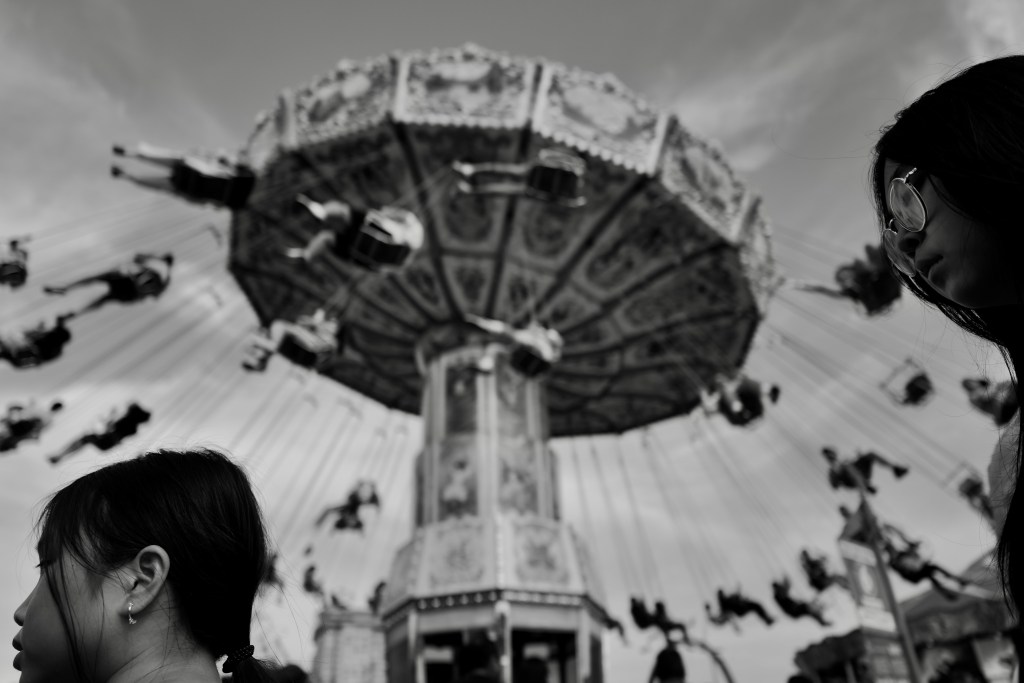
Princess & Nunavut (CNE), Toronto, 2024

Those are my own 10 tips — what tips would you give a younger version of yourself, today, based on your experiences to date?


  1. If you just want to use the kit lens that came with your camera — likely a zoom lens — then just set it to a single fixed focal lens and restrict in in place with some electrical tape. ↩︎
  2. Of course, if you are just taking creepy shots of people — such as some street photographers who use massive zoom lenses to exclusively take long distance photographs of attractive people — then this will just “out” you and what you’re up to. Don’t be one of those people! ↩︎
Categories
Aside

2024.9.17

In an unexpected but pleasant twist, tonight, I chatted with a friend about what I saw in the images I’d posted to Glass throughout the year. He has an artistic background and was often able to see — and speak to — things that I’d not considered previously. It’s also clear that I’m getting better at explaining and outlining what’s in my images, the common thematics and how they’re developing over time, and able to provide critique to past work.

So a pleasant twist and progress!

Categories
Aside

Putting in the Work

For better or worse, I tend to be decent enough at adding routines or processes into my life and then just maintaining them. When I was in grad school — prior to getting the first Series 0 Apple Watch — I personally committed to a particular fitness regime.

Fast forward to today and that has me putting in 5-6 hours a week in our (petite!) home gym. And typically if I don’t make it to our gym I’m, instead, adding in some long hours outside and moving about during the day or night.

Only a few years until I hit 4,000!