Categories
Writing

Vaccination, Discrimination, and Canadian Civil Liberties

Photo by Karolina Grabowska on Pexels.com

Civil liberties debates about whether individuals should have to get vaccinated against Covid-19 are on the rise. Civil liberties groups broadly worry that individuals will suffer intrusions into their privacy, or that rights of association or other rights will be unduly abridged, as businesses and employers require individuals to demonstrate proof of vaccination.

As discussed in a recent article published by the CBC, some individuals are specifically unable to, or concerned about, receiving Covid-19 vaccines on the basis that, “they’re taking immunosuppressant drugs, for example, while others have legitimate concerns about the safety and efficacy of the COVID-19 vaccines or justifiable fears borne from previous negative interactions with the health-care system.” The same expert, Arthur Schafer of the Centre for Professional and Applied Ethics at the University of Manitoba, said, “[w]e should try to accommodate people who have objections, conscientious or scientific or even religious, where we can do so without compromising public safety and without incurring a disproportionate cost to society.”

Other experts, such as Ann Cavoukian, worry that being compelled to disclose vaccination status could jeopardize individuals’ medical information should it be shared with parties who are not equipped to protect it, or who may combine it with other information to discriminate against individuals. For the Canadian Civil Liberties Association, they have taken the stance that individuals should have the freedom to choose to be vaccinated or not, that no compulsions should be applied to encourage vaccination (e.g., requiring vaccination to attend events), and broadly that, “COVID is just another risk now that we have to incorporate into our daily lives.”

In situations where individuals are unable to be vaccinated, either due to potential allergic responses or lack of availability of vaccine (e.g., those under the age of 12), then it is imperative to ensure that individuals do not face discrimination. In these situations, those affected cannot receive a vaccine and it is important to not create castes of the vaccinated and unable-to-be-vaccinated. For individuals who are hesitant due to historical negative experiences with vaccination efforts, or medical experimentation, some accommodations may also be required.

However, in the cases where vaccines are available and there are opportunities to receive said vaccine, then not getting vaccinated does constitute a choice. As it stands, today, in many Canadian schools children are required to received a set of vaccinations in order to attend school and if their parents refuse, then the children are required to use alternate educational systems (e.g., home schooling). When parents make a specific choice they are compelled to deal with the consequences of said decision. (Of course, there is not a vaccine for individuals under 12 years of age at the moment and so we shouldn’t be barring unvaccinated children from schools, but adopting such a requirement in the future might align with how schools regularly require proof of vaccination status to attend public schools.)

The ability to attend a concert, as an example, can and should be predicated on vaccination status where vaccination is an option for attendees. Similarly, if an individual refuses to be vaccinated their decision may have consequences in cases where they are required to be in-person in their workplace. There may be good reasons for why some workers decline to be vaccinated, such as a lack of paid days off and fear that losing a few days of work due to vaccination symptoms may prevent them from paying the rent or getting food; in such cases, accommodations to enable them to get vaccinated are needed. However, once such accommodations are made decisions to continue to not get vaccinated may have consequences.

In assessing whether policies are discriminatory individuals’ liberties as well as those of the broader population must be taken into account, with deliberate efforts made to ensure that group rights do not trample on the rights of minority or disenfranchised members of society. Accommodations must be made so that everyone can get vaccinated; rules cannot be established that apply equally but affect members of society in discriminatory ways. But, at the same time, the protection of rights is conditional and mitigating the spread of a particularly virulent disease that has serious health and economic effects is arguably one of those cases where protecting the community (and, by extension, those individuals who are unable to receive a vaccine for medical reasons) is of heightened importance.

Is this to say that there are no civil liberties concerns that might arise when vaccinating a population? No, obviously not.

In situations where individuals are unhoused or otherwise challenged in keeping or retaining a certification that they have been vaccinated, then it is important to build policies that do not discriminate against these classes of individuals. Similarly, if there is a concern that vaccination passes might present novel security risks that have correlate rights concerns (e.g., a digital system that links presentations of a vaccination credential with locational information) then it is important to carefully assess, critique, and re-develop systems so that they provide the minimum data required to reduce the risk of Covid-19’s spread. Also, as the population of vaccinated persons reaches certain percentages there may simply be less of a need to assess or check that someone is vaccinated. While this means that some ‘free riders’ will succeed, insofar as they will decline to be vaccinated and not suffer any direct consequences, the goal is not to punish people who refuse vaccination and instead to very strongly encourage enough people to get vaccinated so that the population as a whole is well-protected.

However, taking a position that Covid-19 is part of society and that society just has to get used to people refusing to be vaccinated while participating in ‘regular’ social life, and that this is just a cost of enjoying civil liberties, seems like a bad argument and a poor framing of the issue. Making this kind of broader argument risks pushing the majority of Canadians towards discounting all reasons that individuals may present to justify or explain not getting vaccinated, with the effect of inhibiting civil society from getting the public on board to protect the rights of those who would be harmfully affected by mandatory vaccination policies or demands that individuals always carry vaccine passport documents.

Those who have made a choice to opt-out of vaccination may experience resulting social costs, but those who cannot opt to get a vaccine in the first place or who have proven good reasons for avoiding vaccination shouldn’t be unduly disadvantaged. That’s the line in the sand to hold and defend, not that protecting civil liberties means that there should be no cost for voluntarily opting out of life saving vaccination programs.

Categories
Links Writing

Does Canada, Really, Need A Foreign Intelligence Service?

A group of former senior Canadian government officials who have been heavily involved in the intelligence community recently penned an op-ed that raised the question of “does Canada need a foreign intelligence service?” It’s a curious piece, insofar as it argues that Canada does need such a service while simultaneously discounting some of the past debates about whether this kind of a service should be established, as well as giving short shrift to Canada’s existing collection capacities that are little spoken about. They also fundamentally fail to take up what is probably the most serious issue currently plaguing Canada’s intelligence community, which is the inability to identify, hire, and retain qualified staff in existing agencies that have intelligence collection and analysis responsibilities.

The Argument

The authors’ argument proceeds in a few pieces. First, it argues that Canadian decision makers don’t really possess an intelligence mindset insofar as they’re not primed to want or feel the need to use foreign intelligence collected from human sources. Second, they argue that the Canadian Security Intelligence Service (CSIS) really does already possess a limited foreign intelligence mandate (and, thus, that the Government of Canada would only be enhancing pre-existing powers instead of create new powers from nothing). Third, and the meat of the article, they suggest that Canada probably does want an agency that collects foreign intelligence using human sources to support other members of the intelligence community (e.g., the Communications Security Establishment) and likely that such powers could just be injected into CSIS itself. The article concludes with the position that Canada’s allies “have quietly grumbled from time to time that Canada is not pulling its weight” and that we can’t prioritize our own collection needs when we’re being given intelligence from our close allies per agreements we’ve established with them. This last part of the argument has a nationalistic bent to it: implicitly they’re asking whether we can really trust even our allies and closest friends? Don’t we need to create a capacity and determine where such an agency and its tasking should focus on, perhaps starting small but with the intent of it getting larger?

Past Debates and Existing Authorities

The argument as positioned fails to clearly make the case for why these expanded authorities are required and simultaneously does not account for the existing powers associated with the CSE, the Canadian military, and Global Affairs Canada.

With regards to the former, the authors state, “the arguments for and against the establishment of a new agency have never really been examined; they have only been cursorily debated from time to time within the government by different agencies, usually arguing on the basis of their own interests.” In making this argument they depend on people not remembering their history. The creation of CSIS saw a significant debate about whether to include foreign human intelligence elements and the decision by Parliamentarians–not just the executive–was to not include these elements. The question of whether to enable CSIS or another agency to collect foreign human intelligence cropped up, again, in the late 1990s and early 2000, and again around 2006-2008 or so when the Harper government proposed setting up this kind of an agency and then declined to do so. To some extent, the authors’ op-ed is keeping with the tradition of this question arising every decade or so before being quietly set to the side.

In terms of agencies’ existing authorities and capacities, the CSE is responsible for conducting signals intelligence for the Canadian government and is tasked to focus on particular kinds of information per priorities that are established by the government. Per its authorizing legislation, the CSE can also undertake certain kinds of covert operations, the details of which have been kept firmly under wraps. The Canadian military has been aggressively building up its intelligence capacities with few details leaking out, and its ability to undertake foreign intelligence using human sources as unclear as the breadth of its mandate more generally.1 Finally, GAC has long collected information abroad. While their activities are divergent from the CIA or MI6–officials at GAC aren’t planning assassinations, as an example–they do collect foreign intelligence and share it back with the rest of the Government of Canada. Further, in their increasingly distant past they stepped in for the CIA in environments the Agency was prevented from operating within, such as in Cuba.

All of this is to say that Canada periodically goes through these debates of whether it should stand up a foreign intelligence service akin to the CIA or MI6. But the benefits of such a service are often unclear, the costs prohibitive, and the actual debates about what Canada already does left by the wayside. Before anyone seriously thinks about establishing a new service, they’d be well advised to read through Carvin’s, Juneau’s, and Forcese’s book Top Secret Canada. After doing so, readers will appreciate that staffing is already a core problem facing the Canadian intelligence community and recognize that creating yet another agency will only worsen this problem. Indeed, before focusing on creating new agencies the authors of the Globe and Mail op-ed might turn their minds to how to overcome the existing staffing problems. Solving that problem might enable agencies to best use their existing authorizing legislation and mandates to get much of the human foreign intelligence that the authors are so concerned about collecting. Maybe that op-ed could be titled, “Does Canada’s Intelligence Community Really Have a Staffing Problem?”


  1. As an example of the questionable breadth of the Canadian military’s intelligence function, when the military was tasked with assisting long-term care home during the height of the Covid-19 pandemic in Canada, they undertook surveillance of domestic activism organizations for unclear reasons and subsequently shared the end-products with the Ontario government. ↩︎
Categories
Links Writing

Which States Most Require ‘Democratic Support’?

Roland Paris and Jennifer Walsh have an excellent, and thought-provoking, column in the Globe and Mail where they argue that Western democracies need to adopt a ‘democratic support’ agenda. Such an agenda has multiple points comprising:

  1. States getting their own democratic houses in order;
  2. States defending themselves and other democracies against authoritarian states’ attempts to disrupt democracies or coerce residents of democracies;
  3. States assisting other democracies which are at risk of slipping toward authoritarianism.

In principle, each of these points make sense and can interoperate with one another. The vision is not to inject democracy into states but, instead, to protect existing systems and demonstrate their utility as a way of weaning nations towards adopting and establishing democratic institutions. The authors also assert that countries like Canada should learn from non-Western democracies, such as Korea or Taiwan, to appreciate how they have maintained their institutions in the face of the pandemic as a way to showcase how ‘peer nations’ also implement democratic norms and principles.

While I agree with the positions the authors suggest, far towards the end of the article they delicately slip in what is the biggest challenge to any such agenda. Namely, they write:

Time is short for Canada to articulate its vision for democracy support. The countdown to the 2024 U.S. presidential election is already under way, and no one can predict its outcome. Meanwhile, two of Canada’s closest democratic partners in Europe, Germany and France, may soon turn inward, preoccupied by pivotal national elections that will feature their own brands of populist politics.1

In warning that the United States may be an unreliable promoter of democracy (and, by extension, human rights and international rules and order which have backstopped Western-dominated world governance for the past 50 years) the authors reveal the real threat. What does it mean when the United States is regarded as likely to become more deeply mired in internecine ideological conflicts that absorbs its own attention, limits its productive global engagements, and is used by competitor and authoritarian nations to warn of the consequences of “American-style” democracy?

I raise these questions because if the authors’ concerns are fair (and I think they are) then any democracy support agenda may need to proceed with the presumption that the USA may be a wavering or episodic partner in associated activities. To some extent, assuming this position would speak more broadly to a recognition that the great power has significantly fallen. To even take this as possible–to the extent that contingency planning is needed to address potential episodic American commitment to the agenda of buttressing democracies–should make clear that the American wavering is the key issue: in a world where the USA is regarded as unreliable, what does this mean for other democracies and how they support fellow democratic states? Do countries, such as Canada and others with high rule-of-law democratic governments, focus first and foremost on ‘supporting’ US democracy? And, if so, what does this entail? How do you support a flailing and (arguably) failing global hegemon?

I don’t pretend to have the answers. But it seems that when we talk about supporting democracies, and can’t rely on the USA to show up in five years, then the metaphorical fire isn’t approaching our house but a chunk of the house is on fire. And that has to absolutely be our first concern: can we put out the fire and save the house, or do we need to retreat with our children and most precious objects and relocate? And, if we must retreat…to where do we retreat?


  1. Emphasis not in original. ↩︎
Categories
Links Writing

Building a Strategic Vision to Combat Cybercrime

The Financial Times has a good piece examining the how insurance companies are beginning to recalculate how they assess insurance premiums that are used to cover ransomware payments. In addition to raising fees (and, in some cases, deciding whether to drop insuring against ransomware) some insurers like AIG are adopting stronger underwriting, including:

… an additional 25 detailed questions on clients’ security measures. “If [clients] have very, very low controls, then we may not write coverage at all,” Tracie Grella, AIG’s global head of cyber insurance, told the Financial Times.

To be sure, there is an ongoing, and chronic, challenge of getting companies to adopt baseline security postures, inclusive of running moderately up-to-date software, adopting multi-factor authorization, employing encryption at rest, and more. In the Canadian context this is made that much harder because the majority of Canadian businesses are small and mid-sized; they don’t have an IT team that can necessarily maintain or improve on their organization’s increasingly complicated security posture.

In the case of larger mid-sized, or just large, companies the activities of insurers like AIG could force them to modify their security practices for the better. Insurance is generally regarded as cheaper than security and so seeing the insurance companies demand better security to receive insurance is a way of incentivizing organizational change. Further change can be incentivized by government adopting policies such as requiring a particular security posture in order to bid on, or receive, government contracts. This governmental incentivization doesn’t necessarily encourage change for small organizations that already find it challenging to contract with government due to the level of bureaucracy involved. For other organizations, however, it will mean that to obtain/maintain government contracts they’ll need to focus on getting the basics right. Again, this is about aligning incentives such that organizations see value in changing their operational policies and postures to close off at least some security vulnerabilities. There may be trickle down effects to these measures, as well, insofar as even small-sized companies may adopt better security postures based on actionable guidance that is made available to the smaller companies responsible for supplying those middle and larger-sized organizations, which do have to abide by insurers’ or governments’ requirements.1

While the aforementioned incentives might improve the cybersecurity stance of some organizations the key driver of ransomware and other criminal activities online is its sheer profitability. The economics of cybercrime have been explored in some depth over the past 20 years or so, and there are a number of conclusions that have been reached that include focusing efforts on actually convicting cybercriminals (this is admittedly hard where countries like Russia and former-Soviet Republic states indemnify criminals that do not target CIS-region organizations or governments) to selectively targeting payment processors or other intermediaries that make it possible to derive revenues from the criminal activities.

Clearly it’s not possible to prevent all cybercrime, nor is it possible to do all things at once: we can’t simultaneously incentivize organizations to adopt better security practices, encourage changes to insurance schemas, and find and address weak links in cybercrime monetization systems with the snap of a finger. However, each of the aforementioned pieces can be done with a strategic vision of enhancing defenders’ postures while impeding the economic incentives that drive online criminal activities. Such a vision is ostensibly shared by a very large number of countries around the world. Consequently, in theory, this kind of strategic vision is one that states can cooperate on across borders and, in the process, build up or strengthen alliances focused on addressing challenging international issues pertaining to finance, crime, and cybersecurity. Surely that’s a vision worth supporting and actively working towards.


  1. To encourage small suppliers to adopt better security practices when they are working with larger organizations that have security requirements placed on them, governments might set aside funds to assist the mid-sized and large-sized vendors to secure down the supply chain and thus relieve small businesses of these costs. ↩︎
Categories
Photo Essay Photography Writing

A Place That Grew

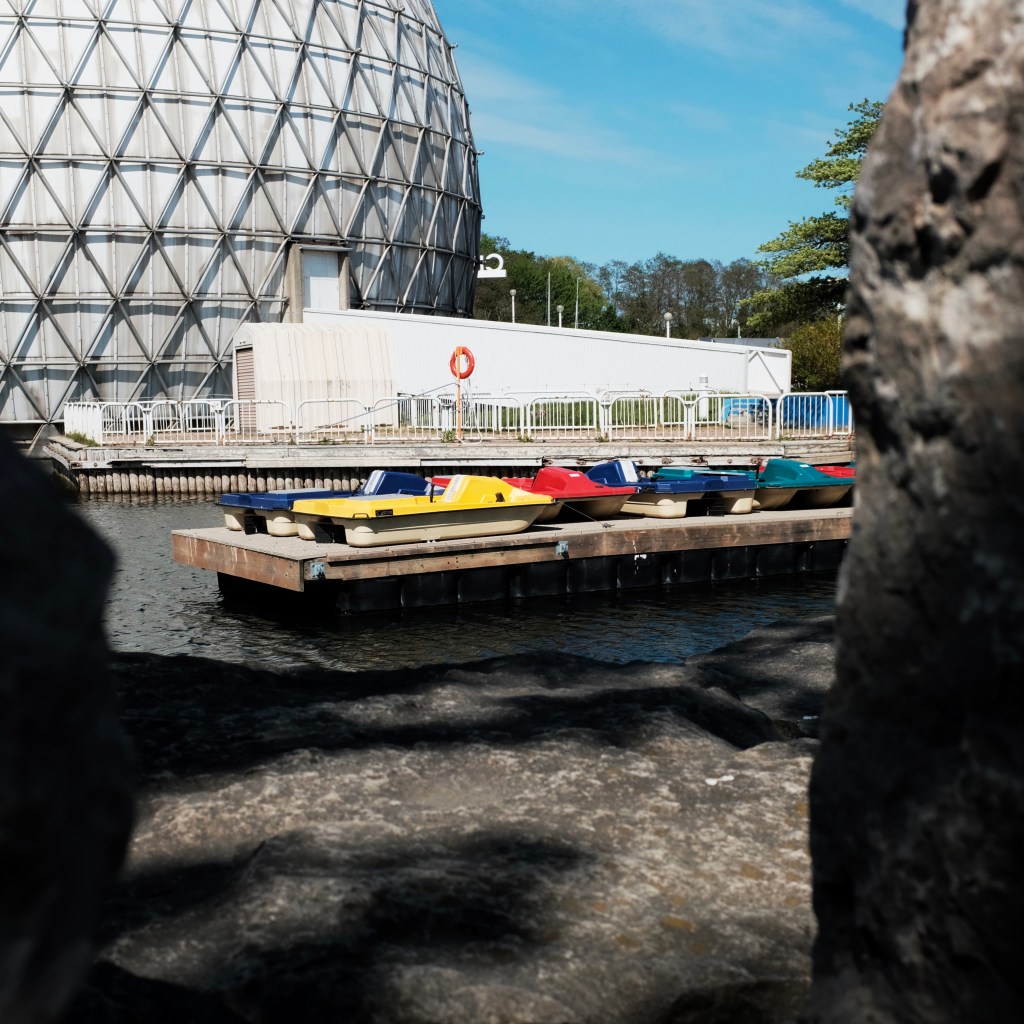
Toronto is home to Ontario Place, which was once a park that had splash pads, rides, a Legoland, and more. It was opened in 1971 and hugs Lake Ontario. It was closed in 2012 for redevelopment and, since then, has largely languished as successive governments have suggested ideas but none have come to fruition. Ontario’s official motto is “A Place to Grow”, and by extension Ontario Place itself is a place that has since grown up and is now slowly wasting away due to government neglect.

It’s also one of my favourite places in the city to visit and photograph, and especially during the pandemic when it has been relatively quiet and free of people. It’s both a very calming location and one that has very interesting buildings and urban ruins to photograph.

(Highway Views by Christopher Parsons)
(Modes of Locomotion by Christopher Parsons)

It’s getting warmer in Toronto which means that people are inclined to be outdoors; there are more cyclists and skateboarders in Toronto than I think ever before, and they’re all using the paths that are typically used predominantly by people who are walking or jogging.

(Unity Run by Christopher Parsons)
(Light Rails BW by Christopher Parsons)

Each year, I’ve managed to find or access or photograph a new part of the park that’s succumbed to lack of upkeep, and this year is no exception. An enterprising soul laid down some boards to cross over into part of the flume ride which meant I could see it for the first time! I suspect that it’ll only be a matter of time until a provincial government finally gets its way and tears down these ruins.

(Towards the Apex by Christopher Parsons)
(Down We Go by Christopher Parsons)
(Flume(ing) Graffiti by Christopher Parsons)
(Landlocked by Christopher Parsons)

I’m sure that more and more people will be using the park this year it’s limited attractions, and especially as more Torontonians get vaccinated. While I’ll miss feeling like the park is my own, it’ll be terrific to have another part of the city return to normality.

(Goodbye! by Christopher Parsons)

(All photos shot using an iPhone 12 Pro and Fuji x100f, and edited using my presets in Darkroom.)

Categories
Writing

Two Thoughts on China’s Draft Privacy Law

Alexa Lee, Samm Sacks, Rogier Creemers, Mingli Shi, and Graham Webster have collectively written a helpful summary of the new Chinese Data Privacy Law over at Stanford’s DigiChina.

There were a pair of features that most jump out to me.

First, that the proposed legislation will compel Chinese companies “to police the personal data practices across their platforms” as part of Article 57. As noted by the team at Stanford,

“the three responsibilities identified for big platform companies here resonate with the “gatekeeper” concept for online intermediaries in Europe, and a requirement for public social responsibility reports echoes the DMA/DSA mandate to provide access to platform data by academic researchers and others. The new groups could also be compared with Facebook’s nominally independent Oversight Board, which the company established to review content moderation decisions.”

I’ll be particularly curious to see the kinds of transparency reporting that emerges out of these companies. I doubt the reports will parallel those in the West, which tend to focus on the processes and number of disclosures from private companies to government and, instead, the Chinese companies’ reports will focus on how companies are being ‘socially responsible’ with how they collect, process, and disclose data to other Chinese businesses. Still, if we see this more consumer-focused approach it will demonstrate yet another transparency report tradition that will be useful to assess in academic and public policy writing.

Second, the Stanford team notes that,

“new drafts of both the PIPL and the DSL added language toughening requirements for Chinese government approval before data holders in China cooperate with foreign judicial or law enforcement requests for data, making failure to gain permission a clear violation punishable by financial penalties up to 1 million RMB.”

While not surprising, this kind of restriction will continue to raise data sovereignty borders around personal information held in China. The effect? Western states will still need to push for Mutual Legal Assistant Treaty (MLAT) reform to successfully extract information from Chinese companies (and, perhaps in all likelihood, fail to conclude these reforms).1

It’s perhaps noteworthy that while China is moving to build up walls there is a simultaneous attempt by the Council of Europe to address issues of law enforcement access to information held by cloud providers (amongst other things). The United States passed the CLOUD Act in 2018 to begin to try and alleviate the issue of states gaining access to information held by cloud providers operating in foreign jurisdictions (though did not address human rights concerns which were mitigated through traditional MLAT processes). Based on the proposed Chinese law, it’s unlikely that the CLOUD Act will gain substantial traction with the Chinese government, though admittedly this wasn’t the aim of the CLOUD Act or an expected outcome of its passage.

Nevertheless, as competing legal frameworks are established that place the West on one side, and China and Russia on the other, the effect will be further entrenching the legal cultures of the Internet between different economic and political (and security) regimes. At the same time, data will be easily stored anywhere in the world including out of reach of relevant law enforcement agencies by criminal actors that routinely behave with technical and legal savvy.

Ultimately, the raising of regional and national digital borders is a topic to watch, both to keep an eye on what the forthcoming legal regimes will look like and, also, to assess the extents to which we see languages of ‘strong sovereignty’ or nationalism creep functionally into legislation around the world.


  1. For more on MLAT reform, see these pieces from Lawfare ↩︎
Categories
Writing

Overclassification and Its Impacts

Photo by Wiredsmart on Pexels.com

Jason Healey and Robert Jervis have a thought provoking piece over at the Modern War Institute at West Point. The crux of the argument is that, as a result of overclassification, it’s challenging if not impossible for policymakers or members of the public (to say nothing of individual analysts in the intelligence community or legislators) to truly understand the nature of contemporary cyberconflict. While there’s a great deal written about how Western organizations have been targeted by foreign operators, and how Western governments have been detrimentally affected by foreign operations, there is considerably less written about the effects of Western governments’ own operations towards foreign states because those operations are classified.

To put it another way, there’s no real way of understanding the cause and effect of operations, insofar as it’s not apparent why foreign operators are behaving as they are in what may be reaction to Western cyber operations or perceptions of Western cyber operations. The kinds of communiques provided by American intelligence officials, while somewhat helpful, also tend to obscure as much as they reveal (on good days). Healey and Jervis write:

General Nakasone and others are on solid ground when highlighting the many activities the United States does not conduct, like “stealing intellectual property” for commercial profit or disrupting the Olympic opening ceremonies. There is no moral equivalent between the most aggressive US cyber operations like Stuxnet and shutting down civilian electrical power in wintertime Ukraine or hacking a French television station and trying to pin the blame on Islamic State terrorists. But it clouds any case that the United States is the victim here to include such valid complaints alongside actions the United States does engage in, like geopolitical espionage. The concern of course is a growing positive feedback loop, with each side pursuing a more aggressive posture to impose costs after each fresh new insult by others, a posture that tempts adversaries to respond with their own, even more aggressive posture.

Making things worse, the researchers and academics who are ostensibly charged with better understanding and unpacking what Western intelligence agencies are up to sometimes decline to fulfill their mandate. The reasons are not surprising: engaging in such revelations threaten possible career prospects, endanger the very publication of the research in question, or risk cutting off access to interview subjects in the future. Healey and Jervis focus on the bizarre logics of working and researching the intelligence community in the United States, saying (with emphasis added):

Think-tank staff and academic researchers in the United States often shy away from such material (with exceptions like Ben Buchanan) so as not to hamper their chances of a future security clearance. Even as senior researchers, we were careful not to directly quote NSA’s classified assessment of Iran, but rather paraphrased a derivative article.

A student, working in the Department of Defense, was not so lucky, telling us that to get through the department’s pre-publication review, their thesis would skip US offensive operations and instead focus on defense.

Such examples highlight the distorting effects of censorship or overclassification: authors are incentivized to avoid what patrons want ignored and emphasize what patrons want highlighted or what already exists in the public domain. In paper after paper over the decades, new historical truths are cumulatively established in line with patrons’ preferences because they control the flow and release of information.

What are the implications as written by Healey and Jervis? In intelligence communities the size of the United States’, information gets lost or not passed to whomever it ideally should be presented to. Overclassification also means that policy makers and legislators who aren’t deeply ‘in the know’ will likely engage in decisions based on half-founded facts, at best. In countries such as Canada, where parliamentary committees cannot access classified information, they will almost certainly be confined to working off of rumour, academic reports, government reports that are unclassified, media accounts that divulge secrets or gossip, and the words spoken by the heads of security and intelligence agencies. None of this is ideal for controlling these powerful organizations, and the selective presentation of what Western agencies are up to actually risks compounding broader social ills.

Legislative Ignorance and Law

One of the results of overclassification is that legislators, in particular, become ill-suited to actually understanding national security legislation that is presented before them. It means that members of the intelligence and national security communities can call for powers and members of parliament are largely prevented from asking particularly insightful questions, or truly appreciate the implications of the powers that are being asked for.

Indeed, in the Canadian context it’s not uncommon for parliamentarians to have debated a national security bill in committee for months and, when asked later about elements of the bill, they admit that they never really understood it in the first place. The same is true for Ministers who have, subsequently, signed off on broad classes of operations that have been authorized by said legislation.

Part of that lack of understanding is the absence of examples of how powers have been used in the past, and how they might be used in the future; when engaging with this material entirely in the abstract, it can be tough to grasp the likely or possible implications of any legislation or authorization that is at hand. This is doubly true in situations where new legislation or Ministerial authorization will permit secretive behaviour, often using secretive technologies, to accomplish equally secretive objectives.

Beyond potentially bad legislative debates leading to poorly understood legislation being passed into law and Ministers consenting to operations they don’t understand, what else may follow from overclassification?

Nationalism, Miscalculated Responses, and Racism

To begin with, it creates a situation where ‘we’ in the West are being attacked by ‘them’ in Russia, Iran, China, North Korea, or other distant lands. I think this is problematic because it casts Western nations, and especially those in the Five Eyes, as innocent victims in the broader world of cyber conflict. Of course, individuals with expertise in this space will scoff at the idea–we all know that ‘our side’ is up to tricks and operations as well!–but for the general public or legislators, that doesn’t get communicated using similarly robust or illustrative examples. The result is that the operations of competitor nations can be cast as acts of ‘cyberwar’ without any appreciation that those actions may, in fact, be commensurate with the operations that Five Eyes nations have themselves launched. In creating an Us versus Them, and casting the Five Eyes and West more broadly as victims, a kind of nationalism can be incited where ‘They’ are threats whereas ‘We’ are innocents. In a highly complex and integrated world, these kinds of sharp and inaccurate concepts can fuel hate and socially divisive attitudes, activities, and policies.

At the same time, nations may perceive themselves to be targeted by Five Eyes nations, and deduce effects to Five Eyes operations even when that isn’t the case. When a set of perimeter logs show something strange, or when computers are affected by ransomware or wiperware, or another kind of security event takes place, these less resourced nations may simply assume that they’re being targeted by a Five Eyes operation. The result is that foreign government may both drum up nationalist concerns about ‘the West’ or ‘the Five Eyes’ while simultaneously queuing up their own operations to respond to what may, in fact, have been an activity that was totally divorced from the Five Eyes.

I also worry that the overclassification problem can lead to statements in Western media that demonizes broad swathes of the world as dangerous or bad, or threatening for reasons that are entirely unapparent because Western activities are suppressed from public commentary. Such statements arise with regular frequency, where China is attributed to this or to that, or when Russia or Middle Eastern countries are blamed for the most recent ill on the Internet.

The effect of such statements can be to incite differential degrees of racism. When mainstream newspapers, as an example, constantly beat the drum that the Chinese government (and, by extension, Chinese people) are threats to the stability and development of national economies or world stability, over time this has the effect of teaching people that China’s government and citizens alike are dangerous. Moreover, without information about Western activities, the operations conducted by foreign agencies can be read out of context with the effect that people of certain ethnicities are regarded as inherently suspicious or sneaky as compared to those (principally white) persons who occupy the West. While I would never claim that the overclassification of Western intelligence operations are the root cause of racism in societies I do believe that overclassification can fuel misinformation about the scope of geopolitics and Western intelligence gathering operations, with the consequence of facilitating certain subsequent racist attitudes.

Solutions

A colleague of mine has, in the past, given presentations and taught small courses in some of Canada’s intelligence community. This colleague lacks any access to classified materials and his classes focus on how much high quality information is publicly available when you know how and where to look for it, and how to analyze it. Students are apparently regularly shocked: they have access to the classified materials, but their understandings of the given issues are routinely more myopic and less robust. However, because they have access to classified material they tend to focus as much, or more, on it because the secretive nature of the material makes it ‘special’.

This is not a unique issue and, in fact, has been raised in the academic literature. When someone has access to special or secret knowledge they are often inclined to focus in on that material, on the assumption that it will provide insights in excess of what are available in open source. Sometimes that’s true, but oftentimes less so. And this ‘less so’ becomes especially problematic when operating in an era where governments tend to classify a great deal of material simply because the default is to assume that anything could potentially be revelatory to an agency’s operations. In this kind of era, overvaluing classified materials can lead to less insightful understandings of the issues of the day while simultaneously not appreciating that much of what is classified, and thus cast as ‘special’, really doesn’t provide much of an edge when engaging in analysis.

The solution is not to declassify all materials but, instead, to adopt far more aggressive declassification processes. This could, as just an example, entail tying declassification in some way to organizations’ budgets, such that if they fail to declassify materials their budgets are forced to be realigned in subsequent quarters or years until they make up from the prior year(s)’ shortfalls. Extending the powers of Information Commissioners, which are tasked with forcing government institutions to publish documents when they are requested by members of the public or parliamentarians (preferably subject to a more limited set of exemptions than exist today) might help. And having review agencies which can unpack higher-level workings of intelligence community organizations can also help.

Ultimately, we need to appreciate that national security and intelligence organizations do not exist in a bubble, but that their mandates mean that the externalized problems linked with overclassification are typically not seen as issues that these organizations, themselves, need to solve. Nor, in many cases, will they want to solve them: it can be very handy to keep legislators in the dark and then ask for more powers, all while raising the spectre of the Other and concealing the organizations’ own activities.

We do need security and intelligence organizations, but as they stand today their tendency towards overclassification runs the risk of compounding a range of deleterious conditions. At least one way of ameliorating those conditions almost certainly includes reducing the amount of material that these agencies currently classify as secret and thus kept from public eye. On this point, I firmly agree with Healey and Jervis.

Categories
Links Writing

Pandemic Burnout in Academia

Virginia Gewin, writing for Nature:

Even before the pandemic, many researchers in academia were struggling with poor mental health. Desiree Dickerson, an academic mental-health consultant in Valencia, Spain, says that burnout is a problem inherent in the academic system: because of how narrowly it defines excellence, and how it categorizes and rewards success. “We need to reward and value the right things,” she says.

Yet evidence of empathetic leadership at the institutional level is in short supply, says Richard Watermeyer, a higher-education researcher at the University of Bristol, UK, who has been conducting surveys to monitor impacts of the pandemic on academia. Performative advice from employers to look after oneself or to leave one day a week free of meetings to catch up on work is pretty superficial, he says. Such counsel does not reduce work allocation, he points out.

Academia has a rampant problem in how it is professionally configured. To get even a short term contract, now, requires a CV that would have been worthy of tenure twenty or thirty years ago. Which means that, when someone is hired as an assistant professor (with a 3-6 year probation period) they are already usually more qualified than their peers of the past and have to be prolific in the work that they contribute to and output, and do so with minimal or no complaints so as to avoid any problems in their transition from assistant to associate professor (i.e., full-time and sometimes protected employee).

Once someone has gone through the gauntlet, they come to expect that others should go through it as well: if the current generation can cut it, then surely the next generation of hires should be able to as well if they’re as ‘good’ as the current generation. Which means that those who were forced into an unsustainable work environment that routinely eats into personal time, vacation time (i.e., time when you use vacation days to catch up on other work that otherwise is hard to get done), child rearing time, and so forth, expect that those following them do the same.

Add into this the fact that most academic units are semi-self governing, and those in governorship positions (e.g., department chairs, deans) tend to lack any actual qualifications in managing a largely autonomous workforce and cannot rebalance work loads in a systemically positive way so as to create more sustainable working environments. As a result of a lack of formal management skills, these same folks tend to be unable to identify the issues that might come up in a workforce/network of colleagues, and they are also not resourced to know how to actually treat the given problem. And all of this presumes they are motivated to find and resolve problems in the first place. This very premise is often found faulty, given that those who are governing are routinely most concerned with the smooth running of their units and, of course, may keep in mind any junior colleagues who happen to cause ‘problems’ by expecting assistance or consideration given the systemic overwork that is the normal work-life imbalance.

What’s required is a full-scale revolt in the very structure of university departments if work-life balance is to be truly valued, and if academics are to be able to satisfy their teaching, service, and research requirements in the designated number of working hours. While the job is often perceived as very generous–and it is, in a whole lot of ways!–because you (ideally) have parts of it that you love, expecting people to regularly have 50-75 hour work weeks, little real downtime, little time with family and friends, and being placed on a constant treadmill of outputs is a recipe for creating jaded, cynical, and burned out professionals. Sadly, that’s how an awful lot of contemporary departments are configured.

Categories
Photo Essay Photography Writing

One Year Later

This long form photoessay showcases the absences that have been wrought by the pandemic in my city of Toronto, Ontario. The essay provides a meditation on a world of social isolation and distancing, and how the spaces that have historically united and bound Toronto’s residents have been left empty or made safe in response to being associated with risk and disease. Throughout, people are represented as separate from one another in their efforts to socially and physically distance, with individuals, pairs, or very small groups standing in juxtaposition to the much larger built world they inhabit.

All of the images were created using a combination of a Fuji X100f, Sony rx100ii, iPhone 11 Pro, and iPhone 12 Pro. Images were edited to taste using Apple Photos (for cropping) and Darkroom; two images had some healing applied using Snapseed.

(Parked I by Christopher Parsons)
(Looking to the Past by Christopher Parsons)
(Temporary Gigs by Christopher Parsons)
(Chance of Clouds by Christopher Parsons)
(Pals by Christopher Parsons)
(Unhoused by Christopher Parsons)
(Embracing Walk by Christopher Parsons)
(Time Alone by Christopher Parsons)
(Light and Tunnel by Christopher Parsons)
(Contemporary Ruins by Christopher Parsons)
(Stay Safe by Christopher Parsons)
(Urban Emptiness by Christopher Parsons)
(Comfort Run by Christopher Parsons)
(Down, Not Out by Christopher Parsons)
(Hope by Christopher Parsons)
(Dockside by Christopher Parsons)
(Not So Soon by Christopher Parsons)
(Signs by Christopher Parsons)
(Hydrophobic by Christopher Parsons)
(Social Distancing I by Christopher Parsons)
(Gateless by Christopher Parsons)
(Through a Glass Darkly by Christopher Parsons)
(Riderless by Christopher Parsons)
(Summer I by Christopher Parsons)
(Summer II by Christopher Parsons)
(Closing Time by Christopher Parsons)
(The Visitor by Christopher Parsons)
(Waiting for Next Summer by Christopher Parsons)
(Ride by Christopher Parsons)
(Parked II by Christopher Parsons)
(Christmas 2020 by Christopher Parsons)
(Message by Christopher Parsons)
(Racing the Light by Christopher Parsons)
(Midnight Stroll by Christopher Parsons)
(Spotlights by Christopher Parsons)
(Calm by Christopher Parsons)
(Arachnid Problem by Christopher Parsons)
(Urban Eatery by Christopher Parsons)
(Observer by Christopher Parsons)
(Couples by Christopher Parsons)
(Seeing Stars by Christopher Parsons)
(In The Neighbourhood by Christopher Parsons)
(Closed for New Year by Christopher Parsons)
(Social Distancing II by Christopher Parsons)
(The Walk by Christopher Parsons)
(They Are Legend by Christopher Parsons)
(The Theatre by Christopher Parsons)
(Focused by Christopher Parsons)
(Empty Stage by Christopher Parsons)
Categories
Writing

The Failure to Frame Covid-19 Mobility Data

(Photo by Gabriel Meinert on Unsplash)

For the past year, the Toronto Star has repeatedly run articles that take mobility data from mobile device advertisers, to then assess the extent to which Torontonians are moving too much. Reporting has routinely shown how people are moving more or less frequently, with articles often suggesting that people are moving too much when they’re supposed to be staying put.

The problem? The ways in which ‘too much’ is assessed runs contrary to public health advice and lacks sufficient nuance to inform the public. In the most recent reporting, we find that:

Between Jan. 18 and Feb. 28, average mobility across Ontario increased from 58 per cent to 65 per cent, according to the marketing firm Environics Analytics. Environics defines mobility as a percentage of residents 15 or older who travelled 500 metres or more beyond their home postal code.

To be clear: in Ontario the provincial and local public health leaders have strongly stated that people should get outside and exercise. That can involve walking or other outdoor activities. Those activities are not supposed to be restricted to 500 metres from your home, which was advice that was largely provided in more restrictive lockdowns in European countries. And we know that mobility data is often higher in areas with higher percentages of BIPOC residents because they tend to have lower-paying jobs and must travel further to reach their places of employment.

As has become the norm, the fact that people have moved around more frequently as (admittedly ineffective) restrictions have been raised, and that people are ‘region hopping’ by going from more restricted zones to less restricted ones, is being tightly associated with personal or individual failures. From a quoted expert, we find that:

“It shows that once things start to open, people just seem to do whatever, and that’s a recipe for disaster.”

I would suggest that what we are seeing is a pent up, pretty normal, human response: the provincial government has behaved erratically and you have some people racing around to get stuff done before returning to another (ineffective) set of restrictions, and a related set of people who believe that if the government is letting them move around then things must be comparatively safer. To put it another way, in the former case you have people behaving rationally (if, in some eyes, selfishly) whereas in the latter you have a failure by government to solve a collective action problem by downloading responsibility to individuals. In both cases you are seeing an uptick in behaviour which is suggestive that they believe it’s safer to do things, now, than weren’t before when the government assumed some responsibility and signalled that moving was less safe and actively discouraged it by keeping businesses and other ‘fun’ things shut down.

Throughout the pandemic response in Ontario, what has been evident is that the provincial government simply cannot develop and implement effective policies to mitigate the spread of the pandemic. The result of muddling through things has been that the public, and especially small business, has suffered extraordinarily whilst the gains have been meagre. The lack of paid sick leave, as an example, has seriously stymied the ability of lower-income workers to actually keep themselves apart from others while they wait for diagnoses and, if positive, recover from their infections.

To be fair, the Toronto Star and other outlets have covered paid sick leave issues, along with lots of other failures by the provincial government in its handling of the pandemic. And there is certainly some obligation on individuals to best adhere to public health advice. But we’ve long known these are collective action problems: there is a need to move beyond downloading responsibility to individuals and for governments to behave effectively, coherently, and accountably throughout major crises. The provincial government has failed, and continues to fail, on every one of these measures to the effect that individuals are responding to the past, present, and expected future actions of the government: more unpredictability and more restrictions on their daily lives as a result of government ineptitude.

Whereas the journalists could have cast what Ontarians are doing as a semi-natural response to the aforementioned government failings, instead those individuals are being castigated. We shouldn’t be blaming the victims of the pandemic, but I guess that’s what happens when assessing mobility data.