Categories
Aside Writing

Adding Some Positivity to the Internet

Beneath Old Grandfather
(Beneath Old Grandfather by Christopher Parsons)

Over the past two years or so the parts of the Internet that I inhabit have tended to become less pleasant. Messages that I see on a regular basis are just short, rude, and often mean. And the messages that are directed to people who have an online professional presence, such those who write and speak professionally, are increasingly abusive.

I’m one of those writers and speakers, and this year I decided to do something that isn’t particularly normal: when I come across a good piece of writing, or analysis of an issue, or just generally appreciate one of my colleagues’ work, I’ve been letting them know. The messages don’t tend to be long and usually focus on specific things I appreciated (to show that I’m familiar with the work in question) and thanking them for their contributions.

This might sound like a small thing. However, from experience I know that it’s surprisingly uncommon to receive much positive praise for the work that writers or speakers engage in. The times that I’ve received such positive feedback are pretty rare, but each time it’s made my day.

There are any number of policy proposals for ‘correcting’ online behaviour, many of which I have deep and severe concerns about. Simply saying ‘thanks’ in specific ways isn’t going to cure the ills of an increasingly cantankerous and abusive (and dangerous) Internet culture. But communicating our appreciation for one another can at least remind us that the Internet is filled with denizens who do appreciate the work that creators are undertaking day after day to inform, education, delight, and entertain us. That’s not nothing and can help to fuel the work that we all want to see produced for our benefit.

Categories
Photography Writing

Improving My Photography In 2021

CB1A5DDF-8273-47CD-81CF-42C2FC0BA6F5
(Climbing Gear by Christopher Parsons)

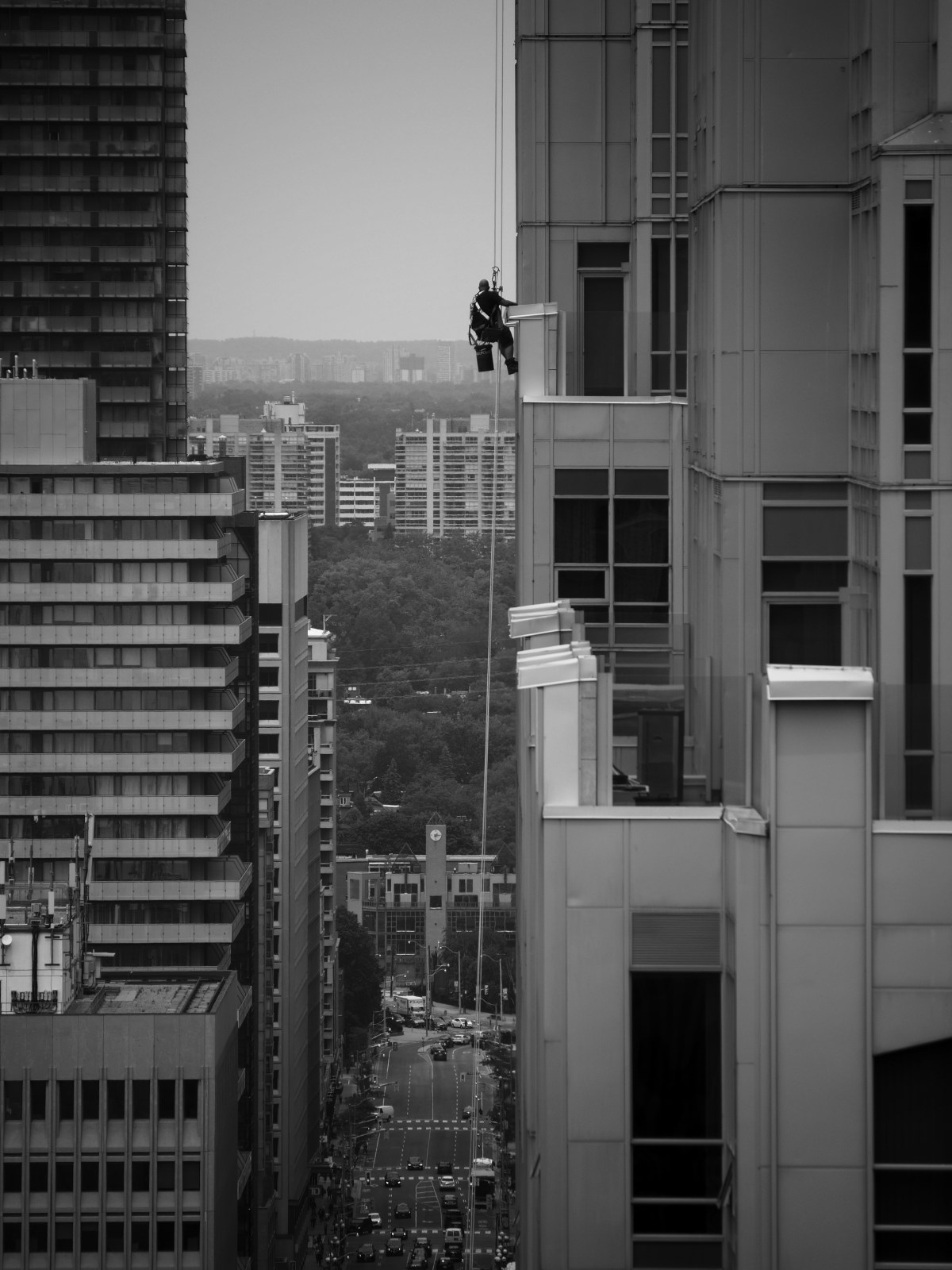
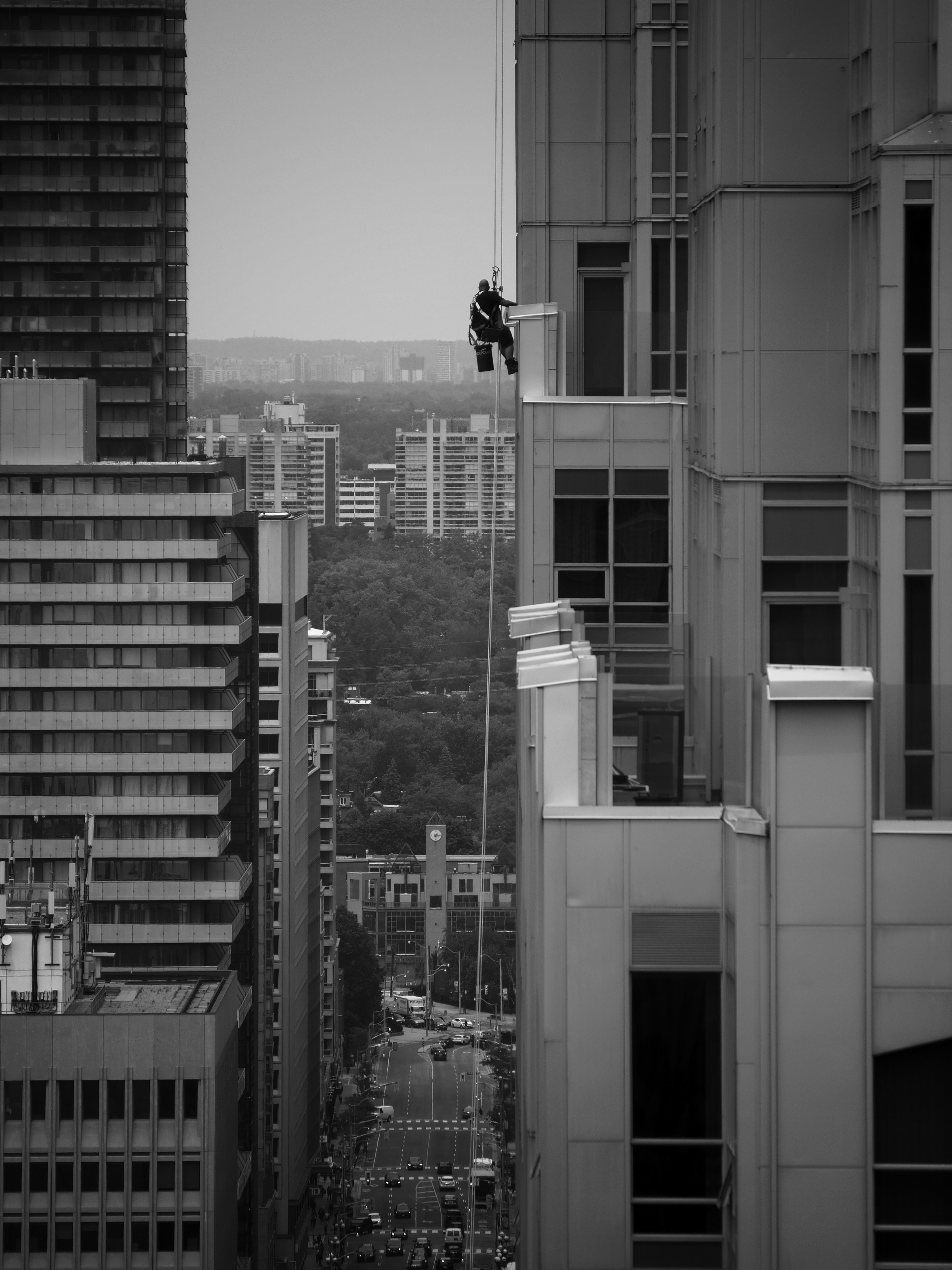
I’ve spent a lot of personal time behind my cameras throughout 2021 and have taken a bunch of shots that I really like. At the same time, I’ve invested a lot of personal time learning more about the history of photography and how to accomplish things with my cameras. Below, in no particular order, is a list of the ways I worked to improve my photography in 2021.

Fuji Recipes

I started looking at different ‘recipes’ that I could use for my Fuji x100f, starting with those at Fuji X Weekly and some YouTube channels. I’ve since started playing around with my own black and white recipes to get a better sense of what works for making my own images. The goal in all of this is to create jpgs that are ‘done’ in body and require an absolute minimum amount of adjustment. It’s very much a work in progress, but I’ve gotten to the point that most of my photos only receive minor crops, as opposed to extensive edits in Darkroom.

Comfort in Street Photography

The first real memory I have of ‘doing’ street photography was being confronted by a bus driver after I took his photo. I was scared off of taking pictures of other people for years as a result.

Over the past year, however, I’ve gotten more comfortable by watching a lot of POV-style YouTube videos of how other street photographers go about making their images. I don’t have anyone else to go an shoot with, and learn from, so these videos have been essential to my learning process. In particular, I’ve learned a lot from watching and listening to Faizal Westcott, the folks over at Framelines, Joe Allan, Mattias Burling, and Samuel Lintaro Hopf.

Moreover, just seeing the photos that other photographers are making and how they move in the street has helped to validate that what I’m doing, when I go out, definitely fits within the broader genre of street photography.

Histories of Photography

In the latter three months of 2021 I spent an enormous amount of time watching videos from the Art of Photography, Tatiana Hopper, and a bit from Sean Tucker. The result is that I’m developing a better sense of what you can do with a camera as well as why certain images are iconic or meaningful.

Pocket Camera Investment

I really love my Fuji X100F and always have my iPhone 12 Pro in my pocket. Both are terrific cameras. However, I wanted something that was smaller than the Fuji and more tactile than the iPhone, and which I could always have in a jacket pocket.

To that end, in late 2021 I purchase a very lightly used Ricoh GR. While I haven’t used it enough to offer a full review of it I have taken a lot of photos with it that I really, really like. More than anything else I’m taking more photos since buying it because I always have a good, very tactile, camera with me wherever I go.

Getting Off Instagram

I’m not a particularly big fan of Instagram these days given Facebook’s unwillingness or inability to moderate its platform, as well as Instagram’s constant addition of advertisements and short video clips. So since October 2021 I’ve been posting my photos almost exclusively to Glass and (admittedly to a lesser extent) to this website.

Not only is the interface for posting to Glass a lot better than the one for Instagram (and Flickr, as well), the comments I get on my photos on Glass are better than anywhere else I’ve ever posted my images. Admittedly Glass still has some growing pains but I’m excited to see how it develops in the coming year.

Categories
Reviews Writing

Book Review: Blockchain Chicken Farm And Other Stories of Tech in China’s Countryside (2020) ⭐️⭐️⭐️

Xiaowei Wang’s book, Blockchain Chicken Farm And Other Stories of Tech in China’s Countryside, presents a nuanced and detailed account of the lives reality of many people in China through the lenses of history, culture, and emerging technologies. She makes clear through her writing that China is undergoing a massive shift through efforts to digitize the economy and society (and especially rural economies and societies) while also effectively communicating why so many of these initiatives are being undertaken. 

From exploring the relationship between a fraught cold chain and organic chicken, to attempts to revitalize rural villages by turning them into platform manufacturing towns, to thinking through and reflecting on the state of contemporary capitalistic performativity in rural China and the USA alike, we see how technologies are being used to try and ‘solve’ challenges while often simultaneously undermining and endangering the societies within which they are embedded. Wang is careful to ensure that a reader leaves with an understanding of the positive attributes of how technologies are applied while, at the same time, making clear how they do not remedy—and, in fact, often reify or extenuate—unequal power relationships. Indeed, many of the positive elements of technologies, from the perspective of empowering rural citizens or improving their earning powers, are either being negatively impacted by larger capitalistic actors or the technology companies whose platforms many of these so-called improvements operate upon. 

Wang’s book, in its conclusion, recognizes that we need to enhance and improve upon the cultural spaces we operate and live within if we are to create a new or reformed politics that is more responsive to the specific needs of individuals and their communities. Put differently, we must tend to the dynamism of the Lifeworld if we are to modify the conditions of the System that surrounds, and unrelentingly colonizes, the Lifeworld. 

Her wistful ending—that such efforts of (re)generation are all that we can do—speaks both to a hope but also an almost resignation that (re)forming the systems we operate in can only take place if we manage to avoid being distracted by the bauble or technology that is dangled in front of us, to distract us from the existential crises facing our societies and humanity writ large. As such, it concludes very much in the spirit of our times: with hope for the future but a fearful resignation that despite our best efforts, we may be too late to succeed. But, what else can we do?

Categories
Photography Writing

Glass in 2022

GlassProfile

I’ve been primarily posting my photos to Glass for about three months now. There have been several quality of life improvements1 but, on the whole, the app has been pretty true to its original DNA.

That’s been a bit frustrating for some folks, such as Matt Birchler. He notes that Glass seems to be populated by professional photographers and lacks the life and diversity that you can sometimes find on Instagram or other photography sites. I was particularly struck by his comment that, “I used to enjoy the feed because it was high quality stuff, but now I scroll and everyone is making photos that look like every else’s.”

I don’t discount that Matt’s experience has been seeing a lot of professionals making photos but have to admit that his experiences don’t really parallel my own. To be clear, the photographers that I follow are doing neat work and some are definitely serious amateurs or professionals. But perhaps because I’m more focused on street photography it’s rarely self-apparent to me that I’m following professionals versus amateurs, nor that everyone’s work looks the same.

That being said, I definitely do follow a lot fewer people on Glass. If I have a problem with the app it’s that discovering active photographers on the platform is difficult; a lot of people signed up for the trial period but aren’t regularly posting. The result is that it’s hard to develop an active stream of photos and a photographic community. At the same time, however, I don’t browse the Glass app like I would Instagram: I pop in once or twice a day, and try to set aside some time every day or three (or four…) to leave comments on others photographers’ work. I treat Glass more seriously than free photography applications, if only because I have (thus far) only has positive experiences with the other active photographers posting their work there.

The only other problem I have with Glass—annoyance really!—is that I think that you actually can see/display photographers’ profiles in a much more beautiful way on non-phone devices. The image for this post was a screen capture from my iPad which attractively lays out photos. In contrast, you just get a flat waterfall of images if you visit my profile in the Glass app itself. That’s a shame and hopefully something that is improved upon in 2022.

To date I’m happy with Glass and incredibly pleased to no longer posting my photos to a Facebook platform. I really hope that Glass’s developers are able to maintain the app going forward, which will almost certainly depend in part on building the community and enhancing discoverability.

I’m currently planning to continue posting my work to Glass regularly. Even if the service doesn’t explode (which would be fine for me, though probably not great for its long term survival!) I find that the comments that I receive are far more valuable than anything I tended to receive on Instagram or other social sites, and the actual process of posting is also a comparative breeze and joy. If you’re looking for a neat photography site to try out, I heartily recommend that you give Glass a shot!


  1. Specifically, the developers have added some photography categories and public profiles, as well as the ability to ‘appreciate’ photos and comments ↩︎
Categories
Writing

Chinese Spies Accused of Using Huawei in Secret Australia Telecom Hack

Bloomberg has an article that discusses how Chinese spies were allegedly involved in deploying implants on Huawei equipment which was operated in Australia and the United States. The key parts of the story include:

At the core of the case, those officials said, was a software update from Huawei that was installed on the network of a major Australian telecommunications company. The update appeared legitimate, but it contained malicious code that worked much like a digital wiretap, reprogramming the infected equipment to record all the communications passing through it before sending the data to China, they said. After a few days, that code deleted itself, the result of a clever self-destruct mechanism embedded in the update, they said. Ultimately, Australia’s intelligence agencies determined that China’s spy services were behind the breach, having infiltrated the ranks of Huawei technicians who helped maintain the equipment and pushed the update to the telecom’s systems. 

Guided by Australia’s tip, American intelligence agencies that year confirmed a similar attack from China using Huawei equipment located in the U.S., six of the former officials said, declining to provide further detail.

The details from the story are all circa 2012. The fact that Huawei equipment was successfully being targeted by these operations, in combination with the large volume of serious vulnerabilities in Huawei equipment, contributed to the United States’ efforts to bar Huawei equipment from American networks and the networks of their closest allies.1

Analysis

We can derive a number of conclusions from the Bloomberg article, as well as see links between activities allegedly undertaken by the Chinese government and those of Western intelligence agencies.

To begin, it’s worth noting that the very premise of the article–that the Chinese government needed to infiltrate the ranks of Huawei technicians–suggests that circa 2012 Huawei was not controlled by, operated by, or necessarily unduly influenced by the Chinese government. Why? Because if the government needed to impersonate technicians to deploy implants, and do so without the knowledge of Huawei’s executive staff, then it’s very challenging to say that the company writ large (or its executive staff) were complicit in intelligence operations.

Second, the Bloomberg article makes clear that a human intelligence (HUMINT) operation had to be conducted in order to deploy the implants in telecommunications networks, with data then being sent back to servers that were presumably operated by Chinese intelligence and security agencies. These kinds of HUMINT operations can be high-risk insofar because if operatives are caught then the whole operation (and its surrounding infrastructure) can be detected and burned down. Building legends for assets is never easy, nor is developing assets if they are being run from a distance as opposed to spies themselves deploying implants.2

Third, the United States’ National Security Agency (NSA) has conducted similar if not identical operations when its staff interdicted equipment while it was being shipped, in order to implant the equipment before sending it along to its final destination. Similarly, the CIA worked for decades to deliberately provide cryptographically-sabotaged equipment to diplomatic facilities around the world. All of which is to say that multiple agencies have been involved in using spies or assets to deliberately compromise hardware, including Western agencies.

Fourth, the Canadian Communications Security Establish Act (‘CSE Act’), which was passed into law in 2019, includes language which authorizes the CSE to do, “anything that is reasonably necessary to maintain the covert nature of the [foreign intelligence] activity” (26(2)(c)). The language in the CSE Act, at a minimum, raises the prospect that the CSE could undertake operations which parallel those of the NSA and, in theory, the Chinese government and its intelligence and security services.3

Of course, the fact that the NSA and other Western agencies have historically tampered with telecommunications hardware to facilitate intelligence collection doesn’t take away from the seriousness of the allegations that the Chinese government targeted Huawei equipment so as to carry out intelligence operations in Australia and the United States. Moreover, the reporting in Bloomberg covers a time around 2012 and it remains unclear whether the relationship(s) between the Chinese government and Huawei have changed since then; it is possible, though credible open source evidence is not forthcoming to date, that Huawei has since been captured by the Chinese state.

Takeaway

The Bloomberg article strongly suggests that Huawei, as of 2012, didn’t appear captured by the Chinese government given the government’s reliance on HUMINT operations. Moreover, and separate from the article itself, it’s important that readers keep in mind that the activities which were allegedly carried out by the Chinese government were (and remain) similar to those also carried out by Western governments and their own security and intelligence agencies. I don’t raise this latter point as a kind of ‘whataboutism‘ but, instead, to underscore that these kinds of operations are both serious and conducted by ‘friendly’ and adversarial intelligence services alike. As such, it behooves citizens to ask whether these are the kinds of activities we want our governments to be conducting on our behalves. Furthermore, we need to keep these kinds of facts in mind and, ideally, see them in news reporting to better contextualize the operations which are undertaken by domestic and foreign intelligence agencies alike.


  1. While it’s several years past 2012, the 2021 UK HCSEC report found that it continued “to uncover issues that indicate there has been no overall improvement over the course of 2020 to meet the product software engineering and cyber security quality expected by the NCSC.” (boldface in original) ↩︎
  2. It is worth noting that, post-2012, the Chinese government has passed national security legislation which may make it easier to compel Chinese nationals to operate as intelligence assets, inclusive of technicians who have privileged access to telecommunications equipment that is being maintained outside China. That having been said, and as helpfully pointed out by Graham Webster, this case demonstrates that the national security laws were not needed in order to use human agents or assets to deploy implants. ↩︎
  3. There is a baseline question of whether the CSE Act created new powers for the CSE in this regard or if, instead, it merely codified existing secret policies or legal interpretations which had previously authorized the CSE to undertake covert activities in carrying out its foreign signals intelligence operations. ↩︎
Categories
Links Writing

Mandatory Patching of Serious Vulnerabilities in Government Systems

Photo by Mati Mango on Pexels.com

The Cybersecurity and Infrastructure Security Agency (CISA) is responsible for building national capacity to defend American infrastructure and cybersecurity assets. In the past year they have been tasked with receiving information about American government agencies’ progress (or lack thereof) in implementing elements of Executive Order 14028: Improving the Nation’s Cybersecurity and have been involved in responses to a number of events, including Solar Winds, the Colonial Pipeline ransomware attack, and others. The Executive Order required that CISA first collect a large volume of information from government agencies and vendors alike to assess the threats towards government infrastructure and, subsequently, to provide guidance concerning cloud services, track the adoption of multi factor authentication and seek ways of facilitating its implementation, establish a framework to respond to security incidents, enhance CISA’s threat hunting abilities in government networks, and more.1

Today, CISA promulgated a binding operational directive that will require American government agencies to adopt more aggressive patch tempos for vulnerabilities. In addition to requiring agencies to develop formal policies for remediating vulnerabilities it establishes a requirement that vulnerabilities with a common vulnerabilities and exposure ID be remediated within 6 months, and all others with two weeks. Vulnerabilities to be patched/remediated are found in CISA’s “Known Exploited Vulnerabilities Catalogue.”

It’s notable that while patching is obviously preferred, the CISA directive doesn’t mandate patching but that ‘remediation’ take place.2 As such, organizations may be authorized to deploy defensive measures that will prevent the vulnerability from being exploited but not actually patch the underlying vulnerability, so as to avoid a patch having unintended consequences for either the application in question or for other applications/services that currently rely on either outdated or bespoke programming interfaces.

In the Canadian context, there aren’t equivalent levels of requirements that can be placed on Canadian federal departments. While Shared Services Canada can strongly encourage departments to patch, and the Treasury Board Secretariat has published a “Patch Management Guidance” document, and Canada’s Canadian Centre for Cyber Security has a suggested patch deployment schedule,3 final decisions are still made by individual departments by their respective deputy minister under the Financial Administration Act.

The Biden administration is moving quickly to accelerate its ability to identify and remediate vulnerabilities while simultaneously lettings its threat intelligence staff track adversaries in American networks. That last element is less of an issue in the Canadian context but the first two remain pressing and serious challenges.

While its positive to see the Americans moving quickly to improve their security positions I can only hope that the Canadian federal, and provincial, governments similarly clear long-standing logjams that delegate security decisions to parties who may be ill-suited to make optimal decisions, either out of ignorance or because patching systems is seen as secondary to fulfilling a given department’s primary service mandate.


  1. For a discussion of the Executive Order, see: “Initial Thoughts on Biden’s Executive Order on Improving the Nation’s Cybersecurity” or “Everything You Need to Know About the New Executive Order on Cybersecurity.” ↩︎
  2. For more, see CISA’s “Vulnerability Remediation Requirements“. ↩︎
  3. “CCCS’s deployment schedule only suggests timelines for deployment. In actuality, an organization should take into consideration risk tolerance and exposure to a given vulnerability and associated attack vector(s) as part of a risk‑based approach to patching, while also fully considering their individual threat profile. Patch management tools continue to improve the efficiency of the process and enable organizations to hasten the deployment schedule.” Source: “Patch Management Guidance↩︎
Categories
Writing

Apple Music Voice Plan- The New iPod Shuffle?

A lot of tech commentators are scratching their heads over Apple’s new Apple Music Voice Plan. The plan is half the price of a ‘normal’ Apple Music subscription. If subscribed, individuals will can ask Siri to play songs or playlists but will not have access to a text-based or icon-based way to search for or play music.

I am dubious that this will be a particularly successful music plan. Siri is the definition of a not-good (and very bad) voice assistant.

Nevertheless, Apple has released this music plan into the world. I think that it’s probably most like the old iPod Shuffle that lacked any ability to really select or manage an individual’s music. The Shuffle was a cult favourite.

I have a hard time imagining a Siri-based interface developing a cult following like the iPods of yore, but the same thing was thought about the old Shuffle, too.

Categories
Writing

Detecting Academic National Security Threats

Photo by Pixabay on Pexels.com

The Canadian government is following in the footsteps of it’s American counterpart and has introduced national security assessments for recipients of government natural science (NSERC) funding. Such assessments will occur when proposed research projects are deemed sensitive and where private funding is also used to facilitate the research in question. Social science (SSHRC) and health (CIHR) funding will be subject to these assessments in the near future.

I’ve written, elsewhere, about why such assessments are likely fatally flawed. In short, they will inhibit student training, will cast suspicion upon researchers of non-Canadian nationalities (and especially upon researchers who hold citizenship with ‘competitor nations’ such as China, Russia, and Iran), and may encourage researchers to hide their sources of funding to be able to perform their required academic duties while also avoiding national security scrutiny.

To be clear, such scrutiny often carries explicit racist overtones, has led to many charges but few convictions in the United States, and presupposes that academic units or government agencies can detect a human-based espionage agent. Further, it presupposes that HUMINT-based espionage is a more serious, or equivalent, threat to research productivity as compared to cyber-espionage. As of today, there is no evidence in the public record in Canada that indicates that the threat facing Canadian academics is equivalent to the invasiveness of the assessments, nor that human-based espionage is a greater risk than cyber-based means.

To the best of my knowledge, while HUMINT-based espionage does generate some concerns they pale in comparison to the risk of espionage linked to cyber-operations.

However, these points are not the principal focus of this post. I recently re-read some older work by Bruce Schneier that I think nicely casts why asking scholars to engage in national security assessments of their own, and their colleagues’, research is bound to fail. Schneier wrote the following in 2007, when discussing the US government’s “see something, say something” campaign:

[t]he problem is that ordinary citizens don’t know what a real terrorist threat looks like. They can’t tell the difference between a bomb and a tape dispenser, electronic name badge, CD player, bat detector, or trash sculpture; or the difference between terrorist plotters and imams, musicians, or architects. All they know is that something makes them uneasy, usually based on fear, media hype, or just something being different.

Replace “terrorist” with “national security” threat and we get to approximately the same conclusions. Individuals—even those trained to detect and investigate human intelligence driven espionage—can find it incredibly difficult to detect human agent-enabled espionage. Expecting academics, who are motivated to develop international and collegial relationships, who may be unable to assess the national security implications of their research, and who are being told to abandon funding while the government fails to supplement that which is abandoned, guarantees that this measure will fail.

What will that failure mean, specifically? It will involve incorrect assessments and suspicion being aimed at scholars from ‘competitor’ and adversary nations. Scholars will question whether they should work with a Chinese, Russian, or Iranian scholar even when they are employed in a Western university let alone when they are in a non-Western institution. I doubt these same scholars will similarly question whether they should work with Finish, French, or British scholars. Nationality and ethnicity lenses will be used to assess who are the ‘right’ people with whom to collaborate.

Failure will not just affect professors. It will also extend to affect undergraduate and graduate students, as well as post-doctoral fellows and university staff. Already, students are questioning what they must do in order to prove that they are not considered national security threats. Lab staff and other employees who have access to university research environments will similarly be placed under an aura of suspicion. We should not, we must not, create an academy where these are the kinds of questions with which our students and colleagues and staff must grapple.

Espionage is, it must be recognized, a serious issue that faces universities and Canadian businesses more broadly. The solution cannot be to ignore it and hope that the activity goes away. However, the response to such threats must demonstrate necessity and proportionality and demonstrably involve evidence-based and inclusive policy making. The current program that is being rolled out by the Government of Canada does not meet this set of conditions and, as such, needs to be repealed.

Categories
Photography Writing

Photography and Social Media

5CC1F7AF-32C8-44BD-9E44-C061F92CC924
(Passer By by Christopher Parsons)

Why do we want to share our photos online? What platforms are better or worse to use in sharing images? These are some of the questions I’ve been pondering for the past few weeks.

Backstory

About a month ago a colleague stated that she would be leaving Instagram given the nature of Facebook’s activities and the company’s seeming lack of remorse. Her decision has stuck with me and left me wondering whether I want to follow her lead.

I deleted my Facebook accounts some time ago, and have almost entirely migrated my community away from WhatsApp. But as an amateur photographer I’ve hesitated to leave an app that was, at least initially, designed with photographers in mind. I’ve used the application over the years to develop and improve my photographic abilities and so there’s an element of ‘sunk cost’ that has historically factored into my decision to stay or leave.

But Instagram isn’t really for photographers anymore. The app is increasingly stuffed with either videos or ads, and is meant to create a soft landing point for when/if Facebook truly pivots away from its main Facebook app.1 The company’s pivot makes it a lot easier to justify leaving the application though, at the same time, leaves me wondering what application or platform, if any, I want to move my photos over to.

The Competition(?)

Over the past week or two I’ve tried Flickr.2 While it’s the OG of photo sharing sites its mobile apps are just broken. I can’t create albums unless I use the web app. The sharing straight from the Apple Photos app is janky. I worry (for no good reason, really) about the cost for the professional version (do I even need that as an amateur?) as well as the annoyance of tagging photos in order to ‘find my tribe.’

It’s also not apparent to me how much community truly exists on Flickr: the whole platform seems a bit like a graveyard with only a small handful of active photographers still inhabiting the space.

I’m also trying Glass at the moment. It’s not perfect: search is non-existent, you can’t share your gallery of photos with non-Glass users at the moment, discovery is a bit rough, there’s no Web version, and it’s currently iPhone only. However, I do like that the app (and its creators) is focused on sharing images and that it has a clear monetization schema in the form of a yearly subscription. The company’s formal roadmap also indicates that some of these rough edges may be filed away in the coming months.

I also like that Glass doesn’t require me to develop a tagging system (that’s all done in the app using presets), let’s me share quickly and easily from the Photos app, looks modern, and has a relatively low yearly subscription cost. And, at least so far, most of the comments are better than on the other platforms, which I think is important to developing my own photography.

Finally, there’s my blog here! And while I like to host photo series here this site isn’t really designed as a photo blog first and foremost. Part of the problem is that WordPress continues to suck for posting media in my experience but, more substantively, this blog hosts a lot more text than images. I don’t foresee changing this focus anytime in the near or even distant future.

The Necessity of Photo Sharing?

It’s an entirely fair question to ask why even bother sharing photos with strangers. Why not just keep my images on my devices and engage in my own self-critique?

I do engage in such critique but I’ve personally learned more from putting my images into the public eye than I would just by keeping them on my own devices.3 Some of that is from comments but, also, it’s been based on what people have ‘liked’ or left emoji comments on. These kinds of signals have helped me better understand what is a better or less good photograph.

However, at this point I don’t think that likes and emojis are the source of my future photography development: I want actual feedback, even if it’s limited to just a sentence or so. I’m hoping that Glass might provide that kind of feedback though I guess only time will tell.


  1. For a good take on Facebook and why its functionally ‘over’ as a positive brand check out M.G. Siegler’s article, “Facebook is Too Big, Fail.” ↩︎
  2. This is my second time with Flickr, as I closed a very old account several years ago given that I just wasn’t using it. ↩︎
  3. If I’m entirely honest, I bet I’ve learned as much or more from reading photography teaching/course books, but that’s a different kind of learning entirely. ↩︎
Categories
Links Writing

The Lawfare Dimension of Asymetrical Conflict

The past week has seen a logjam begin to clear in Canadian-Chinese-American international relations. After agreeing to the underlying facts associated with her (and Huawei’s) violation of American sanctions that have been placed on Iran, Meng Wanzhou was permitted to return to China after having been detained in Canada for several years. Simultaneously, two Canadian nationals who had been charged with national security crimes were themselves permitted to return to Canada on health-related grounds. The backstory is that these Canadians were seized shortly following the detainment of Huawei’s CFO, with the Chinese government repeatedly making clear that the Canadians were being held hostage and would only be released when the CFO was repatriated to China.

A huge amount of writing has taken place following the swap. But what I’ve found to be particular interesting in terms of offering a novel contribution to the discussions was an article by Julian Ku in Lawfare. In his article, “China’s Successful Foray Into Asymmetric Lawfare,” Ku argues that:

Although Canadians are relieved that their countrymen have returned home, the Chinese government’s use of its own weak legal system to carry out “hostage diplomacy,” combined with Meng’s exploitation of the procedural protections of the strong and independent Canadian and U.S. legal systems, may herald a new “asymmetric lawfare” strategy to counter the U.S. This strategy may prove an effective counter to the U.S. government’s efforts to use its own legal system to enforce economic sanctions, root out Chinese espionage, indict Chinese hackers, or otherwise counter the more assertive and threatening Chinese government.

I remain uncertain that this baseline premise, which undergirds the rest of his argument, holds true. In particular, his angle of analysis seems to set to the side, or not fully engage with, the following:

  1. China’s hostage taking has further weakened the trust that foreign companies will have in the Chinese government. They must now acknowledge, and build into their risk models, the possibility that their executives or employees could be seized should the Chinese government get into a diplomatic, political, or economic dispute with the country from which they operate.
  2. China’s blatant hostage taking impairs its world standing and has led to significant parts of the world shifting their attitudes towards the Chinese government. The results of these shifts are yet to be fully seen, but to date there have been doubts about entering into trade agreements with China, an increased solidarity amongst middle powers to resist what is seen as bad behaviour by China, and a push away from China and into the embrace of liberal democratic governments. This last point, in particular, runs counter to China’s long-term efforts to showcase its own style of governance as a genuine alternative to American and European models of democracy.
  3. Despite what has been written, I think that relying on hostage diplomacy associated with its weak rule of law showcases China’s comparatively weak hand. Relying on low rule of law to undertake lawfare endangers its international strategic interests, which rely on building international markets and being treated as a respectable and reputable partner on the world stage. Resorting to kidnapping impairs the government’s ability to demonstrate compliance with international agreements and fora so as to build out its international policies.

Of course, none of the above discounts the fact that the Chinese government did, in fact, exploit this ‘law asymmetry’ between its laws and those of high rule of law countries. And the Canadian government did act under duress as a result of their nationals having been taken hostage, including becoming a quiet advocate for Chinese interests insofar as Canadian diplomats sought a way for the US government to reach a compromise with Huawei/Meng so that Canada’s nationals could be returned home. And certainly the focus on relying on high rule of law systems can delay investigations into espionage or other illicit foreign activities and operations that are launched by the Chinese government. Nevertheless, neither the Canadian or American legal systems actually buckled under the foreign and domestic pressure to set aside the rule of law in favour of quick political ‘fixes.’

While there will almost certainly be many years of critique in Canada and the United States about how this whole affair was managed the fact will remain that both countries demonstrated that their justice systems would remain independent from the political matters of the day. And they did so despite tremendous pressure: from Trump, during his time as the president, and despite the Canadian government being subjected to considerable pressure campaigns by numerous former government officials who were supportive, for one reason or another, of the Chinese government’s position to return Huawei’s CFO.

While it remains to be written what the actual, ultimate, effect of this swap of Huawei’s CFO for two inappropriately detained Canadians will be, some lasting legacies may include diminished political capital for the Chinese government while, at the same time, a reinforcing of the trust that can be put in the American and Canadian (and, by extension, Western democratic) systems of justice. Should these legacies hold then China’s gambit will almost certainly prove to have backfired.