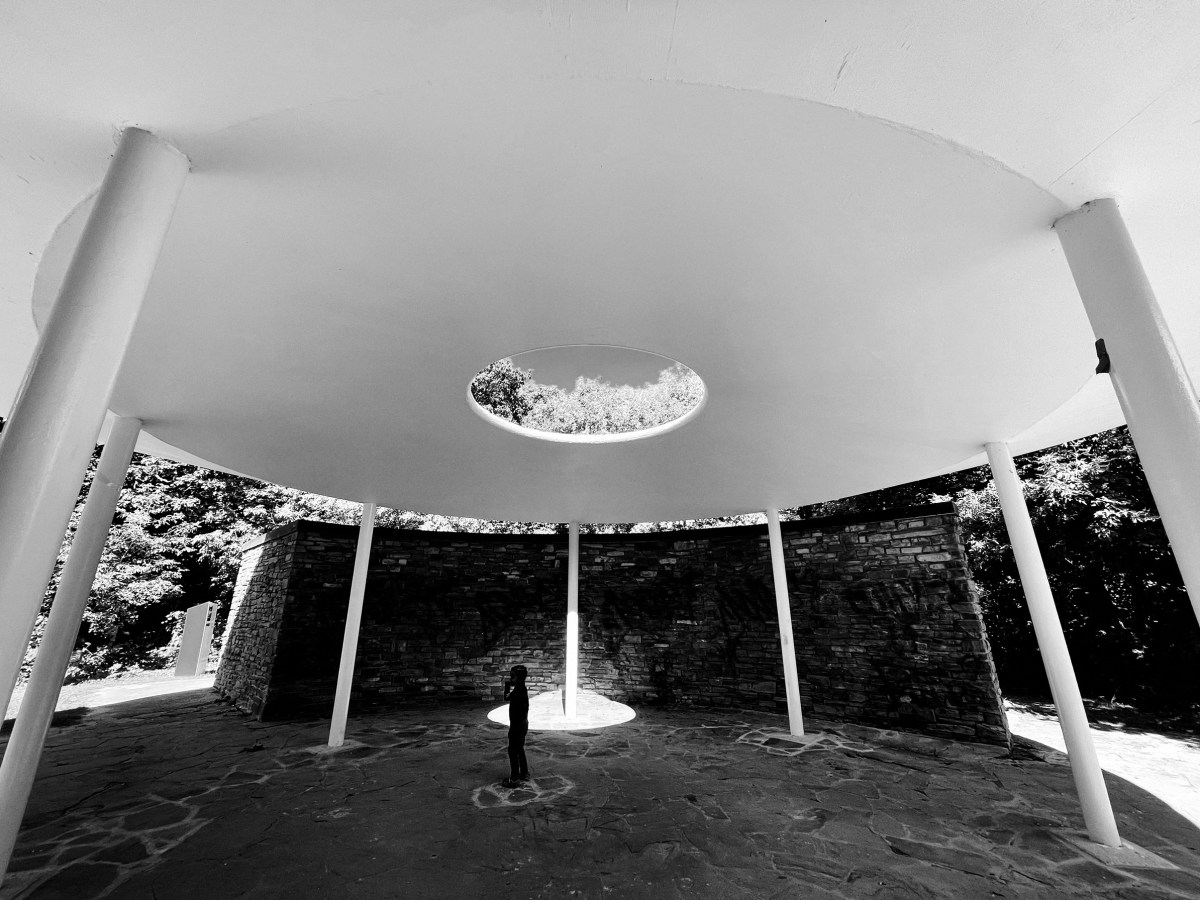
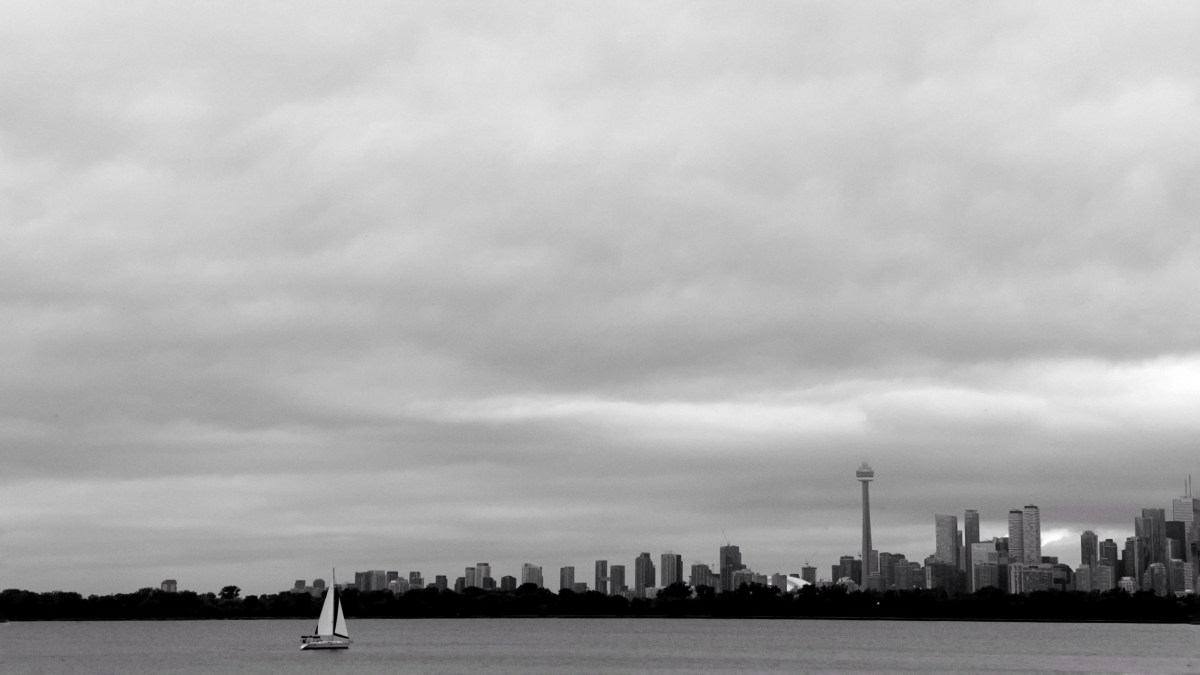
This year I took a very late vacation while Toronto was returning to its new normal. I’ve been capturing the city throughout the COVID-19 pandemic and I wanted to focus in on how the streets felt.
During the pandemic we’ve all been attached to our devices, and our phones in particular, and thus decided to document the city through the lens of our ever-present screen: the smartphone. I exclusively shot with my iPhone 12 Pro using the Noir filter. This filter created a strong black and white contrast, with the effect of deepening shadows and blacks and lifting highlights and whites. I choose this, over a monotone, as I wanted to emphasize that while the city was waking up there were still stark divides between the lived experiences of the pandemic and a continuation of strong social distancing from one another.
(Between Frames by Christopher Parsons)(Calm Decay by Christopher Parsons)(Reflections by Christopher Parsons)(The Guarded Groom by Christopher Parsons)
95% of my photos were captured using ProRaw with the exception of those where I wanted to utilize Apple’s long exposure functionality in the Photos application.
(Caught by Christopher Parsons)(Just Passing by Christopher Parsons)
Darkroom Settings
In excess of the default Noir filter, I also created a secondary filter in Darkroom that adjusted what came off the iPhone just a bit to establish tones that were to my liking. My intent was to make the Noir that much punchier, while also trying to reduce a bit of the sharpness/clarity that I associate with Apple’s smartphone cameras. This adjustment reflected, I think, that digital communications themselves are often blurrier or more confused than our face-to-face interactions. Even that which seems clear, when communicated over digital systems, often carries with it a misrepresentation of meaning or intent.
A lot of tech commentators are scratching their heads over Apple’s new Apple Music Voice Plan. The plan is half the price of a ‘normal’ Apple Music subscription. If subscribed, individuals will can ask Siri to play songs or playlists but will not have access to a text-based or icon-based way to search for or play music.
I am dubious that this will be a particularly successful music plan. Siri is the definition of a not-good (and very bad) voice assistant.
Nevertheless, Apple has released this music plan into the world. I think that it’s probably most like the old iPod Shuffle that lacked any ability to really select or manage an individual’s music. The Shuffle was a cult favourite.
I have a hard time imagining a Siri-based interface developing a cult following like the iPods of yore, but the same thing was thought about the old Shuffle, too.
For the past several months a group of us have been playing Gloomhaven: Jaws of the Lion. Jaws of the Lion is meant to be the ‘intro to Gloomhaven’ boxed set, though we’ve experienced a relatively steep learning curve and I’ve spent a lot of time trying to figure out some of the more confusing or unclear rules.
Anyhow! I built a playlist for Jaws of the Lion, just as I did for the Dungeons and Dragons campaigns we’ve played.1 I’ll continue to update it periodically, though not regularly.
If you’re interested in using the playlist for Gloomhaven: Jaws of the Lion we’re using, you can find it at Apple Music.
The Canadian government is following in the footsteps of it’s American counterpart and has introduced national security assessments for recipients of government natural science (NSERC) funding. Such assessments will occur when proposed research projects are deemed sensitive and where private funding is also used to facilitate the research in question. Social science (SSHRC) and health (CIHR) funding will be subject to these assessments in the near future.
I’ve written, elsewhere, about why such assessments are likely fatally flawed. In short, they will inhibit student training, will cast suspicion upon researchers of non-Canadian nationalities (and especially upon researchers who hold citizenship with ‘competitor nations’ such as China, Russia, and Iran), and may encourage researchers to hide their sources of funding to be able to perform their required academic duties while also avoiding national security scrutiny.
To be clear, such scrutiny often carries explicit racist overtones, has led to many charges but few convictions in the United States, and presupposes that academic units or government agencies can detect a human-based espionage agent. Further, it presupposes that HUMINT-based espionage is a more serious, or equivalent, threat to research productivity as compared to cyber-espionage. As of today, there is no evidence in the public record in Canada that indicates that the threat facing Canadian academics is equivalent to the invasiveness of the assessments, nor that human-based espionage is a greater risk than cyber-based means.
To the best of my knowledge, while HUMINT-based espionage does generate some concerns they pale in comparison to the risk of espionage linked to cyber-operations.
However, these points are not the principal focus of this post. I recently re-read some older work by Bruce Schneier that I think nicely casts why asking scholars to engage in national security assessments of their own, and their colleagues’, research is bound to fail. Schneier wrote the following in 2007, when discussing the US government’s “see something, say something” campaign:
[t]he problem is that ordinary citizens don’t know what a real terrorist threat looks like. They can’t tell the difference between a bomb and a tape dispenser, electronic name badge, CD player, bat detector, or trash sculpture; or the difference between terrorist plotters and imams, musicians, or architects. All they know is that something makes them uneasy, usually based on fear, media hype, or just something being different.
Replace “terrorist” with “national security” threat and we get to approximately the same conclusions. Individuals—even those trained to detect and investigate human intelligence driven espionage—can find it incredibly difficult to detect human agent-enabled espionage. Expecting academics, who are motivated to develop international and collegial relationships, who may be unable to assess the national security implications of their research, and who are being told to abandon funding while the government fails to supplement that which is abandoned, guarantees that this measure will fail.
What will that failure mean, specifically? It will involve incorrect assessments and suspicion being aimed at scholars from ‘competitor’ and adversary nations. Scholars will question whether they should work with a Chinese, Russian, or Iranian scholar even when they are employed in a Western university let alone when they are in a non-Western institution. I doubt these same scholars will similarly question whether they should work with Finish, French, or British scholars. Nationality and ethnicity lenses will be used to assess who are the ‘right’ people with whom to collaborate.
Failure will not just affect professors. It will also extend to affect undergraduate and graduate students, as well as post-doctoral fellows and university staff. Already, students are questioning what they must do in order to prove that they are not considered national security threats. Lab staff and other employees who have access to university research environments will similarly be placed under an aura of suspicion. We should not, we must not, create an academy where these are the kinds of questions with which our students and colleagues and staff must grapple.
Espionage is, it must be recognized, a serious issue that faces universities and Canadian businesses more broadly. The solution cannot be to ignore it and hope that the activity goes away. However, the response to such threats must demonstrate necessity and proportionality and demonstrably involve evidence-based and inclusive policy making. The current program that is being rolled out by the Government of Canada does not meet this set of conditions and, as such, needs to be repealed.
Climate change is a reality of contemporary life and is leading to increasingly numbers of weather-related catastrophes. One of the many threats now facing humanity is severe flooding. Such threats have been, and continue to be, driven by harmful and destructive human activities that impair and change the climate, and amplified by housing councils that permit developers to build homes on floodplains along with other development pressures linked to humans moving in increasing numbers into urban environments.
With the climate emergency in mind, Toronto artist John Notten has created a series of styrofoam installations that are presently located in Ontario Place. On the one side they show the image of an iceberg and the other show homes, vehicles, and other urban architecture. As discussed in the artist statement, the installation is intended to offer:
… an opportunity for the viewer to consider connections between this provocative material, the image of floating icebergs, and those of half-submerged iconic institutions.
(Over Flow 9 by Christopher Parsons)(Over Flow 7 by Christopher Parsons)
It was particularly special to have a pair of kayakers visit the exhibit at the same time that I was there. Their presence—and my effort to present them as blurred subjects—helps to give a sense that climate change affects all subjects—all people—and isn’t something that is linked to any one specific subject. In essence, I wanted to convey that all humans are threatened by climate change and that focusing on individuals and their efforts does not adequately appreciate the structural and collective drivers that endanger all life on Earth.
(Over Flow 13 by Christopher Parsons)
Over Flow will be in Ontario Place until October 31, 2021, and will then be moved to other locations in the spring of 2021.
All images were made using an iPhone 12 Pro and the Noir filter, and then slightly edited using a filter in Darkroom.
Disappointed that Apple seems to have changed the delivery date for my new Apple Watch last minute with minimal notice. Definitely not how to create delight and joy with their customers.
I’m liking the incremental update to the Photos application on iOS and iPadOS in the newest release of the operating systems. The ability to easily add titles to my photos and also access the EXIF metadata helps to maintain a (slightly) more organized photo library. Access to this information also makes it easier to share out photos straight from the Photos app, since I can copy the title of an image as part of sharing it.
However, I’m still missing the ability to create Smart Folders. Specifically I want to be able to have folders that are accessible, on iOS devices, and which sort based on the camera that took a given set of images. It’s been in MacOS for a very, very long time and it’s nuts that this kind of feature parity hasn’t been reached between operating systems.
I haven’t seen evidence that the newest version of iOS has fixed the green flare issue (which I first encountered when reviewing my iPhone 11 Pro). I know it was in an earlier beta but haven’t yet seen it implemented in a production release.
The history of Canada is linked to settle colonialism and white supremacy. Only recently have elements of Canada come to truly think through what this means: Canada, and settler Canadians, owe their existence to the forceful removal of indigenous populations from their terrorities.
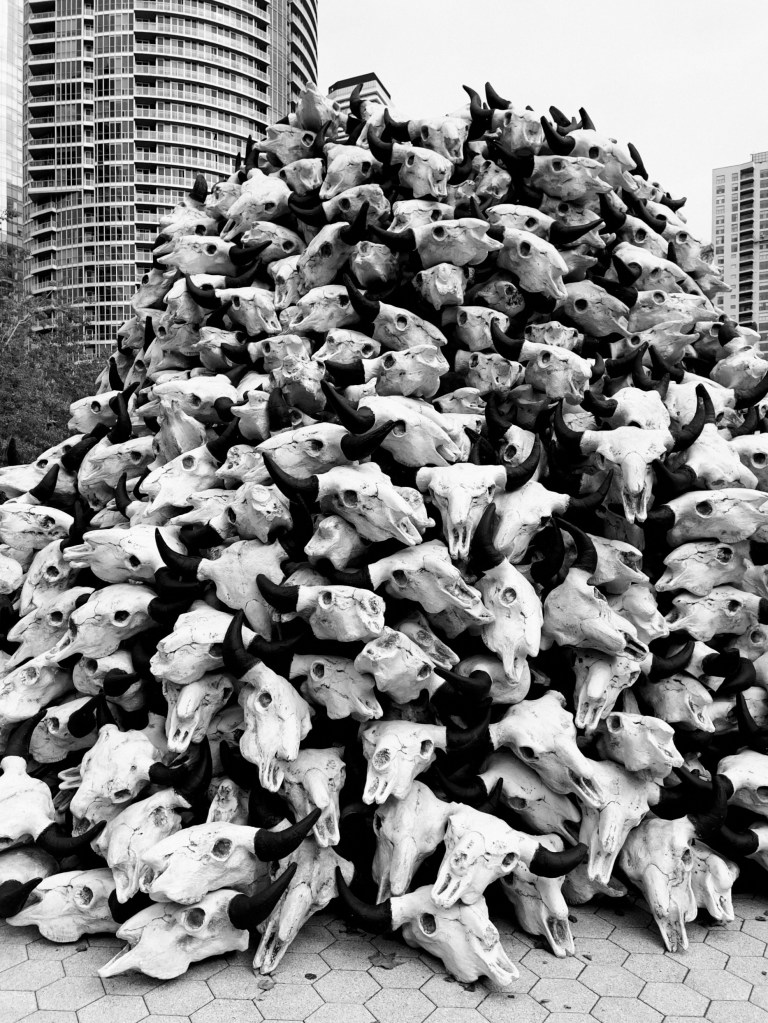
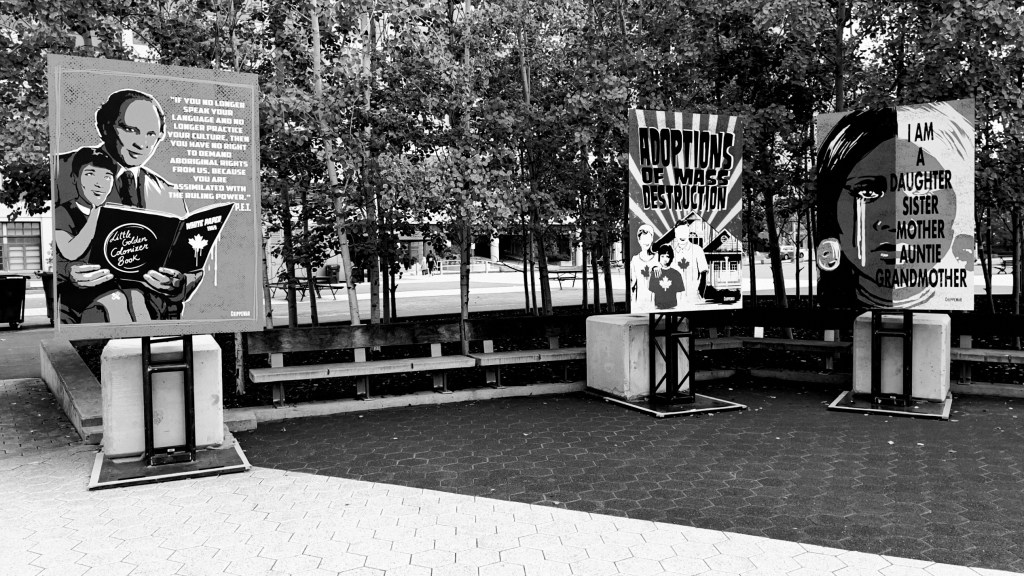
Toronto is currently hosting an art exhibit, “Built on Genocide.” It’s created by the indigenous artist, Jay Soule | CHIPPERWAR,1 and provides a visual record of the link between the deliberate decimation of the buffalo and its correlation with the genocide of indigenous populations. From the description of the exhibit:
Built on Genocide is a powerful visual record of the 19th-century buffalo genocide that accompanied John A. MacDonald’s colonial expansion west with the railroad. In the mid-19th century, an estimated 30 to 60 million buffalo roamed the prairies, by the late 1880s, fewer than 300 remained. As the buffalo were slaughtered and the prairie ecosystem decimated, Indigenous peoples were robbed of their foods, lands, and cultures. The buffalo genocide became a genocide of the people.
Working from archival records, Soule combines installation and paintings to connect the past with the present, demanding the uncomfortable acknowledgement that Canada is a nation built on genocide.
What follows are a series of photographs that I made while visiting the exhibit on October 13, 2021. All images were made using an iPhone 12 Pro using the ‘Noir’ filter in Apple Photos, and subsequently edited using a Darkroom App filter.
(Built on Genocide 1 by Christopher Parsons)(Built on Genocide 2 by Christopher Parsons)(Built on Genocide 3 by Christopher Parsons)(Built on Genocide 4 by Christopher Parsons)(Built on Genocide 5 by Christopher Parsons)
Canada is, and needs to be, going through a reckoning concerning its past. This process is challenging for settlers, both to appreciate their actual histories and to be made to account for how they arrived at their current life situations. There are, obviously, settlers who are in challenging life situations—som experience poverty and are otherwise disadvantaged in society—but their challenges routinely pale in comparison to what is sadly normal and typical in Canada’s indigenous societies. As just one example, while poverty is a real issue for some white and immigrant Canadians, few lack routine access to safe and clean drinking water. None have lacked access to safe and clean water for over 26 years but this is the lived reality of indigenous populations in Canada.
Jay creates art under the name CHIPPEWAR, which represents the hostile relationship that Canada’s Indigenous peoples have with the government of the land they have resided in since their creation. CHIPPEWAR is also a reminder of the importance of the traditional warrior role that exists in Indigenous cultures across North America that survives into the present day. ↩︎
Why do we want to share our photos online? What platforms are better or worse to use in sharing images? These are some of the questions I’ve been pondering for the past few weeks.
Backstory
About a month ago a colleague stated that she would be leaving Instagram given the nature of Facebook’s activities and the company’s seeming lack of remorse. Her decision has stuck with me and left me wondering whether I want to follow her lead.
I deleted my Facebook accounts some time ago, and have almost entirely migrated my community away from WhatsApp. But as an amateur photographer I’ve hesitated to leave an app that was, at least initially, designed with photographers in mind. I’ve used the application over the years to develop and improve my photographic abilities and so there’s an element of ‘sunk cost’ that has historically factored into my decision to stay or leave.
But Instagram isn’t really for photographers anymore. The app is increasingly stuffed with either videos or ads, and is meant to create a soft landing point for when/if Facebook truly pivots away from its main Facebook app.1The company’s pivot makes it a lot easier to justify leaving the application though, at the same time, leaves me wondering what application or platform, if any, I want to move my photos over to.
The Competition(?)
Over the past week or two I’ve tried Flickr.2 While it’s the OG of photo sharing sites its mobile apps are just broken. I can’t create albums unless I use the web app. The sharing straight from the Apple Photos app is janky. I worry (for no good reason, really) about the cost for the professional version (do I even need that as an amateur?) as well as the annoyance of tagging photos in order to ‘find my tribe.’
It’s also not apparent to me how much community truly exists on Flickr: the whole platform seems a bit like a graveyard with only a small handful of active photographers still inhabiting the space.
I’m also trying Glass at the moment. It’s not perfect: search is non-existent, you can’t share your gallery of photos with non-Glass users at the moment, discovery is a bit rough, there’s no Web version, and it’s currently iPhone only. However, I do like that the app (and its creators) is focused on sharing images and that it has a clear monetization schema in the form of a yearly subscription. The company’s formal roadmap also indicates that some of these rough edges may be filed away in the coming months.
I also like that Glass doesn’t require me to develop a tagging system (that’s all done in the app using presets), let’s me share quickly and easily from the Photos app, looks modern, and has a relatively low yearly subscription cost. And, at least so far, most of the comments are better than on the other platforms, which I think is important to developing my own photography.
Finally, there’s my blog here! And while I like to host photo series here this site isn’t really designed as a photo blog first and foremost. Part of the problem is that WordPress continues to suck for posting media in my experience but, more substantively, this blog hosts a lot more text than images. I don’t foresee changing this focus anytime in the near or even distant future.
The Necessity of Photo Sharing?
It’s an entirely fair question to ask why even bother sharing photos with strangers. Why not just keep my images on my devices and engage in my own self-critique?
I do engage in such critique but I’ve personally learned more from putting my images into the public eye than I would just by keeping them on my own devices.3 Some of that is from comments but, also, it’s been based on what people have ‘liked’ or left emoji comments on. These kinds of signals have helped me better understand what is a better or less good photograph.
However, at this point I don’t think that likes and emojis are the source of my future photography development: I want actual feedback, even if it’s limited to just a sentence or so. I’m hoping that Glass might provide that kind of feedback though I guess only time will tell.
For a good take on Facebook and why its functionally ‘over’ as a positive brand check out M.G. Siegler’s article, “Facebook is Too Big, Fail.” ↩︎
This is my second time with Flickr, as I closed a very old account several years ago given that I just wasn’t using it. ↩︎
If I’m entirely honest, I bet I’ve learned as much or more from reading photography teaching/course books, but that’s a different kind of learning entirely. ↩︎
The past week has seen a logjam begin to clear in Canadian-Chinese-American international relations. After agreeing to the underlying facts associated with her (and Huawei’s) violation of American sanctions that have been placed on Iran, Meng Wanzhou was permitted to return to China after having been detained in Canada for several years. Simultaneously, two Canadian nationals who had been charged with national security crimes were themselves permitted to return to Canada on health-related grounds. The backstory is that these Canadians were seized shortly following the detainment of Huawei’s CFO, with the Chinese government repeatedly making clear that the Canadians were being held hostage and would only be released when the CFO was repatriated to China.
A huge amount of writing has taken place following the swap. But what I’ve found to be particular interesting in terms of offering a novel contribution to the discussions was an article by Julian Ku in Lawfare. In his article, “China’s Successful Foray Into Asymmetric Lawfare,” Ku argues that:
Although Canadians are relieved that their countrymen have returned home, the Chinese government’s use of its own weak legal system to carry out “hostage diplomacy,” combined with Meng’s exploitation of the procedural protections of the strong and independent Canadian and U.S. legal systems, may herald a new “asymmetric lawfare” strategy to counter the U.S. This strategy may prove an effective counter to the U.S. government’s efforts to use its own legal system to enforce economic sanctions, root out Chinese espionage, indict Chinese hackers, or otherwise counter the more assertive and threatening Chinese government.
I remain uncertain that this baseline premise, which undergirds the rest of his argument, holds true. In particular, his angle of analysis seems to set to the side, or not fully engage with, the following:
China’s hostage taking has further weakened the trust that foreign companies will have in the Chinese government. They must now acknowledge, and build into their risk models, the possibility that their executives or employees could be seized should the Chinese government get into a diplomatic, political, or economic dispute with the country from which they operate.
China’s blatant hostage taking impairs its world standing and has led to significant parts of the world shifting their attitudes towards the Chinese government. The results of these shifts are yet to be fully seen, but to date there have been doubts about entering into trade agreements with China, an increased solidarity amongst middle powers to resist what is seen as bad behaviour by China, and a push away from China and into the embrace of liberal democratic governments. This last point, in particular, runs counter to China’s long-term efforts to showcase its own style of governance as a genuine alternative to American and European models of democracy.
Despite what has been written, I think that relying on hostage diplomacy associated with its weak rule of law showcases China’s comparatively weak hand. Relying on low rule of law to undertake lawfare endangers its international strategic interests, which rely on building international markets and being treated as a respectable and reputable partner on the world stage. Resorting to kidnapping impairs the government’s ability to demonstrate compliance with international agreements and fora so as to build out its international policies.
Of course, none of the above discounts the fact that the Chinese government did, in fact, exploit this ‘law asymmetry’ between its laws and those of high rule of law countries. And the Canadian government did act under duress as a result of their nationals having been taken hostage, including becoming a quiet advocate for Chinese interests insofar as Canadian diplomats sought a way for the US government to reach a compromise with Huawei/Meng so that Canada’s nationals could be returned home. And certainly the focus on relying on high rule of law systems can delay investigations into espionage or other illicit foreign activities and operations that are launched by the Chinese government. Nevertheless, neither the Canadian or American legal systems actually buckled under the foreign and domestic pressure to set aside the rule of law in favour of quick political ‘fixes.’
While there will almost certainly be many years of critique in Canada and the United States about how this whole affair was managed the fact will remain that both countries demonstrated that their justice systems would remain independent from the political matters of the day. And they did so despite tremendous pressure: from Trump, during his time as the president, and despite the Canadian government being subjected to considerable pressure campaigns by numerous former government officials who were supportive, for one reason or another, of the Chinese government’s position to return Huawei’s CFO.
While it remains to be written what the actual, ultimate, effect of this swap of Huawei’s CFO for two inappropriately detained Canadians will be, some lasting legacies may include diminished political capital for the Chinese government while, at the same time, a reinforcing of the trust that can be put in the American and Canadian (and, by extension, Western democratic) systems of justice. Should these legacies hold then China’s gambit will almost certainly prove to have backfired.












 Excited Pixels